

176
C. ALBERS
which is known as the Henderson-Hasselbalch equation.
For a given concentration [AH] we obtain from Eq. (4) [H+]
[A-] = const, which can be interpreted in a similar manner as Eq. (1).
Therefore, if [H'] increases [A-] must decrease. If we add a strong acid
to a weak acid, hydrogen ions recombine with the anion A- to form the
undissociated acid AH. Thus, the dissociation of AH is dependent on
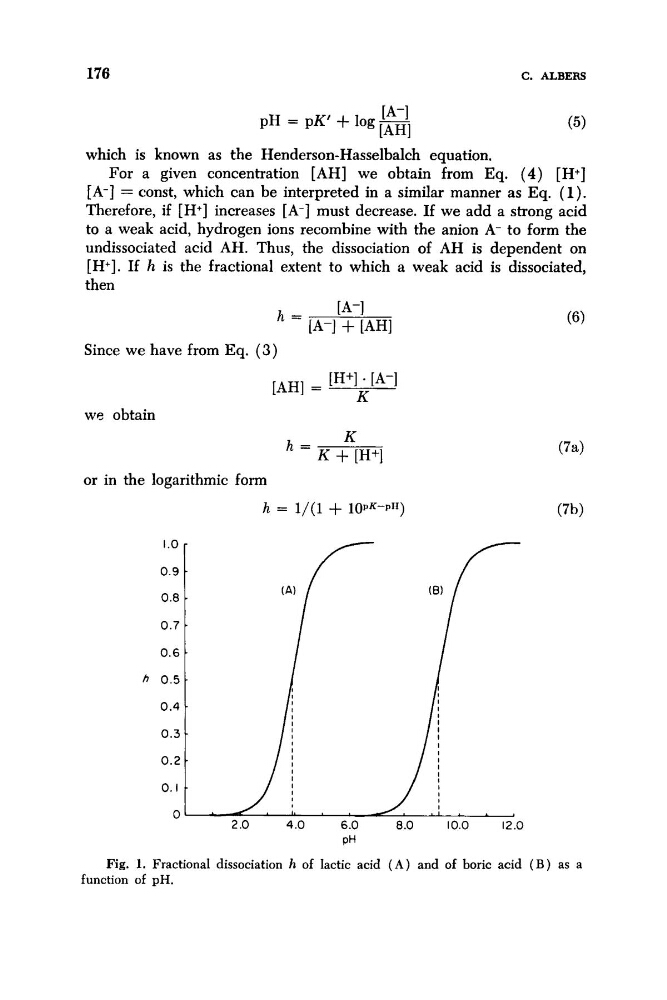
[H']. If h is the fractional extent to which a weak acid is dissociated,
then
[A-I
/
I = [A-] + [AH]
Since we have from Eq. (3)
W+l* [A-I
K
[AH] =
we obtain
K
= K + [Hf]
or in the logarithmic form
h = 1/(1 + 1OP-H)
1.0
0.9
0.8
0.7
0.6
0.5
0.4
0.3
0.2
0. I
0
PH
Fig. 1. Fractional dissociation h of lactic acid ( A ) and of boric acid ( B ) as a
function of pH.
C. ALBERS
which is known as the Henderson-Hasselbalch equation.
For a given concentration [AH] we obtain from Eq. (4) [H+]
[A-] = const, which can be interpreted in a similar manner as Eq. (1).
Therefore, if [H'] increases [A-] must decrease. If we add a strong acid
to a weak acid, hydrogen ions recombine with the anion A- to form the
undissociated acid AH. Thus, the dissociation of AH is dependent on
[H']. If h is the fractional extent to which a weak acid is dissociated,
then
[A-I
/
I = [A-] + [AH]
Since we have from Eq. (3)
W+l* [A-I
K
[AH] =
we obtain
K
= K + [Hf]
or in the logarithmic form
h = 1/(1 + 1OP-H)
1.0
0.9
0.8
0.7
0.6
0.5
0.4
0.3
0.2
0. I
0
PH
Fig. 1. Fractional dissociation h of lactic acid ( A ) and of boric acid ( B ) as a
function of pH.