

5. ACID-BASE BALANCE
175
neglect the difference between [H'] and all+ in the following derivations.
This is also justified because all methods for the determination of [H+]
actually give information about all+.
Sometimes it is more convenient to use logarithmic units. A logarithmic scale is also justified on a physicochemical basis, since the chemical
potential or the energy associated with the activity of an ion is related
to the logarithm of the activity. This leads to the concept of pH, which
was introduced first by Sorensen (1909) as the negative logarithm of
the concentration of hydrogen ions. The definition of pH commonly
accepted now is
pH = -log U H +
(2)
From this definition it is easy to see that an increase in [H'] (or a l l + )
is denoted by a decrease in pH and vice versa. The p H scale covers a
large concentration range, one unit being equivalent to a tenfold change
in [H']. When the pH scale is used, the actual changes in [H'] are
often underrated. Actually, a change of 0.3 pH units does not look too
impressive, but it really means a doubling of [H']. One should not forget
this fact when speaking about the relative constancy of arterial p H for
instance.
B. Dissociation of Weak Acids
Let us consider an acid AH which dissociates into hydrogen ions and
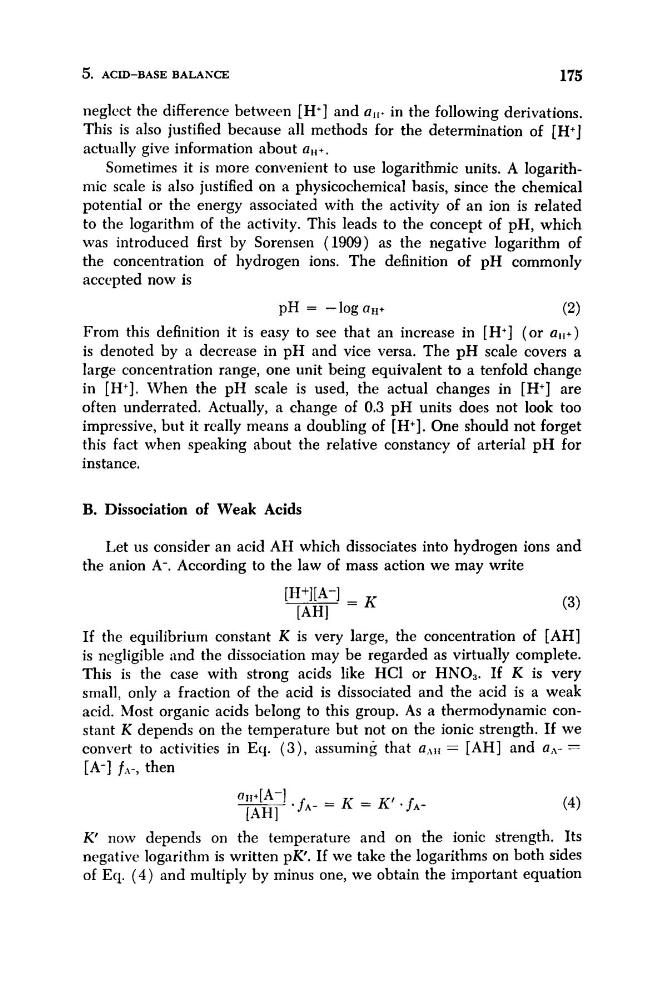
the anion A-. According to the law of mass action we may write
If the equilibrium constant K is very large, the concentration of [AH]
is ncgligible and the dissociation may be regarded as virtually complete.
This is the case with strong acids like HC1 or HNO,. If K is very
small, only a fraction of the acid is dissociated and the acid is a weak
acid. Most organic acids belong to this group. As a thermodynamic constant K depends on the temperature but not on the ionic strength. If we
convert to activities in Eq. ( 3 ) , assuming that
= [AH] and a,\- =
[A-I f A - , then
K' now depends on the temperature and on the ionic strength. Its
negative logarithm is written pK'. If we take the logarithms on both sides
of Eq. ( 4 ) and multiply by minus one, we obtain the important equation
175
neglect the difference between [H'] and all+ in the following derivations.
This is also justified because all methods for the determination of [H+]
actually give information about all+.
Sometimes it is more convenient to use logarithmic units. A logarithmic scale is also justified on a physicochemical basis, since the chemical
potential or the energy associated with the activity of an ion is related
to the logarithm of the activity. This leads to the concept of pH, which
was introduced first by Sorensen (1909) as the negative logarithm of
the concentration of hydrogen ions. The definition of pH commonly
accepted now is
pH = -log U H +
(2)
From this definition it is easy to see that an increase in [H'] (or a l l + )
is denoted by a decrease in pH and vice versa. The p H scale covers a
large concentration range, one unit being equivalent to a tenfold change
in [H']. When the pH scale is used, the actual changes in [H'] are
often underrated. Actually, a change of 0.3 pH units does not look too
impressive, but it really means a doubling of [H']. One should not forget
this fact when speaking about the relative constancy of arterial p H for
instance.
B. Dissociation of Weak Acids
Let us consider an acid AH which dissociates into hydrogen ions and
the anion A-. According to the law of mass action we may write
If the equilibrium constant K is very large, the concentration of [AH]
is ncgligible and the dissociation may be regarded as virtually complete.
This is the case with strong acids like HC1 or HNO,. If K is very
small, only a fraction of the acid is dissociated and the acid is a weak
acid. Most organic acids belong to this group. As a thermodynamic constant K depends on the temperature but not on the ionic strength. If we
convert to activities in Eq. ( 3 ) , assuming that
= [AH] and a,\- =
[A-I f A - , then
K' now depends on the temperature and on the ionic strength. Its
negative logarithm is written pK'. If we take the logarithms on both sides
of Eq. ( 4 ) and multiply by minus one, we obtain the important equation