

living orpminni arc diuc:usscci I)y Sliwchko ( 1952). It is widely distributed in irniniul tissues and umongst itivertebrates amine oxidase has
been found in high concentration in the hepatopancreas of Octopus and
Sepia (Blaschko, l!f41 ; Blaschko and Hawkins, 1952), in echinoderms,
but not in annelids and coelenterates (Rlaschko et al., 1937).
Berrill ( 1 929) reported thiLt ascidiaii amylase had an optimum pH
for activity near to 7.6 and that the proteases were active between 6.0
and 10.0. Vim Wee1 (1940) foiind that d 1 the enzymes worked at a pH
in exceuu of 7.0 and that the protcwc and lipase worked best between
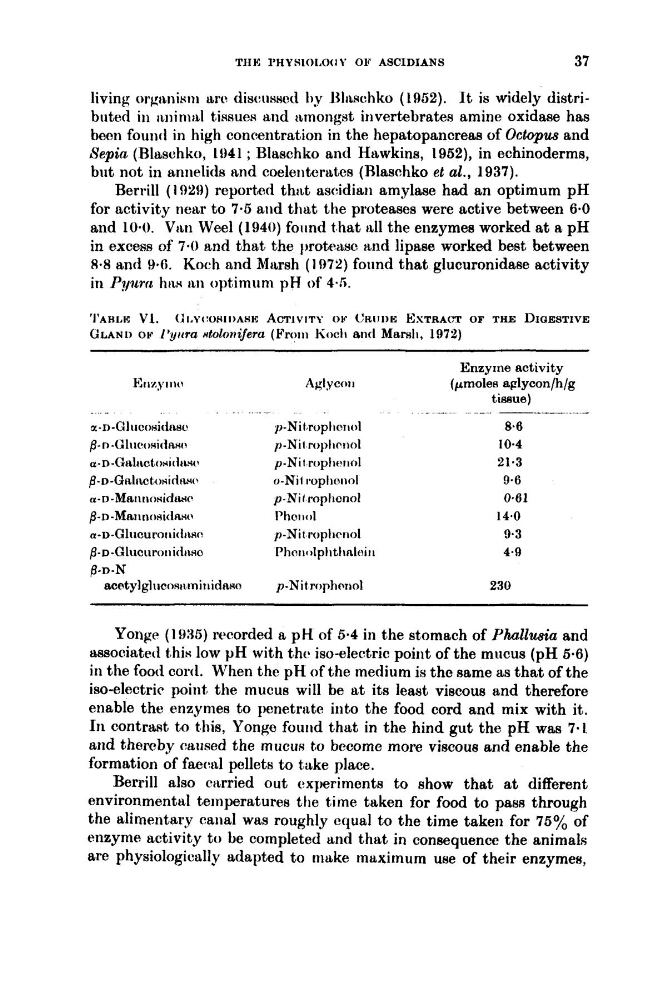
8.8 and 9 4 . Koch and Mitrsh ( 1 972) found that glucuronidase activity
in P?yum hits tm optimum pH of 4.5.
‘I’AHLB vl. (:IdY(’OHII)A8E A C T I V I T Y OF C h i J D L C EXTRACT OF THE DIGESTIVE
GLAND OY f’yura Ntobnifera (Proin liocli anti Marsh, 1972)
Agl ycoii
p-Nit rophard
Enzyme activity
(prnoles aFlycon/h/g
tissue)
8-6
10.4
21.3
9.6
0.61
14.0
9.3
4.9
. _ _ _
230
Yoiipe (1 935) recorded a pH of 6.4 in the stomach of Phallusia and
associated this low pH with thr iso-electric point of the mucus (pH 5.6)
in the food cord. When the pH of the medium is tho same as that of the
iso-electric point, the mucus will be at its least viscous and therefore
enable the enzymes to penetrcitc? into the food cord and mix with it.
In contra& to this, Yongo fouiid that in the hind gut the pH was 7.1
arid thereby caused the mucus to become more viscous and enable the
formation of f a e d pellets to take place.
Berrill also rltrried out experiments to show that at different
environmental temperatures the time taken for food to pas8 through
the alimentary calla1 was roughly cqual to the time taken for 75% of
enzyme activity to be completed and that in consequence the animals
are physiologically adapted to make maximum use of their enzymes,
been found in high concentration in the hepatopancreas of Octopus and
Sepia (Blaschko, l!f41 ; Blaschko and Hawkins, 1952), in echinoderms,
but not in annelids and coelenterates (Rlaschko et al., 1937).
Berrill ( 1 929) reported thiLt ascidiaii amylase had an optimum pH
for activity near to 7.6 and that the proteases were active between 6.0
and 10.0. Vim Wee1 (1940) foiind that d 1 the enzymes worked at a pH
in exceuu of 7.0 and that the protcwc and lipase worked best between
8.8 and 9 4 . Koch and Mitrsh ( 1 972) found that glucuronidase activity
in P?yum hits tm optimum pH of 4.5.
‘I’AHLB vl. (:IdY(’OHII)A8E A C T I V I T Y OF C h i J D L C EXTRACT OF THE DIGESTIVE
GLAND OY f’yura Ntobnifera (Proin liocli anti Marsh, 1972)
Agl ycoii
p-Nit rophard
Enzyme activity
(prnoles aFlycon/h/g
tissue)
8-6
10.4
21.3
9.6
0.61
14.0
9.3
4.9
. _ _ _
230
Yoiipe (1 935) recorded a pH of 6.4 in the stomach of Phallusia and
associated this low pH with thr iso-electric point of the mucus (pH 5.6)
in the food cord. When the pH of the medium is tho same as that of the
iso-electric point, the mucus will be at its least viscous and therefore
enable the enzymes to penetrcitc? into the food cord and mix with it.
In contra& to this, Yongo fouiid that in the hind gut the pH was 7.1
arid thereby caused the mucus to become more viscous and enable the
formation of f a e d pellets to take place.
Berrill also rltrried out experiments to show that at different
environmental temperatures the time taken for food to pas8 through
the alimentary calla1 was roughly cqual to the time taken for 75% of
enzyme activity to be completed and that in consequence the animals
are physiologically adapted to make maximum use of their enzymes,