

36
I V A N 000DHODY
availuble rewurces. These findings, however, are based on a study of a
few Bhallow-wakr species which feed primarily on finely divided particulate material. A few species of deepwater ascidians such as &&erascidia satiderai Monniot and Monniot ( 1968) are possibly active predators
and it would be of particular interest to know the way in which their
digestive physiology may have been adapted and whether proteases
are more important than amylases.
The earlier work reported on above was Iimited by the techniques
then available. Recently Koch and Marsh (1972) have examined in
detail the hydrolysi8 ofxarbohydrates by the digestive gland of Pyura
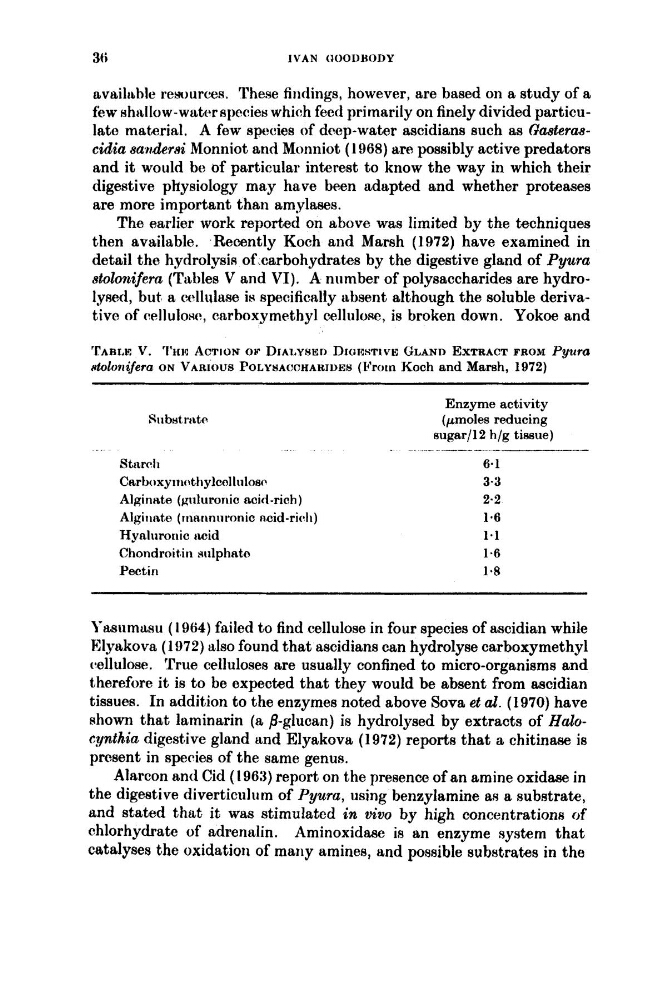
stolonifera (Tiibles V and VI). A number of polysaccharides are hydrolyoed, but a cc4ulase i H specifically absent although the soluble derivative of rellulose, carboxymethyl cellulose, is broken down. Yokoe and
TABLE v. ‘f’Hl4 ACTION OF I)IAl,Y€4ED DIGICSTIVE GLAND EXTRACT FROM PYUra
wto~ovi~fera ON VARIOUS POLYXACOHARII~E8 (E’rotn Koch and Marsh, 1972)
Sttxrch
Carboxyiircith ylcol luloso
Algimte (giiliironic acid-rich)
Algiiints (rnmnuronic ncid-ric41)
Hyaluroriic wid
Ctiondroitin siilphats
Pectin
Enzyme activity
(pmoles reducing
sugar/12 h/g tissue)
6- 1
3.3
2.2
1.6
1.1
1.6
1.8
. .
-
I’asumusu ( 1964) failed to find cellulose in four species of ascidian while
Elyakova ( 1‘372) itlso found that ascidians can hydrolyse carboxymethyl
c.ellulose. True celluloses are usually confined to micro-organisms and
therefore it is to be expected that they would be absent from ascidian
tissues. In addition to the enzymes noted above Sova et al. (1970) have
shown that laminarin (a /3-glucan) is hydrolysed by extracts of Halocynthia digestive gland and Elyakova (1 972) reports that a chitin- is
prcsent in species of the same genus.
Alarcon and Cid (1963) report on the presence of an amine oxidase in
the digestive diverticulum of Pyura, using benzylamine as a subotrate,
and stated that it was stimulated in vivo by high concentrations of
chlorhydrate of adrenalin. Aminoxidaae is an enzyme system that
catalyses the oxidation of marly amines, and possible substrates in the
I V A N 000DHODY
availuble rewurces. These findings, however, are based on a study of a
few Bhallow-wakr species which feed primarily on finely divided particulate material. A few species of deepwater ascidians such as &&erascidia satiderai Monniot and Monniot ( 1968) are possibly active predators
and it would be of particular interest to know the way in which their
digestive physiology may have been adapted and whether proteases
are more important than amylases.
The earlier work reported on above was Iimited by the techniques
then available. Recently Koch and Marsh (1972) have examined in
detail the hydrolysi8 ofxarbohydrates by the digestive gland of Pyura
stolonifera (Tiibles V and VI). A number of polysaccharides are hydrolyoed, but a cc4ulase i H specifically absent although the soluble derivative of rellulose, carboxymethyl cellulose, is broken down. Yokoe and
TABLE v. ‘f’Hl4 ACTION OF I)IAl,Y€4ED DIGICSTIVE GLAND EXTRACT FROM PYUra
wto~ovi~fera ON VARIOUS POLYXACOHARII~E8 (E’rotn Koch and Marsh, 1972)
Sttxrch
Carboxyiircith ylcol luloso
Algimte (giiliironic acid-rich)
Algiiints (rnmnuronic ncid-ric41)
Hyaluroriic wid
Ctiondroitin siilphats
Pectin
Enzyme activity
(pmoles reducing
sugar/12 h/g tissue)
6- 1
3.3
2.2
1.6
1.1
1.6
1.8
. .
-
I’asumusu ( 1964) failed to find cellulose in four species of ascidian while
Elyakova ( 1‘372) itlso found that ascidians can hydrolyse carboxymethyl
c.ellulose. True celluloses are usually confined to micro-organisms and
therefore it is to be expected that they would be absent from ascidian
tissues. In addition to the enzymes noted above Sova et al. (1970) have
shown that laminarin (a /3-glucan) is hydrolysed by extracts of Halocynthia digestive gland and Elyakova (1 972) reports that a chitin- is
prcsent in species of the same genus.
Alarcon and Cid (1963) report on the presence of an amine oxidase in
the digestive diverticulum of Pyura, using benzylamine as a subotrate,
and stated that it was stimulated in vivo by high concentrations of
chlorhydrate of adrenalin. Aminoxidaae is an enzyme system that
catalyses the oxidation of marly amines, and possible substrates in the