

appr(%ntly pli~ys a marked rolo it1 trtmsf(wirig organic matter to large
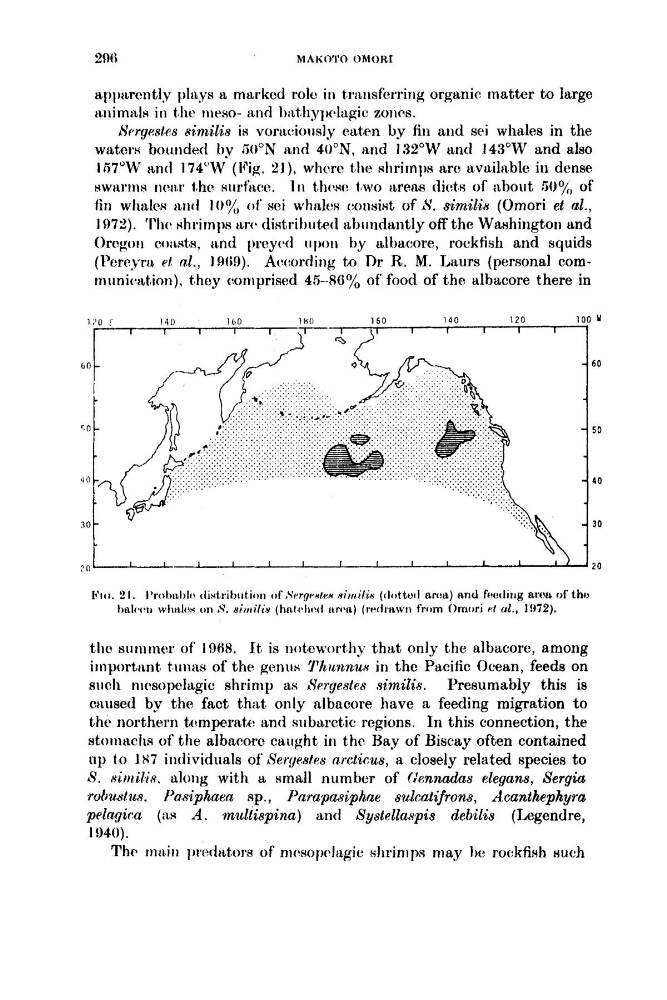
Af,r@as &milis is voruc.ioiisly caten by fin and sci whales in the
watcrs bounded by 5O"N nnd 40°N, mid 132"W and l43"W and also
ITi7*W ttiid 174"W (Vig. 8J), wlicrc the diritnp arc available in dense
~ w t t i ~ i n ~
~ i ~ i i r
thc siirtbw. 111 t h w trwo tireas dioto of' iLboiit SO./,, of
fin whales t ~ i t t l 1 0 % of' sei whtsltts vonuiHt of N. similia (Omori et nl.,
1076). 'I'li~ ~hrirnps t b w t1isfrik)irtrd thiindantly off the W~tnhiligtoii and
Oregon coirsts, kind prey(d II pon by albtlcore, rockfish and squids
(€+rc.yra d nl., I9liD). According to Dr R. M. Luurv (personal communic*tittion). t hcy comprised 4 5 4 6 % of food of the albacore there in
wiirniiln i n t ht. nit'so- itnd I)i~t~hyl)(.I* <1 8' I(' ZOllCS.
the sitiiiniw of 1968. It, is noteworthy t h s t only the albacore, among
irnporttmt tiinas of the genus Y'huni~us in the Pacific Ocean, feeds on
siicli nitwqielagic shrimp as Srrgestrs sirnilin.. Presumably this is
cnused by the fact thiLt only albacore have a feeding migration to
the nort$ht.rn tttmperat,c. ttnd subarctic regions. In this connection, the
stoinwlis of the albacore caught in thc Hay of Biscay often contained
lip to 187 individuals of Reuyrs/es nrcticus, a closely related species to
S. siniilis. along with a snittll number of Gennudas eleguns, Sergia
mbusfus. Pansiphaen op., Pnrapmiphae subatifrons, dcanthephyra
p ~ l n g i ~ n (iLR A . mullispinu) i d Sgstellanspis deb&
(Legendre,
I 1140).
Thc rnaiii p m h t m s of nic+xqwI;igie shrinips may be rockfiHh such
Af,r@as &milis is voruc.ioiisly caten by fin and sci whales in the
watcrs bounded by 5O"N nnd 40°N, mid 132"W and l43"W and also
ITi7*W ttiid 174"W (Vig. 8J), wlicrc the diritnp arc available in dense
~ w t t i ~ i n ~
~ i ~ i i r
thc siirtbw. 111 t h w trwo tireas dioto of' iLboiit SO./,, of
fin whales t ~ i t t l 1 0 % of' sei whtsltts vonuiHt of N. similia (Omori et nl.,
1076). 'I'li~ ~hrirnps t b w t1isfrik)irtrd thiindantly off the W~tnhiligtoii and
Oregon coirsts, kind prey(d II pon by albtlcore, rockfish and squids
(€+rc.yra d nl., I9liD). According to Dr R. M. Luurv (personal communic*tittion). t hcy comprised 4 5 4 6 % of food of the albacore there in
wiirniiln i n t ht. nit'so- itnd I)i~t~hyl)(.I* <1 8' I(' ZOllCS.
the sitiiiniw of 1968. It, is noteworthy t h s t only the albacore, among
irnporttmt tiinas of the genus Y'huni~us in the Pacific Ocean, feeds on
siicli nitwqielagic shrimp as Srrgestrs sirnilin.. Presumably this is
cnused by the fact thiLt only albacore have a feeding migration to
the nort$ht.rn tttmperat,c. ttnd subarctic regions. In this connection, the
stoinwlis of the albacore caught in thc Hay of Biscay often contained
lip to 187 individuals of Reuyrs/es nrcticus, a closely related species to
S. siniilis. along with a snittll number of Gennudas eleguns, Sergia
mbusfus. Pansiphaen op., Pnrapmiphae subatifrons, dcanthephyra
p ~ l n g i ~ n (iLR A . mullispinu) i d Sgstellanspis deb&
(Legendre,
I 1140).
Thc rnaiii p m h t m s of nic+xqwI;igie shrinips may be rockfiHh such