

udditioii, they &re eaten by tnaiig rookficrli and several species of sea1)irtlrr (Mat,tlit:ws, 1932).
Secmicily, we consider the predtLtors of' mesopelagic shrimps.
Kowka P I n2. ( I !)en) exarnincd t h stoniac~h contents of various fishes
(wight from t tic fishing grouiidx of Scrqirr Zucpn8 in SurugiL Bay, and
fouiid A"~rgia in 22 out of the 44 species of' fiNh iind 3 out of the (i species
of ctoyh;rlopotix. Fruqimicieg of tho occiirence were 90% or more
in the Jiq)aiiew Mi-luli chines Narpudon wicrochir Giinther, the
r
j
- I J
diarkbllie Imdlightfish Diuphus coerulew (Klunzinger), the glandulous hcudlightti~h I). glnrhdulifer Gilbert, the bluebelly roughy Gephyrobrr,y.c japon irue (Ddderlein) antf the rabbitfish Yromethichthys
proiriethpus (hvivr et Vtllrncirnnex, and the last species contained up
to 26 individuals of Sprqiir in a stomach. The= dnta and the results
obtained by Naktti ~t al. (i966) and Omori (1969a) suggest that the
hoadlighttinh. pwticularly D. coeru1eu.s and D. glandulifer, are the most
important predators. The influence. on the stock of S. lucens. of
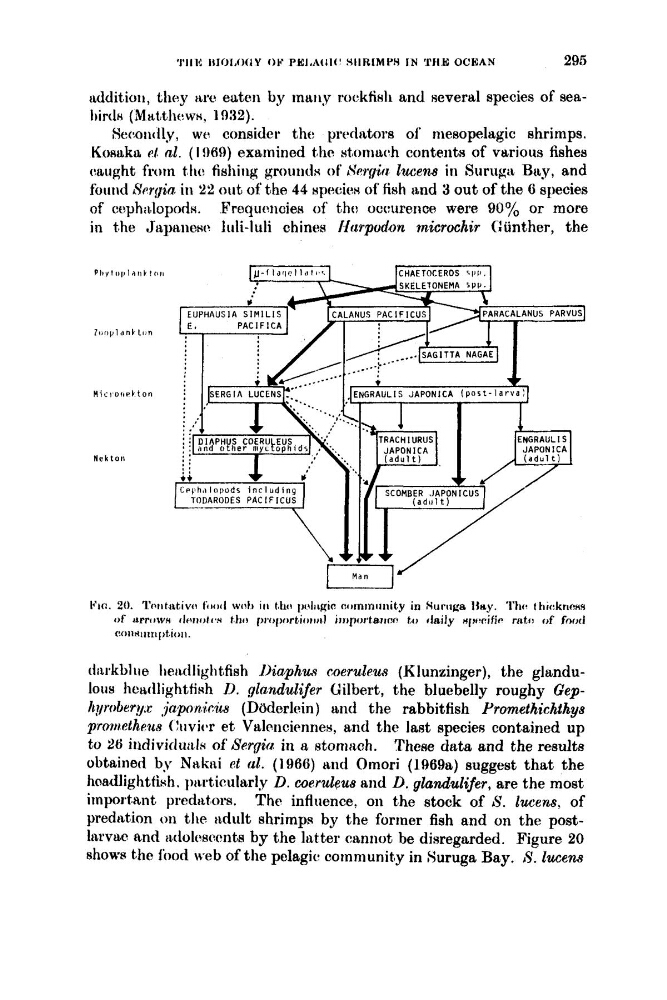
predation on the d u l t shrimps by the former fish and on the postlsrvuc and edolcsrrnts by the latter cannot be disregarded. Figure 20
shows t,he food web of the pelagic+ community in Suruga Bay. 8. lucem
Secmicily, we consider the predtLtors of' mesopelagic shrimps.
Kowka P I n2. ( I !)en) exarnincd t h stoniac~h contents of various fishes
(wight from t tic fishing grouiidx of Scrqirr Zucpn8 in SurugiL Bay, and
fouiid A"~rgia in 22 out of the 44 species of' fiNh iind 3 out of the (i species
of ctoyh;rlopotix. Fruqimicieg of tho occiirence were 90% or more
in the Jiq)aiiew Mi-luli chines Narpudon wicrochir Giinther, the
r
j
- I J
diarkbllie Imdlightfish Diuphus coerulew (Klunzinger), the glandulous hcudlightti~h I). glnrhdulifer Gilbert, the bluebelly roughy Gephyrobrr,y.c japon irue (Ddderlein) antf the rabbitfish Yromethichthys
proiriethpus (hvivr et Vtllrncirnnex, and the last species contained up
to 26 individuals of Sprqiir in a stomach. The= dnta and the results
obtained by Naktti ~t al. (i966) and Omori (1969a) suggest that the
hoadlighttinh. pwticularly D. coeru1eu.s and D. glandulifer, are the most
important predators. The influence. on the stock of S. lucens. of
predation on the d u l t shrimps by the former fish and on the postlsrvuc and edolcsrrnts by the latter cannot be disregarded. Figure 20
shows t,he food web of the pelagic+ community in Suruga Bay. 8. lucem