

have aborlt five zocltl s t a g t ~ ( i u r ~ ~ e p
and Lehour (1941) suggested
that tho gc?nrra with lttrge taggx arc, judged by adult characters of
Oplophori(ii~c!, 011 t,ha wliole more primitive than those with small eggs.
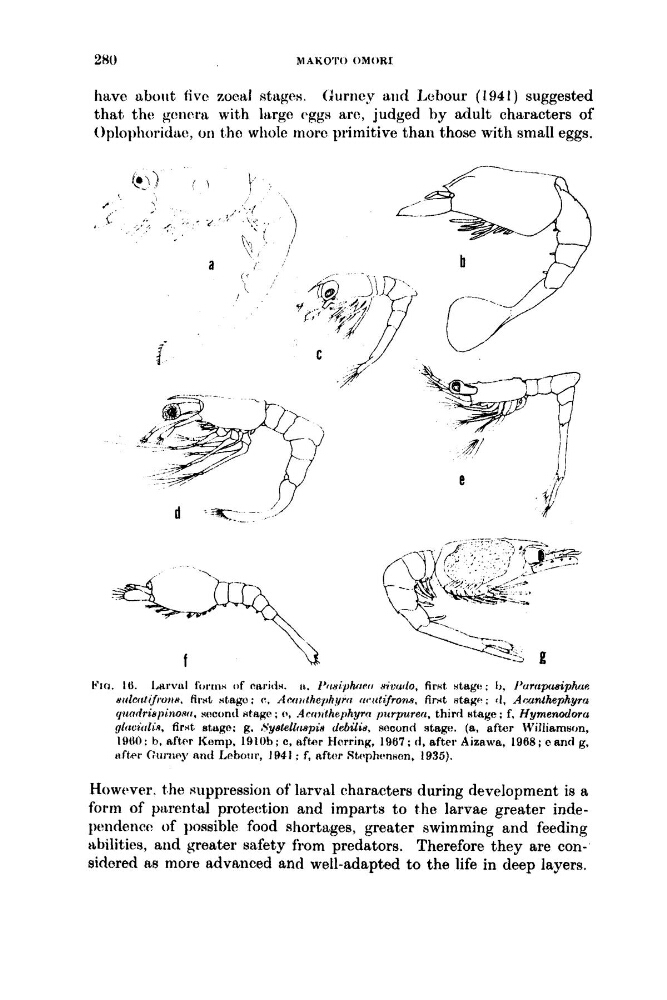
Vlo. 16. 1,nrvul fi)181ns of ~nrtd*. ti. l ' r ~ ~ i p h ~ r r ~
W ~ I I I J I ~ O ,
firnt ~ t n y ~ ,
t ~ , lJ~1rtipt~Uliph(ie
attlcrit(frottx, first stago; r. rfctrttthephqrrt. rr~~ctzfrom, first stage.; 11, Accmlhephyrrc
quodrispino.qtr, nocontl utngr ; (*, Arrrltthephyro purpureri, third ntage ; f, Hymenalorrc
glrtcatrlt~, firqt stage; g. Syelelltlapie debilw, uocond atage. ( a , after W~ll~arncion,
1 H W : b, aftor ICernp, 1910h; c, nftmr Hrrrtng, 1967: d, after A~zawa, 1968; o arid g,
nfter <:ul?ic~y nnci Lebot~r, 1941 : f, nftc~r Stttphtanhon, 1935).
Howtbvcr. t h s suppression of lervltl characters during development is a
form of pctrent.al protection and imparts to the larvae greater indept~ndencc of possible food shortages, greater switnming and feeding
t~bilities, and greater safety from predators. Therefore they are considered as more advanced and well-adapted to the life in deep layers.
and Lehour (1941) suggested
that tho gc?nrra with lttrge taggx arc, judged by adult characters of
Oplophori(ii~c!, 011 t,ha wliole more primitive than those with small eggs.
Vlo. 16. 1,nrvul fi)181ns of ~nrtd*. ti. l ' r ~ ~ i p h ~ r r ~
W ~ I I I J I ~ O ,
firnt ~ t n y ~ ,
t ~ , lJ~1rtipt~Uliph(ie
attlcrit(frottx, first stago; r. rfctrttthephqrrt. rr~~ctzfrom, first stage.; 11, Accmlhephyrrc
quodrispino.qtr, nocontl utngr ; (*, Arrrltthephyro purpureri, third ntage ; f, Hymenalorrc
glrtcatrlt~, firqt stage; g. Syelelltlapie debilw, uocond atage. ( a , after W~ll~arncion,
1 H W : b, aftor ICernp, 1910h; c, nftmr Hrrrtng, 1967: d, after A~zawa, 1968; o arid g,
nfter <:ul?ic~y nnci Lebot~r, 1941 : f, nftc~r Stttphtanhon, 1935).
Howtbvcr. t h s suppression of lervltl characters during development is a
form of pctrent.al protection and imparts to the larvae greater indept~ndencc of possible food shortages, greater switnming and feeding
t~bilities, and greater safety from predators. Therefore they are considered as more advanced and well-adapted to the life in deep layers.