

SOME ASPECTS OF NEOPLASTA IN MARINE ANIMALS
169
considered Its tnajbr entities when making a diagnosis of a specific
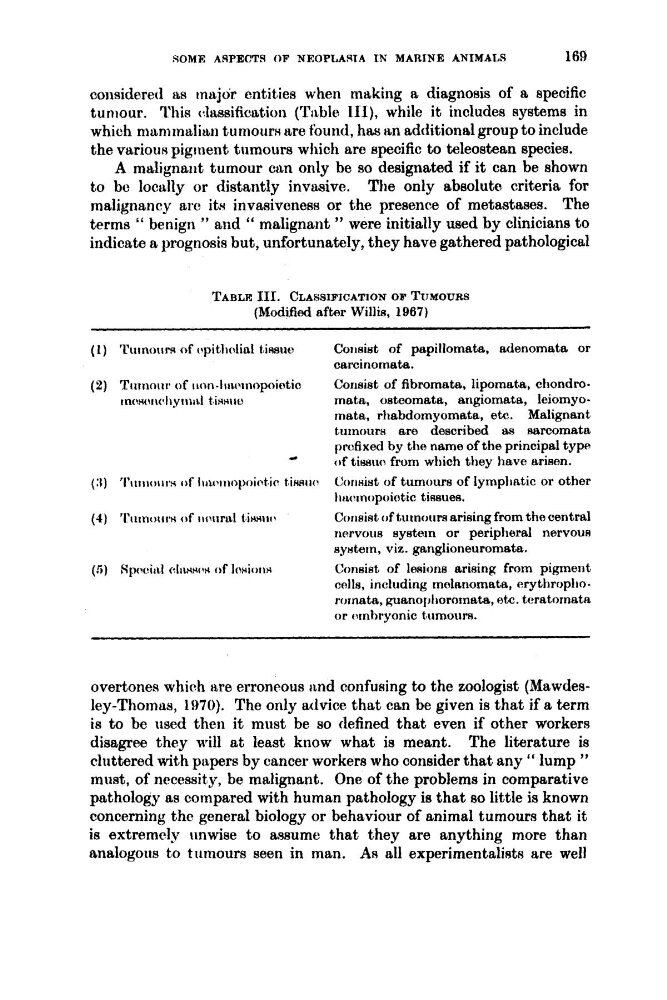
tunlour. This c4ossifictttion ('hble III), while it includes systems in
which mttniinolion tuniourH are found, has ctn additional group to include
the varioucl pigment tiimours which are specific to hleostean species.
A malignant tumour can only be so designated if it can be shown
to bc locally or distantly invosive. The only absolute criteria for
malignancy arc it8 invaaiveness or the presence of metastases. The
terms " benign " and " malignant " were initially used by clinicians to
indicate a prognosis but, unfortunately, they have gathered pathological
TABLE 111. CLASSIFICATION OF TuMouRs
(Modified after Willie, 1967)
Consist of papillomata. adenomata or
carcinomata.
Consist of fibromata, lipomata, chondromata, osteomata, angiomata, leiomyomata, rhabdomyomata, etc. Malignant
tmnours are described a~ sarcomata
prdixed by the name of the principal type
of tiww from which they have arisen.
Consist of turnours of lymplintic or other
licmnopoiotic tissues.
CorisiRt of turnours arising from the central
I I ~ ~ V O U R systern or peripheral nervouR
syatem, viz. ganglioneuromata.
Consist of lesions arising from pigment
cells, inalrrding melanomata, erythroplroromata, guanopt rorotnata, etc. tc:ratomatrt
or cxnbryonic ttimours.
overtones which are erroneous m d confusing to the zoologist (Mawdesley-Thomas, 1970). The only advice that can be given is that if a term
is to be used then it must be so defined that even if other workers
disagree they will at least know what is meant. The literature is
cluttered with papers by cancer workers who consider that any lump "
must, of necessity, be malignant. One of the problems in comparative
pathology aa compared with human pathology is that so little is known
concerning the general biology or behaviour of animal tumours that it
is extremely unwise to asaume that they are anything more than
analogous to tumours seen in man. AR all experimentaliRts are well
169
considered Its tnajbr entities when making a diagnosis of a specific
tunlour. This c4ossifictttion ('hble III), while it includes systems in
which mttniinolion tuniourH are found, has ctn additional group to include
the varioucl pigment tiimours which are specific to hleostean species.
A malignant tumour can only be so designated if it can be shown
to bc locally or distantly invosive. The only absolute criteria for
malignancy arc it8 invaaiveness or the presence of metastases. The
terms " benign " and " malignant " were initially used by clinicians to
indicate a prognosis but, unfortunately, they have gathered pathological
TABLE 111. CLASSIFICATION OF TuMouRs
(Modified after Willie, 1967)
Consist of papillomata. adenomata or
carcinomata.
Consist of fibromata, lipomata, chondromata, osteomata, angiomata, leiomyomata, rhabdomyomata, etc. Malignant
tmnours are described a~ sarcomata
prdixed by the name of the principal type
of tiww from which they have arisen.
Consist of turnours of lymplintic or other
licmnopoiotic tissues.
CorisiRt of turnours arising from the central
I I ~ ~ V O U R systern or peripheral nervouR
syatem, viz. ganglioneuromata.
Consist of lesions arising from pigment
cells, inalrrding melanomata, erythroplroromata, guanopt rorotnata, etc. tc:ratomatrt
or cxnbryonic ttimours.
overtones which are erroneous m d confusing to the zoologist (Mawdesley-Thomas, 1970). The only advice that can be given is that if a term
is to be used then it must be so defined that even if other workers
disagree they will at least know what is meant. The literature is
cluttered with papers by cancer workers who consider that any lump "
must, of necessity, be malignant. One of the problems in comparative
pathology aa compared with human pathology is that so little is known
concerning the general biology or behaviour of animal tumours that it
is extremely unwise to asaume that they are anything more than
analogous to tumours seen in man. AR all experimentaliRts are well