

168
r , i o N EL E. MAW DESLEY-THOMAS
clrtsseR and sub-clwses as possible, an up-dating of the initial work of
Schlumbergcr and Luck6 ( 1948) has been undertaken, and in this article
an up-to-drbte t;ixononiic distribution of tumour bearirig fish has been
included. While there are several omissions, it must be confessed that
sometimes the taxonomy has become tangled. There would appear to
be an increase in t8umours in the teleosteans aa opposed to the chondrichthyes. The exact incidence of tumours can never be accurately assessed
as the population from which they have been obtained can never be
known with any degree of certainty. What can be said is that while
tumours are seen in many fish species, the principal groups affected in
the marine kingdom are the Salmonidae, Gadidae, Bothidae and
Pleuroneotidue. This distribution may again be more apparent than
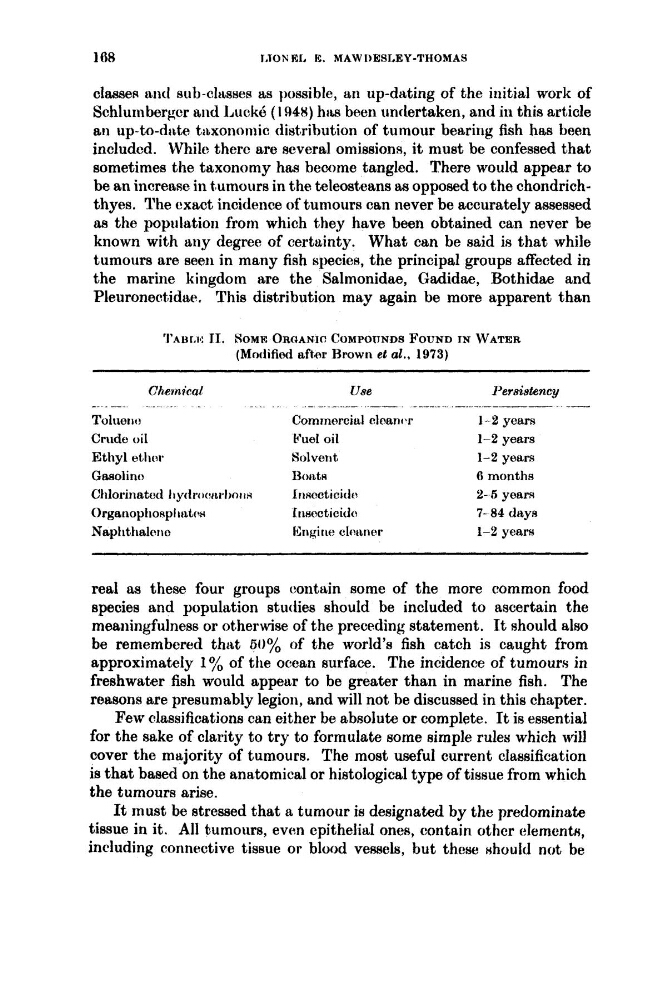
TAULIG TI. HOME ORGANIC COMPOTJNDS FOUND IN WATER
(Modified aRor Brown et d., 1973)
Chemical
- -Toluetw
Crude oil
Ethyl etlinr
Gaaolino
Chlorinated Itydr( tcwl)ot IH
OrganoptioRpl iiitw
Ntlptittialrrio
Persistency
1-2 years
1-2 years
1-2 years
6 months
2-6 yearn
7- 84 day8
1-2 yearn
real as these four groups contain some of the more common food
species and population studies should be included to ascertain the
meaningfulness or otherwise of the preceding statement. It should also
be remembered thltt 50% of the world's fish catch is caught from
approximately 1% of the ocean surface. The incidence of tumours in
freshwater fish would appear to be greater than in marine fish. The
reasons are presumably legion, and will not be discussed in this chapter.
Few classifications can either be absolute or complete. It is essential
for the sake of clarity to try to formulate some simple rules which will
cover the majority of tumours. The most useful current classification
is that based on the anatomical or histological type of tissue from which
the tumours arise.
It must be stressed that a tumour is designated by the predominate
tissue in it. All turnours, even epithelial ones, contain other ebmontrc,
including connective tissue or blood vessels, but thew nhould not be
r , i o N EL E. MAW DESLEY-THOMAS
clrtsseR and sub-clwses as possible, an up-dating of the initial work of
Schlumbergcr and Luck6 ( 1948) has been undertaken, and in this article
an up-to-drbte t;ixononiic distribution of tumour bearirig fish has been
included. While there are several omissions, it must be confessed that
sometimes the taxonomy has become tangled. There would appear to
be an increase in t8umours in the teleosteans aa opposed to the chondrichthyes. The exact incidence of tumours can never be accurately assessed
as the population from which they have been obtained can never be
known with any degree of certainty. What can be said is that while
tumours are seen in many fish species, the principal groups affected in
the marine kingdom are the Salmonidae, Gadidae, Bothidae and
Pleuroneotidue. This distribution may again be more apparent than
TAULIG TI. HOME ORGANIC COMPOTJNDS FOUND IN WATER
(Modified aRor Brown et d., 1973)
Chemical
- -Toluetw
Crude oil
Ethyl etlinr
Gaaolino
Chlorinated Itydr( tcwl)ot IH
OrganoptioRpl iiitw
Ntlptittialrrio
Persistency
1-2 years
1-2 years
1-2 years
6 months
2-6 yearn
7- 84 day8
1-2 yearn
real as these four groups contain some of the more common food
species and population studies should be included to ascertain the
meaningfulness or otherwise of the preceding statement. It should also
be remembered thltt 50% of the world's fish catch is caught from
approximately 1% of the ocean surface. The incidence of tumours in
freshwater fish would appear to be greater than in marine fish. The
reasons are presumably legion, and will not be discussed in this chapter.
Few classifications can either be absolute or complete. It is essential
for the sake of clarity to try to formulate some simple rules which will
cover the majority of tumours. The most useful current classification
is that based on the anatomical or histological type of tissue from which
the tumours arise.
It must be stressed that a tumour is designated by the predominate
tissue in it. All turnours, even epithelial ones, contain other ebmontrc,
including connective tissue or blood vessels, but thew nhould not be