

THE PHYSIOLOGY OF ASCIDIANS
5
the mantle wall or through the epithelial walls of the test vessels. For a
fuller review of the cell types invading the matrix of the test see
Godeaux (1964b). The early literature on the nature and formation of
the test has been reviewed by Saint-Hilaire (1931), Berrill (1960),
Pruvot-Fol (1951), Ranby (1952), Endean (195513, 1961), Godeaux
( I 964b), Wardrop ( I 970), Smith ( 1970~).
I
E
HPV
H
PC
V
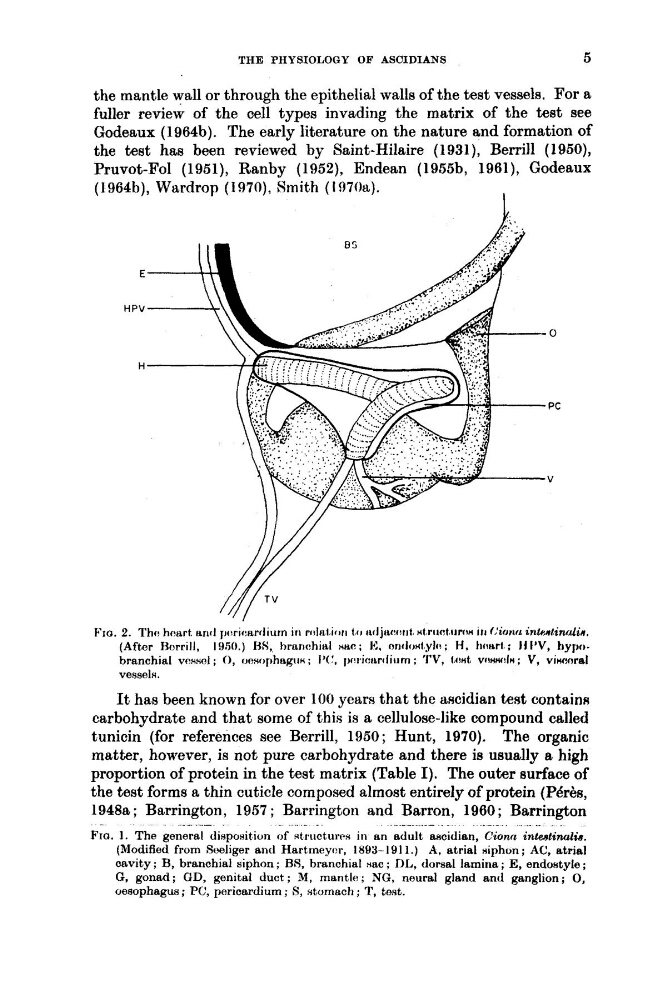
Fro. 2. Tho hoart awl rwrimriliiim i n ritlel 1011 10 culjiwiwt NI riwtiintn 111 fjumu irukalwudin.
(After Borrill, 19.50.) HS, hranohial NIW ; IC, O l l t h H f y l P ; 14, hwrt : t i I’v, hypo.
branchial vf*.rxel ; 0, rJe.r~JphagllN ; f’(‘, ~ ~ f ’ l l ~ ! f L ~ l ~ l l l ~ i
; 1’v, f Wt VitWVln ; v, V i H f m r d
vessels.
It has been known for over 100 years that the amidian test c o n t a h
carbohydrate and that some of this is a cellulose-like compound called
tunicin (for references see Berrill, 1950; Hunt, 1970). The organic
matter, however, is not pure carbohydrate and there is usually a high
proportion of protein in the test matrix (Table I). The outer surface of
the test forms a thin cuticle composed almost entirely of protein (P&r;?s,
1948a; Barrington, 1957 ; Barrington and Barron, 1960; Barrington
- -
-
-
FIQ. 1. The general dispoaition of *tructurcw i n an adult wcidian, C‘zonrc int&inuZiu.
(&lodified from Soeliger and Hartmeyvr, 1893- 191 1.) A, atrial siphon; AC, atrial
cavity ; B, branchial siphon ; BS, branchial Yac ; DL, dorsal lamina; E, endostyle ;
G, gonad; GD, genital duct; M, mantle; NG, neural gland and ganglion; 0,
oesophagus; PC, pericardium ; S, stomach ; T, test.
5
the mantle wall or through the epithelial walls of the test vessels. For a
fuller review of the cell types invading the matrix of the test see
Godeaux (1964b). The early literature on the nature and formation of
the test has been reviewed by Saint-Hilaire (1931), Berrill (1960),
Pruvot-Fol (1951), Ranby (1952), Endean (195513, 1961), Godeaux
( I 964b), Wardrop ( I 970), Smith ( 1970~).
I
E
HPV
H
PC
V
Fro. 2. Tho hoart awl rwrimriliiim i n ritlel 1011 10 culjiwiwt NI riwtiintn 111 fjumu irukalwudin.
(After Borrill, 19.50.) HS, hranohial NIW ; IC, O l l t h H f y l P ; 14, hwrt : t i I’v, hypo.
branchial vf*.rxel ; 0, rJe.r~JphagllN ; f’(‘, ~ ~ f ’ l l ~ ! f L ~ l ~ l l l ~ i
; 1’v, f Wt VitWVln ; v, V i H f m r d
vessels.
It has been known for over 100 years that the amidian test c o n t a h
carbohydrate and that some of this is a cellulose-like compound called
tunicin (for references see Berrill, 1950; Hunt, 1970). The organic
matter, however, is not pure carbohydrate and there is usually a high
proportion of protein in the test matrix (Table I). The outer surface of
the test forms a thin cuticle composed almost entirely of protein (P&r;?s,
1948a; Barrington, 1957 ; Barrington and Barron, 1960; Barrington
- -
-
-
FIQ. 1. The general dispoaition of *tructurcw i n an adult wcidian, C‘zonrc int&inuZiu.
(&lodified from Soeliger and Hartmeyvr, 1893- 191 1.) A, atrial siphon; AC, atrial
cavity ; B, branchial siphon ; BS, branchial Yac ; DL, dorsal lamina; E, endostyle ;
G, gonad; GD, genital duct; M, mantle; NG, neural gland and ganglion; 0,
oesophagus; PC, pericardium ; S, stomach ; T, test.