

62
R. I ( . DELL
close to eight-legged species. It is possible that the extra segments, and
extra pairs of legs may be caused by a doubling of chromosomes or by
unstable development.
It is obvious that in spite of all the work that has been done on
Antarctic pycnogonids, collections are not yet good enough for the
majority of species to give clear cut distribution patterns except for
some few common species. A number of the better documented species
such as Colossendeis robusta Hoek, C. lilliei Calman, C. scotti Calman,
C. australis Hodgson, Pycnogonum gaini Bouvier, Austrodecus glaciale
Hodgson, Dodecolopoda australis Eights, Ammothea carolinensis Leach,
A . glacialis (Hodgson) and A . minor (Hodgson) appear to be circumpolar in distribution.
Other species such as Ecleipsothremma spinosa (Hodgson) are known
from scattered regions in East and West Antarctica, and will probably
also prove to be circumpolar.
Radiative Evolution in the Pycnogonida
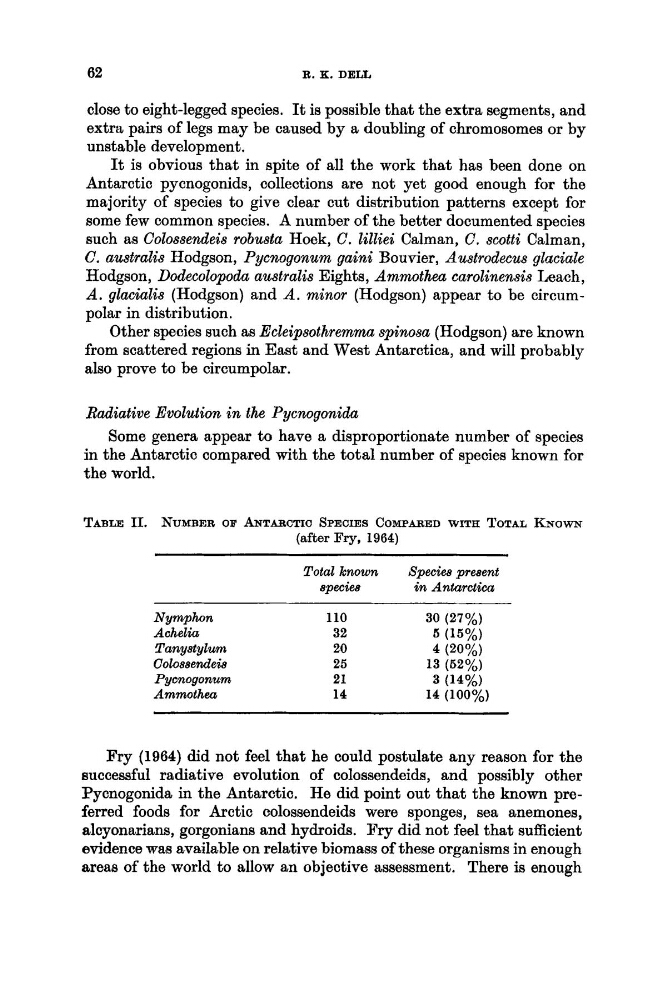
Some genera appear to have a disproportionate number of species
in the Antarctic compared with the total number of species known for
the world.
TABLE 11. NUMBER 01 ANTARCTI0 S P E C I E S COMPARED WITH TOTAL KNOWN
(after Fry, 1964)
Total known
Species present
apeCi&9
in Antarctica
Nymphon
110
30 (27%)
Achelia
32
5 (15%)
Tanyatylum
20
4 (20%)
Colossendeis
25
13 (62%)
Pycnogonum
21
3 (14%)
Ammothm
14
14 (100%)
Fry (1964) did not feel that he could postulate any reason for the
successful radiative evolution of colossendeids, and possibly other
Pycnogonida in the Antarctic. He did point out that the known preferred foods for Arctic colossendeids were sponges, sea anemones,
alcyonarians, gorgonians and hydroids. Fry did not feel that sufficient
evidence was available on relative biomass of these organisms in enough
areas of the world to allow an objective assessment. There is enough
R. I ( . DELL
close to eight-legged species. It is possible that the extra segments, and
extra pairs of legs may be caused by a doubling of chromosomes or by
unstable development.
It is obvious that in spite of all the work that has been done on
Antarctic pycnogonids, collections are not yet good enough for the
majority of species to give clear cut distribution patterns except for
some few common species. A number of the better documented species
such as Colossendeis robusta Hoek, C. lilliei Calman, C. scotti Calman,
C. australis Hodgson, Pycnogonum gaini Bouvier, Austrodecus glaciale
Hodgson, Dodecolopoda australis Eights, Ammothea carolinensis Leach,
A . glacialis (Hodgson) and A . minor (Hodgson) appear to be circumpolar in distribution.
Other species such as Ecleipsothremma spinosa (Hodgson) are known
from scattered regions in East and West Antarctica, and will probably
also prove to be circumpolar.
Radiative Evolution in the Pycnogonida
Some genera appear to have a disproportionate number of species
in the Antarctic compared with the total number of species known for
the world.
TABLE 11. NUMBER 01 ANTARCTI0 S P E C I E S COMPARED WITH TOTAL KNOWN
(after Fry, 1964)
Total known
Species present
apeCi&9
in Antarctica
Nymphon
110
30 (27%)
Achelia
32
5 (15%)
Tanyatylum
20
4 (20%)
Colossendeis
25
13 (62%)
Pycnogonum
21
3 (14%)
Ammothm
14
14 (100%)
Fry (1964) did not feel that he could postulate any reason for the
successful radiative evolution of colossendeids, and possibly other
Pycnogonida in the Antarctic. He did point out that the known preferred foods for Arctic colossendeids were sponges, sea anemones,
alcyonarians, gorgonians and hydroids. Fry did not feel that sufficient
evidence was available on relative biomass of these organisms in enough
areas of the world to allow an objective assessment. There is enough