

FISH NUTRITION
466
Folic acid deficiency in mammals is manifest in various forms of
blood pathology, different anaemias being described in terms of red
and white blood cell numbers and degree of maturation of the cells.
The development of somewhat similar anaemias in folic acid deficient
fish has been described.
The haematological changes occurring in coho salmon fed a folic
acid deficient diet were depression of erythrocyte count, packed cell
volume and haemoglobin content (Smith, 1968), although only erythrocyte count was significantly lowered. The erythrocytes themselves
were frequently abnormally shaped and had nuclear aberrations (the
nuclei being segmented into small lobes). Smith and Halver (1969)
followed the development of this megaloblastic, macrocytic anaemia in
juvenile coho salmon consuming folic acid-deficient diets. The first
anaemic symptoms that appeared six weeks after gross manifestations
of the folic acid deficiency were pale gills, exophthalmia, dark
coloration and retarded growth.
Folic acid anaemia in trout has been described by McLaren et aZ.
(1947) and Phillips (1963). Aoe and Masuda (1967b) failed to induce
any haematological or other changes in carp as a consequence of folic
acid deficiency. Although sulphanilamide was employed in conjunction
with folic acid deficient diets, thereby presumably curbing the possible
supply of folic acid from intestinal bacteria, no folic acid syndrome
appeared.
Folic acid requirement of trout and salmon is reported as 0.1 mg/kg
body weightlday.
9. Choline
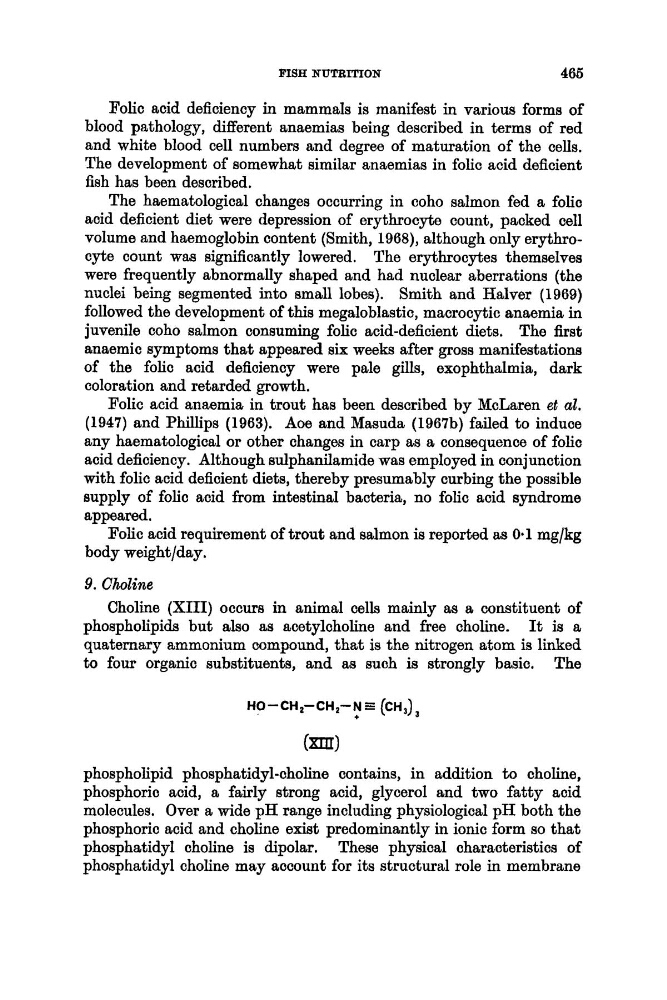
Choline (XIII) occurs in animal cells mainly as a constituent of
phospholipids but also as acetylcholine and free choline. It is a
quaternary ammonium compound, that is the nitrogen atom is linked
to four organic substituents, and as such is strongly basic. The
HO-CH2-CH2-N
(CH3)
+
phospholipid phosphatidyl-choline contains, in addition t o choline,
phosphorio acid, a fairly strong acid, glycerol and two fatty acid
molecules. Over a wide pH range including physiological pH both the
phosphoric acid and choline exist predominantly in ionic form so that
phosphatidyl choline is dipolar. These physical characteristics of
phosphatidyl choline may account for its structural role in membrane
466
Folic acid deficiency in mammals is manifest in various forms of
blood pathology, different anaemias being described in terms of red
and white blood cell numbers and degree of maturation of the cells.
The development of somewhat similar anaemias in folic acid deficient
fish has been described.
The haematological changes occurring in coho salmon fed a folic
acid deficient diet were depression of erythrocyte count, packed cell
volume and haemoglobin content (Smith, 1968), although only erythrocyte count was significantly lowered. The erythrocytes themselves
were frequently abnormally shaped and had nuclear aberrations (the
nuclei being segmented into small lobes). Smith and Halver (1969)
followed the development of this megaloblastic, macrocytic anaemia in
juvenile coho salmon consuming folic acid-deficient diets. The first
anaemic symptoms that appeared six weeks after gross manifestations
of the folic acid deficiency were pale gills, exophthalmia, dark
coloration and retarded growth.
Folic acid anaemia in trout has been described by McLaren et aZ.
(1947) and Phillips (1963). Aoe and Masuda (1967b) failed to induce
any haematological or other changes in carp as a consequence of folic
acid deficiency. Although sulphanilamide was employed in conjunction
with folic acid deficient diets, thereby presumably curbing the possible
supply of folic acid from intestinal bacteria, no folic acid syndrome
appeared.
Folic acid requirement of trout and salmon is reported as 0.1 mg/kg
body weightlday.
9. Choline
Choline (XIII) occurs in animal cells mainly as a constituent of
phospholipids but also as acetylcholine and free choline. It is a
quaternary ammonium compound, that is the nitrogen atom is linked
to four organic substituents, and as such is strongly basic. The
HO-CH2-CH2-N
(CH3)
+
phospholipid phosphatidyl-choline contains, in addition t o choline,
phosphorio acid, a fairly strong acid, glycerol and two fatty acid
molecules. Over a wide pH range including physiological pH both the
phosphoric acid and choline exist predominantly in ionic form so that
phosphatidyl choline is dipolar. These physical characteristics of
phosphatidyl choline may account for its structural role in membrane