

452
0. B. COWEY AND J. R. SARQENT
at which this photochemicaIly induced impulRe is released is not
known.
Vitamiri A is also necessary for the normal functioning of mucous
secreting tissues. Deficiency of vitamin A results in a drying of these
surfaces, a connective tissue type of mucopolysaccharide evidently being
formed ; excess of vitamin A leads to increased formation of mucous
type mucopolysaccharide. Vitamin A thus appears to regulate the
type of mucopolysaccharide formed.
Little reference has been made to the development of impaired vision
in fish which have received vitamin A deficient diets for several months
The main pathological symptoms described are anaemia, haemorrhage
of the skin and eyes, and malformation of the gill lamellae which are
fused together and clubbed at the tips (Kitamura et al., 1967a, b ;
Aoe et al., 1968). Additionally fish exhibit low growth and poor appetite.
It seems probable that effects on gills, skin and surface epithelia are
related to the role of vitamin A in mucopolysaccharide formation.
Drying and hardening of mucous;secreting tissue is one of the earliest
manifestations of vitamin A deficiency in mammals. Fish may weIl
represent an ideal experimental animal for the elucidation of the precise
role of vitamin A in mucus regulation.
The vitamin A requirement in fish is of the order of 100-500
IU/kg body weightlday.
2. Vitamin D
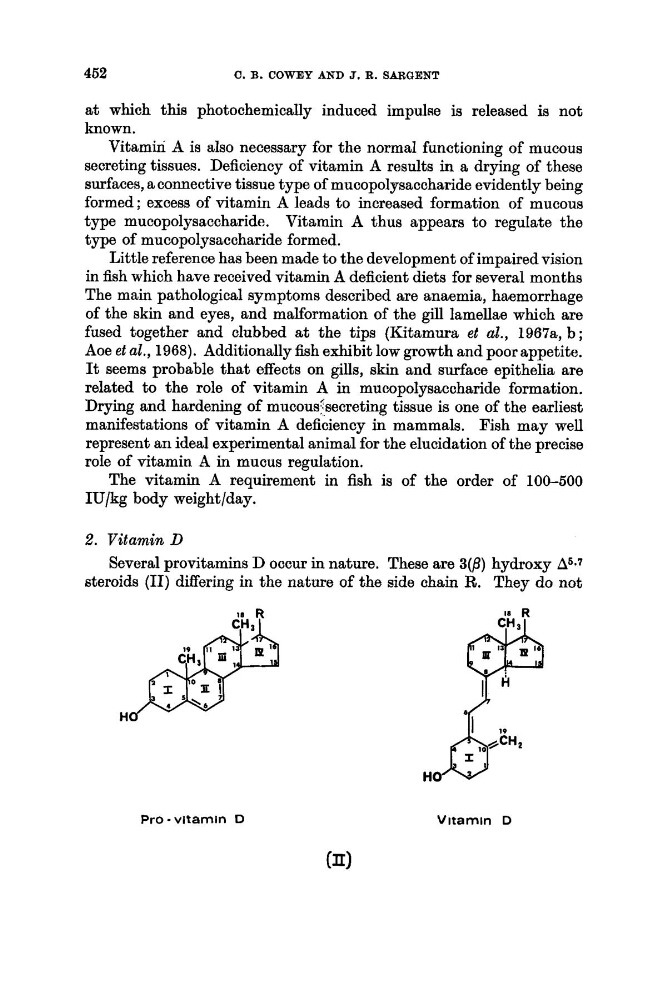
Several provitamins D occur in nature. These are 3(/3) hydroxy A6-7
steroids (11) differing in the nature of the side chain R. They do not
Pro -vitamin D
(a
Vitamin D
0. B. COWEY AND J. R. SARQENT
at which this photochemicaIly induced impulRe is released is not
known.
Vitamiri A is also necessary for the normal functioning of mucous
secreting tissues. Deficiency of vitamin A results in a drying of these
surfaces, a connective tissue type of mucopolysaccharide evidently being
formed ; excess of vitamin A leads to increased formation of mucous
type mucopolysaccharide. Vitamin A thus appears to regulate the
type of mucopolysaccharide formed.
Little reference has been made to the development of impaired vision
in fish which have received vitamin A deficient diets for several months
The main pathological symptoms described are anaemia, haemorrhage
of the skin and eyes, and malformation of the gill lamellae which are
fused together and clubbed at the tips (Kitamura et al., 1967a, b ;
Aoe et al., 1968). Additionally fish exhibit low growth and poor appetite.
It seems probable that effects on gills, skin and surface epithelia are
related to the role of vitamin A in mucopolysaccharide formation.
Drying and hardening of mucous;secreting tissue is one of the earliest
manifestations of vitamin A deficiency in mammals. Fish may weIl
represent an ideal experimental animal for the elucidation of the precise
role of vitamin A in mucus regulation.
The vitamin A requirement in fish is of the order of 100-500
IU/kg body weightlday.
2. Vitamin D
Several provitamins D occur in nature. These are 3(/3) hydroxy A6-7
steroids (11) differing in the nature of the side chain R. They do not
Pro -vitamin D
(a
Vitamin D