

FISH NUTRITION
45 1
was exacerbated when various micro-organisms began to be used to
test for vitamin deficiencies. Consequently, the so-called vitamin B
complex includes a variety of compounds which are not related to
each other either chemically or in their physiological action. For
compilation of the numerous vitamins and growth factors which have
been described Cheldelin’s (1951) paper should be consulted. Only
those vitamins used by Halver (1957) in his complete test diet are
considered below.
A . Pat soluble vitamins
1. Vitamin A
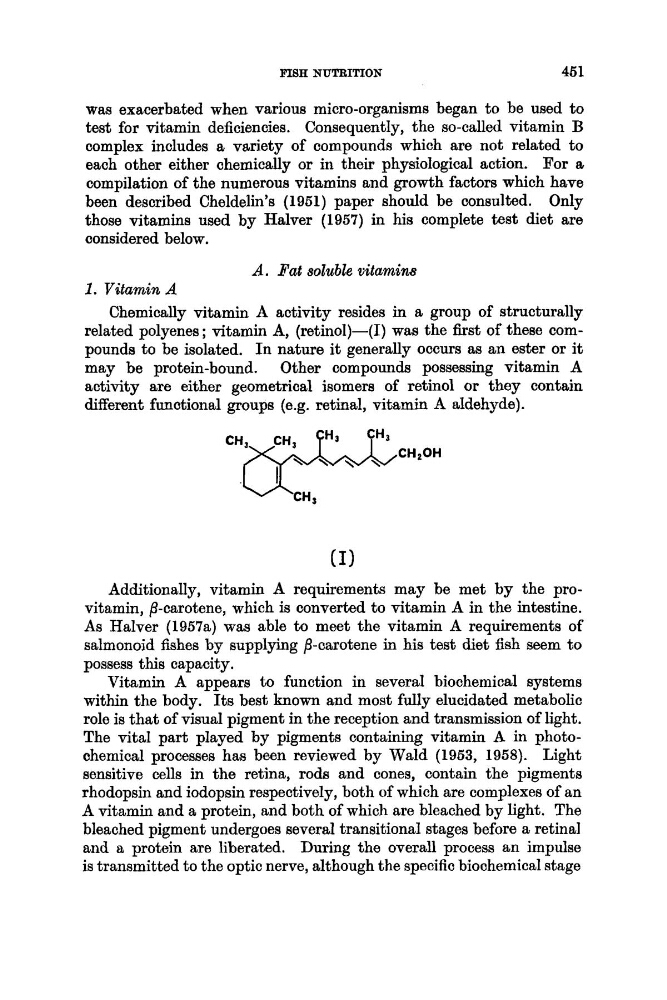
Chemically vitamin A activity resides in a group of structurally
related polyenes ; vitamin A, (retino1)-(I) was the first of these compounds to be isolated. In nature it generally occurs as an ester or it
may be protein-bound. Other compounds possessing vitamin A
activity are either geometrical isomers of retinol or they contain
different functional groups (e.g. retinal, vitamin A aldehyde).
Additionally, vitamin A requirements may be met by the provitamin, 8-carotene, which is converted to vitamin A in the intestine.
As Halver (1957a) was able to meet the vitamin A requirements of
salmonoid fishes by supplying 8-carotene in his test diet fish seem to
possess this capacity.
Vitamin A appears to function in several biochemical systems
within the body. Its best known and most fully elucidated metabolic
role is that of visual pigment in the reception and transmission of light.
The vital part played by pigments containing vitamin A in photochemical processes has been reviewed by Wald (1953, 1958). Light
sensitive cells in the retina, rods and cones, contain the pigments
rhodopsin and iodopsin respectively, both of which are complexes of an
A vitamin and a protein, and both of which are bleached by light. The
bleached pigment undergoes several transitional stages before a retinal
and a protein are liberated. During the overall process an impulse
is transmitted to the optic nerve, although the specific biochemical stage
45 1
was exacerbated when various micro-organisms began to be used to
test for vitamin deficiencies. Consequently, the so-called vitamin B
complex includes a variety of compounds which are not related to
each other either chemically or in their physiological action. For
compilation of the numerous vitamins and growth factors which have
been described Cheldelin’s (1951) paper should be consulted. Only
those vitamins used by Halver (1957) in his complete test diet are
considered below.
A . Pat soluble vitamins
1. Vitamin A
Chemically vitamin A activity resides in a group of structurally
related polyenes ; vitamin A, (retino1)-(I) was the first of these compounds to be isolated. In nature it generally occurs as an ester or it
may be protein-bound. Other compounds possessing vitamin A
activity are either geometrical isomers of retinol or they contain
different functional groups (e.g. retinal, vitamin A aldehyde).
Additionally, vitamin A requirements may be met by the provitamin, 8-carotene, which is converted to vitamin A in the intestine.
As Halver (1957a) was able to meet the vitamin A requirements of
salmonoid fishes by supplying 8-carotene in his test diet fish seem to
possess this capacity.
Vitamin A appears to function in several biochemical systems
within the body. Its best known and most fully elucidated metabolic
role is that of visual pigment in the reception and transmission of light.
The vital part played by pigments containing vitamin A in photochemical processes has been reviewed by Wald (1953, 1958). Light
sensitive cells in the retina, rods and cones, contain the pigments
rhodopsin and iodopsin respectively, both of which are complexes of an
A vitamin and a protein, and both of which are bleached by light. The
bleached pigment undergoes several transitional stages before a retinal
and a protein are liberated. During the overall process an impulse
is transmitted to the optic nerve, although the specific biochemical stage