

424
0. B. COWEY AND J. R. SAROENT
elaborate light reflecting surfaces, are paralleled by unique lipid
compositions in the cells associated with such specializations.
These considerations are of more than academic interest as it is not
unlikely that unique and unusual lipid classes may be associated with
cellular and membrane specializations in aquatic animals. In fact this
situation is already known to exist in the acoustic tissues of certain
marine mammals (Varanasi and Malins, 1971). The provision of new or
unusual lipids either through biosynthesis within the animal or from
dietary sources may necessitate unusual dietary requirements. This
may be especially so in marine fkh which are exposed to and participate
in a complex food chain that contains a variety of unusual and novel
lipids (Malins and Wekell, 1970). The possibility that basically
carnivorous species rely partially or even totally on certain unusual
lipid classes, albeit in small amounts, present in their natural diets
should be constantly borne in mind. I n the absence of definite
information these considerations may constitute an argument for the
inclusion of some generalized fish tissue lipids in the diets of cultured
marine fish at the present time.
B. Putty acids
1. Analyses
Before considering in detail the role of fatty acids in fish nutrition
some words about the nomenclature used to specify fatty acids are
desirable. Much of the literature contains trivial names for fatty acids
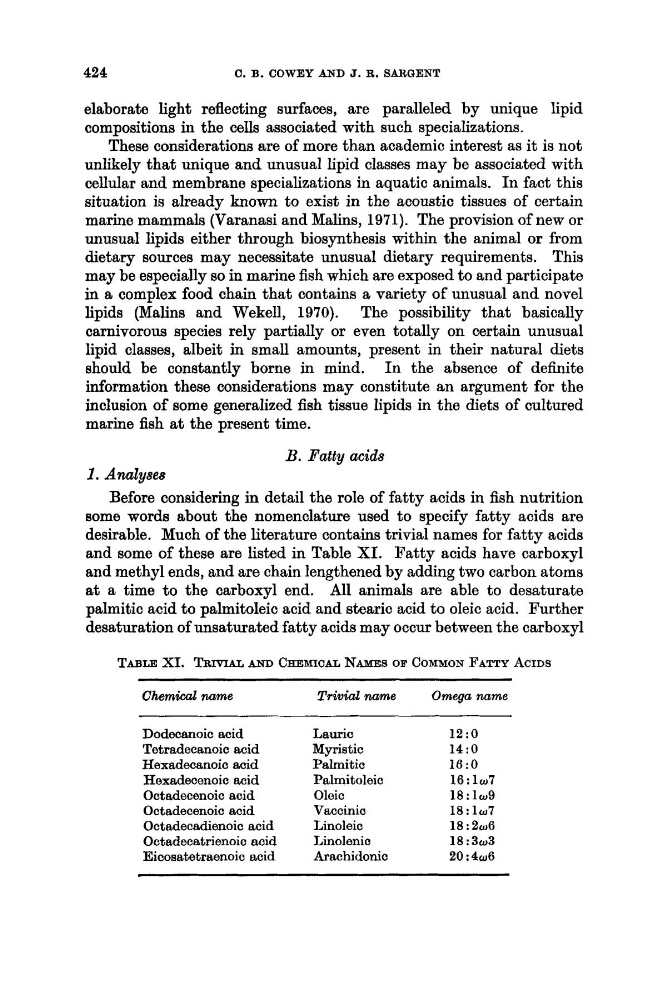
and some of these are listed in Table XI. Fatty acids have carboxyl
and methyl ends, and are chain lengthened by adding two carbon atoms
at a time to the carboxyl end. All animals are able to desaturate
palmitic acid to palmitoleic acid and stearic acid to oleic acid. Further
desaturation of unsaturated fatty acids may occur between the carboxyl
TABLE XI. TRIVIAL AND CHEMIOAL NAMES OB COMMON F A ~ Y
ACIDS
Chemical m r n e
Trivial m r n e
Omega name
Dodecanoic acid
Tetradecanoic acid
Hexadecanoic acid
Hexadecenoic acid
Octadecenoic acid
Octadecenoic acid
Octadecadienoic acid
Octadecatrienoic acid
Eicosatetraenoic acid
Lauric
Myristic
Palmitic
Palmitoleic
Oleic
Vaccinic
Linoleic
Linolenic
Arachidonic
12:o
14:O
16:O
16 : l w 7
18 : l w 9
1 8 : l w 7
18 : 2w6
18:3w3
20 : 4 w 6
0. B. COWEY AND J. R. SAROENT
elaborate light reflecting surfaces, are paralleled by unique lipid
compositions in the cells associated with such specializations.
These considerations are of more than academic interest as it is not
unlikely that unique and unusual lipid classes may be associated with
cellular and membrane specializations in aquatic animals. In fact this
situation is already known to exist in the acoustic tissues of certain
marine mammals (Varanasi and Malins, 1971). The provision of new or
unusual lipids either through biosynthesis within the animal or from
dietary sources may necessitate unusual dietary requirements. This
may be especially so in marine fkh which are exposed to and participate
in a complex food chain that contains a variety of unusual and novel
lipids (Malins and Wekell, 1970). The possibility that basically
carnivorous species rely partially or even totally on certain unusual
lipid classes, albeit in small amounts, present in their natural diets
should be constantly borne in mind. I n the absence of definite
information these considerations may constitute an argument for the
inclusion of some generalized fish tissue lipids in the diets of cultured
marine fish at the present time.
B. Putty acids
1. Analyses
Before considering in detail the role of fatty acids in fish nutrition
some words about the nomenclature used to specify fatty acids are
desirable. Much of the literature contains trivial names for fatty acids
and some of these are listed in Table XI. Fatty acids have carboxyl
and methyl ends, and are chain lengthened by adding two carbon atoms
at a time to the carboxyl end. All animals are able to desaturate
palmitic acid to palmitoleic acid and stearic acid to oleic acid. Further
desaturation of unsaturated fatty acids may occur between the carboxyl
TABLE XI. TRIVIAL AND CHEMIOAL NAMES OB COMMON F A ~ Y
ACIDS
Chemical m r n e
Trivial m r n e
Omega name
Dodecanoic acid
Tetradecanoic acid
Hexadecanoic acid
Hexadecenoic acid
Octadecenoic acid
Octadecenoic acid
Octadecadienoic acid
Octadecatrienoic acid
Eicosatetraenoic acid
Lauric
Myristic
Palmitic
Palmitoleic
Oleic
Vaccinic
Linoleic
Linolenic
Arachidonic
12:o
14:O
16:O
16 : l w 7
18 : l w 9
1 8 : l w 7
18 : 2w6
18:3w3
20 : 4 w 6