

FISH NUTRITION
389
(Litwack et al., 1952). We could not detect xanthine oxidase activity
in plaice livers, and our data applies, instead, to two important
enzymes concerned in the intermediary metabolism of proteins,
namely glutamate-pyruvate transaminase (GPT) and glutamateoxaloacetate transaminase (GOT). Again, there is an effect of dietary
protein level on the activity of these enzymes in plaice livers, but this
effect is much less marked than in rats. In rats GOT and GPT increase
in activity by factors of 2 and 10 respectively with dietary casein
increases from zero to 60% of the diet. When plaice were fed diets
containing different levels of another protein source, namely freeze
dried cod muscle (Table 11), the effects on liver enzyme levels were
similar to those obtained when casein diets were fed. These experiments provide evidence for a limited protein storage in fish.
The broad outlines of the dynamic anabolic-catabolic relationship
involved in protein metabolism are straightforward if attention is
directed to the most characteristic component, i.e. nitrogen. This
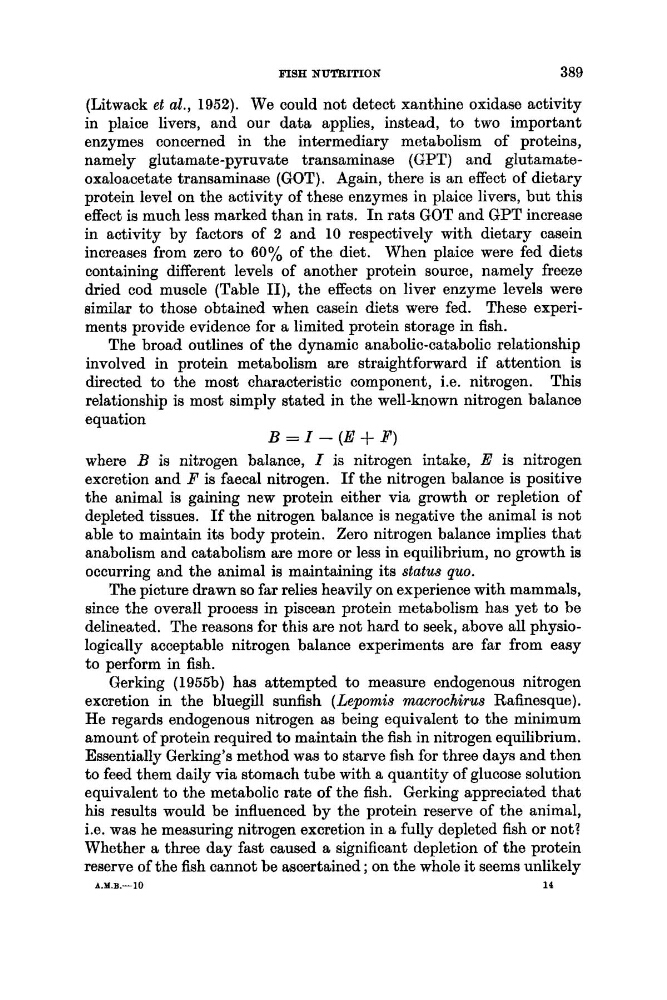
relationship is most simply stated in the well-known nitrogen balance
equation
where B is nitrogen balance, I is nitrogen intake, E is nitrogen
excretion and F is faecal nitrogen. If the nitrogen balance is positive
the animal is gaining new protein either via growth or repletion of
depleted tissues. If the nitrogen balance is negative the animal is not
able to maintain its body protein. Zero nitrogen balance implies that
anabolism and catabolism are more or less in equilibrium, no growth is
occurring and the animal is maintaining its status quo.
The picture drawn so far relies heavily on experience with mammals,
since the overall process in piscean protein metabolism has yet to be
delineated. The reasons for this are not hard to seek, above all physiologically acceptable nitrogen balance experiments are far from easy
to perform in fish.
Gerking (1955b) has attempted to measure endogenous nitrogen
excretion in the bluegill sunfish (Lepomis macrochirus Rafinesque).
He regards endogenous nitrogen as being equivalent to the minimum
amount of protein required to maintain the fish in nitrogen equilibrium.
Essentially Gerking’s method was to starve fish for three days and then
to feed them daily via stomach tube with a quantity of glucose solution
equivalent to the metabolic rate of the fish. Gerking appreciated that
his results would be influenced by the protein reserve of the animal,
i.e. was he measuring nitrogen excretion in a fully depleted fish or not?
Whether a three day fast caused a significant depletion of the protein
reserve of the fish cannot be ascertained ; on the whole it seems unlikely
B = I - ( E + F )
A.M.B.-~O
14
389
(Litwack et al., 1952). We could not detect xanthine oxidase activity
in plaice livers, and our data applies, instead, to two important
enzymes concerned in the intermediary metabolism of proteins,
namely glutamate-pyruvate transaminase (GPT) and glutamateoxaloacetate transaminase (GOT). Again, there is an effect of dietary
protein level on the activity of these enzymes in plaice livers, but this
effect is much less marked than in rats. In rats GOT and GPT increase
in activity by factors of 2 and 10 respectively with dietary casein
increases from zero to 60% of the diet. When plaice were fed diets
containing different levels of another protein source, namely freeze
dried cod muscle (Table 11), the effects on liver enzyme levels were
similar to those obtained when casein diets were fed. These experiments provide evidence for a limited protein storage in fish.
The broad outlines of the dynamic anabolic-catabolic relationship
involved in protein metabolism are straightforward if attention is
directed to the most characteristic component, i.e. nitrogen. This
relationship is most simply stated in the well-known nitrogen balance
equation
where B is nitrogen balance, I is nitrogen intake, E is nitrogen
excretion and F is faecal nitrogen. If the nitrogen balance is positive
the animal is gaining new protein either via growth or repletion of
depleted tissues. If the nitrogen balance is negative the animal is not
able to maintain its body protein. Zero nitrogen balance implies that
anabolism and catabolism are more or less in equilibrium, no growth is
occurring and the animal is maintaining its status quo.
The picture drawn so far relies heavily on experience with mammals,
since the overall process in piscean protein metabolism has yet to be
delineated. The reasons for this are not hard to seek, above all physiologically acceptable nitrogen balance experiments are far from easy
to perform in fish.
Gerking (1955b) has attempted to measure endogenous nitrogen
excretion in the bluegill sunfish (Lepomis macrochirus Rafinesque).
He regards endogenous nitrogen as being equivalent to the minimum
amount of protein required to maintain the fish in nitrogen equilibrium.
Essentially Gerking’s method was to starve fish for three days and then
to feed them daily via stomach tube with a quantity of glucose solution
equivalent to the metabolic rate of the fish. Gerking appreciated that
his results would be influenced by the protein reserve of the animal,
i.e. was he measuring nitrogen excretion in a fully depleted fish or not?
Whether a three day fast caused a significant depletion of the protein
reserve of the fish cannot be ascertained ; on the whole it seems unlikely
B = I - ( E + F )
A.M.B.-~O
14