

HABITAT SELECTION BY AQUATIC INVERTEBRATES
321
two fin dings particularly important since it is the first time that microorganisms from an animal’s naturaI environment have proved to be a
major determinant of habitat selection. The work should be extended
to the settlement of the larvae of benthic invertebrates.
Gray’s work emphasizes the importance of bacteria in the selection
of suitable sediments, but the microbial fauna of freshwater and marine
sand grains includes many other forms whose presence has not been
Bacteria
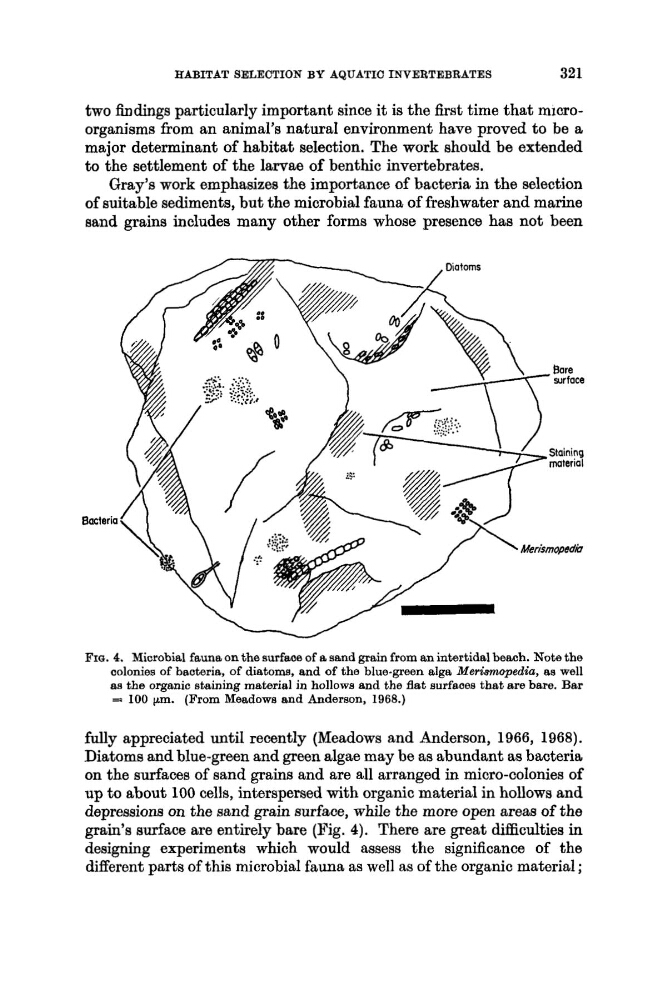
FIG. 4. Microbial fauna on the surfaoe of a sand grain from an intertidal beach. Note the
colonies of bacteria, of diatoms, and of the blue-green alga Merimopedia, as well
as the organic staining material in hollows and the flat surfaces that are bare. Bar
= 100 pm. (From Meadows end Anderson, 1968.)
fully appreciated until recently (Meadows and Anderson, 1966, 1968).
Diatoms and blue-green and green algae may be as abundant as bacteria
on the surfaces of sand grains and are all arranged in micro-colonies of
up to about 100 cells, interspersed with organic material in hollows and
depressions on the sand grain surface, while the more open areas of the
grain’s surface are entirely bare (Fig. 4). There are great difficulties in
designing experiments which would assess the significance of the
different parts of this microbial fauna as well as of the organic material ;
321
two fin dings particularly important since it is the first time that microorganisms from an animal’s naturaI environment have proved to be a
major determinant of habitat selection. The work should be extended
to the settlement of the larvae of benthic invertebrates.
Gray’s work emphasizes the importance of bacteria in the selection
of suitable sediments, but the microbial fauna of freshwater and marine
sand grains includes many other forms whose presence has not been
Bacteria
FIG. 4. Microbial fauna on the surfaoe of a sand grain from an intertidal beach. Note the
colonies of bacteria, of diatoms, and of the blue-green alga Merimopedia, as well
as the organic staining material in hollows and the flat surfaces that are bare. Bar
= 100 pm. (From Meadows end Anderson, 1968.)
fully appreciated until recently (Meadows and Anderson, 1966, 1968).
Diatoms and blue-green and green algae may be as abundant as bacteria
on the surfaces of sand grains and are all arranged in micro-colonies of
up to about 100 cells, interspersed with organic material in hollows and
depressions on the sand grain surface, while the more open areas of the
grain’s surface are entirely bare (Fig. 4). There are great difficulties in
designing experiments which would assess the significance of the
different parts of this microbial fauna as well as of the organic material ;