

320
P. 9. MEADOWS AND J. I. UAMPBELL
by soaking in natural sea water (Wilson, 1954, 1955) or fresh water
(Marzolf, 19661, or in sea water that has previously been in contact with
a suitable sediment (Wilson, 1953b ; Scheltema, 1961), although the
method is not always successful (Meadows, 1964a) and does not distinguish between non-living organic material and living micro-organisms.
It is clear from other experiments that micro-organisms are largely
responsible for the attractiveness of natural sediments. Flagellates
(but not ciliates) render sands more suitable for the settlement of the
polychaete Ophelia bicornis Savigny (Wilson, 1954), while irradiation
of sediments with ultraviolet light, which would kill micro-organisms,
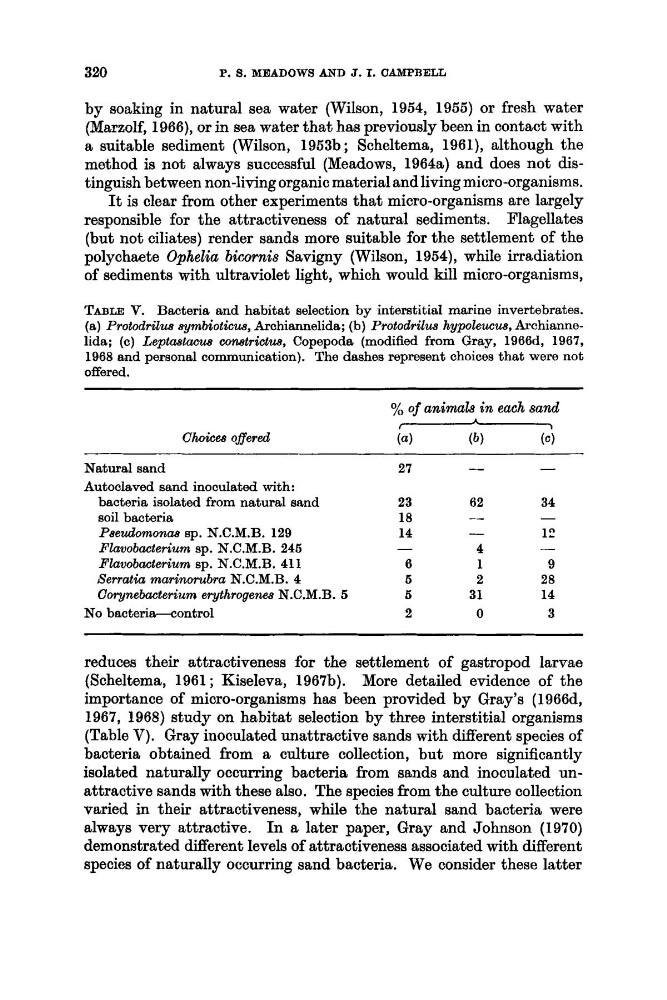
TABLE V. Bacteria and habitat selection by interstitial marine invertebrates.
(a) Protodrilus qmbioticus, Archiannelida; (b) Protodrilw hypoleucw, Arohiannelida; (c) Leptastucw comtrictw, Copepoda (modified from Gray, 1966d, 1967,
1968 and personal communication). The dashes represent choices that were not
offered.
Choices offeved
Natural sand
Autoclaved sand inoculated with:
bacteria isolated from natural sand
soil bacteria
Paeudomonm sp. N.C.M.B. 129
Flavobacterium sp. N.C.M.B. 246
Flavobacterium sp. N.C.M.B. 411
Serratia marinombra N.C.M.B. 4
Corynebacterium erythrogenes N.C.M.B. 5
No bacteriwontrol
27
23
18
14
6
6
6
2
-
62
-
-
4
1
2
31
0
34
1?
9
28
14
3
-
-
reduces their attractiveness for the settlement of gastropod larvae
(Scheltema, 1961 ; Kiseleva, 1967b). More detailed evidence of the
importance of micro-organisms has been provided by Gray’s (1966d,
1967, 1968) study on habitat selection by three interstitial organisms
(Table V). Gray inoculated unattractive sands with different species of
bacteria obtained from a culture collection, but more significantly
isolated naturally occurring bacteria from sands and inoculated unattractive sands with these also. The species from the culture collection
varied in their attractiveness, while the natural sand bacteria were
always very attractive. I n a later paper, Gray and Johnson (1970)
demonstrated different levels of attractiveness associated with different
species of naturally occurring sand bacteria. We consider these latter
P. 9. MEADOWS AND J. I. UAMPBELL
by soaking in natural sea water (Wilson, 1954, 1955) or fresh water
(Marzolf, 19661, or in sea water that has previously been in contact with
a suitable sediment (Wilson, 1953b ; Scheltema, 1961), although the
method is not always successful (Meadows, 1964a) and does not distinguish between non-living organic material and living micro-organisms.
It is clear from other experiments that micro-organisms are largely
responsible for the attractiveness of natural sediments. Flagellates
(but not ciliates) render sands more suitable for the settlement of the
polychaete Ophelia bicornis Savigny (Wilson, 1954), while irradiation
of sediments with ultraviolet light, which would kill micro-organisms,
TABLE V. Bacteria and habitat selection by interstitial marine invertebrates.
(a) Protodrilus qmbioticus, Archiannelida; (b) Protodrilw hypoleucw, Arohiannelida; (c) Leptastucw comtrictw, Copepoda (modified from Gray, 1966d, 1967,
1968 and personal communication). The dashes represent choices that were not
offered.
Choices offeved
Natural sand
Autoclaved sand inoculated with:
bacteria isolated from natural sand
soil bacteria
Paeudomonm sp. N.C.M.B. 129
Flavobacterium sp. N.C.M.B. 246
Flavobacterium sp. N.C.M.B. 411
Serratia marinombra N.C.M.B. 4
Corynebacterium erythrogenes N.C.M.B. 5
No bacteriwontrol
27
23
18
14
6
6
6
2
-
62
-
-
4
1
2
31
0
34
1?
9
28
14
3
-
-
reduces their attractiveness for the settlement of gastropod larvae
(Scheltema, 1961 ; Kiseleva, 1967b). More detailed evidence of the
importance of micro-organisms has been provided by Gray’s (1966d,
1967, 1968) study on habitat selection by three interstitial organisms
(Table V). Gray inoculated unattractive sands with different species of
bacteria obtained from a culture collection, but more significantly
isolated naturally occurring bacteria from sands and inoculated unattractive sands with these also. The species from the culture collection
varied in their attractiveness, while the natural sand bacteria were
always very attractive. I n a later paper, Gray and Johnson (1970)
demonstrated different levels of attractiveness associated with different
species of naturally occurring sand bacteria. We consider these latter