

ASPECITS OF STRESS IN THE TROPICAL MARINE ENVIRONMENT
251
necessarily those in which spawning actually took place. It is hoped
that errors from this last cause do not seriousIy affect general trends.
Although many species phagocytize unspawned genital products,
there must be energy loss in the process, and it would seem economical
to synchronize ripening and spawning as far as possible. The triggering
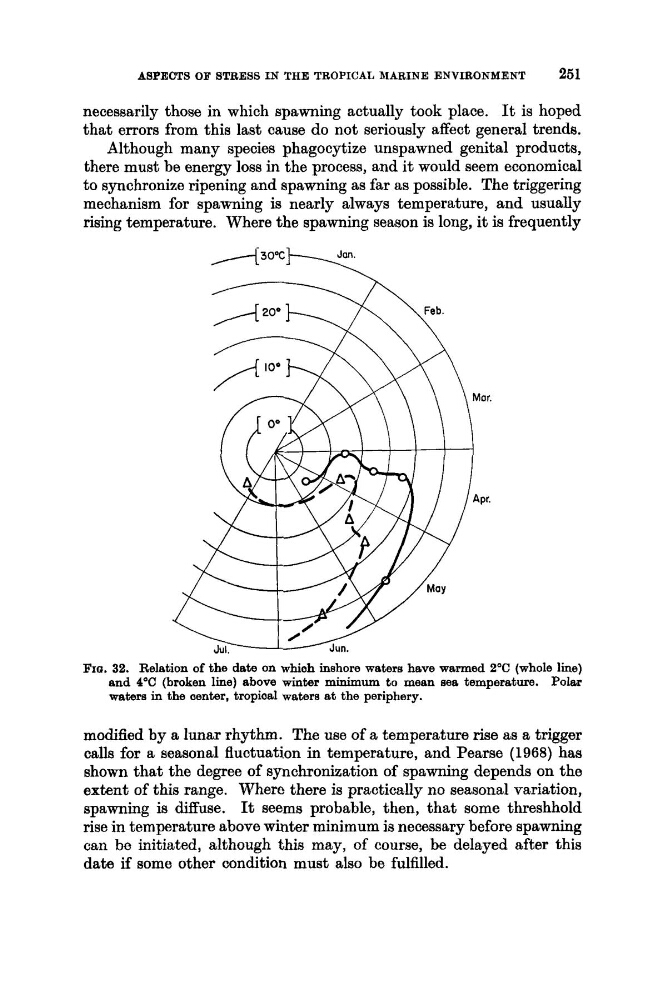
mechanism for spawning is nearly always temperature, and usually
rising temperature. Where the spawning season is long, it is frequently
FIG. 32. Relation of the d ~ t e
on whioh inshore waters have warmed 2°C (whole line)
and 4OC (broken line) above winter minimum to mean sea temperature. Polar
waters in the oenter, tropioal waters at the periphery.
modified by a lunar rhythm. The use of a temperature rise as a trigger
calls for a seasonal fluctuation in temperature, and Pearse (1968) has
shown that the degree of synchronization of spawning depends on the
extent of this range. Where there is practically no seasonal variation,
spawning is diffuse. It seems probable, then, that some threshhold
rise in temperature above winter minimum is necessary before spawning
can be initiated, although this may, of course, be delayed after this
date if some other condition must also be fulfilled.
251
necessarily those in which spawning actually took place. It is hoped
that errors from this last cause do not seriousIy affect general trends.
Although many species phagocytize unspawned genital products,
there must be energy loss in the process, and it would seem economical
to synchronize ripening and spawning as far as possible. The triggering
mechanism for spawning is nearly always temperature, and usually
rising temperature. Where the spawning season is long, it is frequently
FIG. 32. Relation of the d ~ t e
on whioh inshore waters have warmed 2°C (whole line)
and 4OC (broken line) above winter minimum to mean sea temperature. Polar
waters in the oenter, tropioal waters at the periphery.
modified by a lunar rhythm. The use of a temperature rise as a trigger
calls for a seasonal fluctuation in temperature, and Pearse (1968) has
shown that the degree of synchronization of spawning depends on the
extent of this range. Where there is practically no seasonal variation,
spawning is diffuse. It seems probable, then, that some threshhold
rise in temperature above winter minimum is necessary before spawning
can be initiated, although this may, of course, be delayed after this
date if some other condition must also be fulfilled.