

246
HILARY B. MOORE
I40 -
120 -
100 -
80 -
60 -
$
:
& 40-I
20 -
0
0
0
0
0
s o :
0
0
0
0
0
0
O
o m
0
0
0
o o
0
0
0
0
Temperature-eC
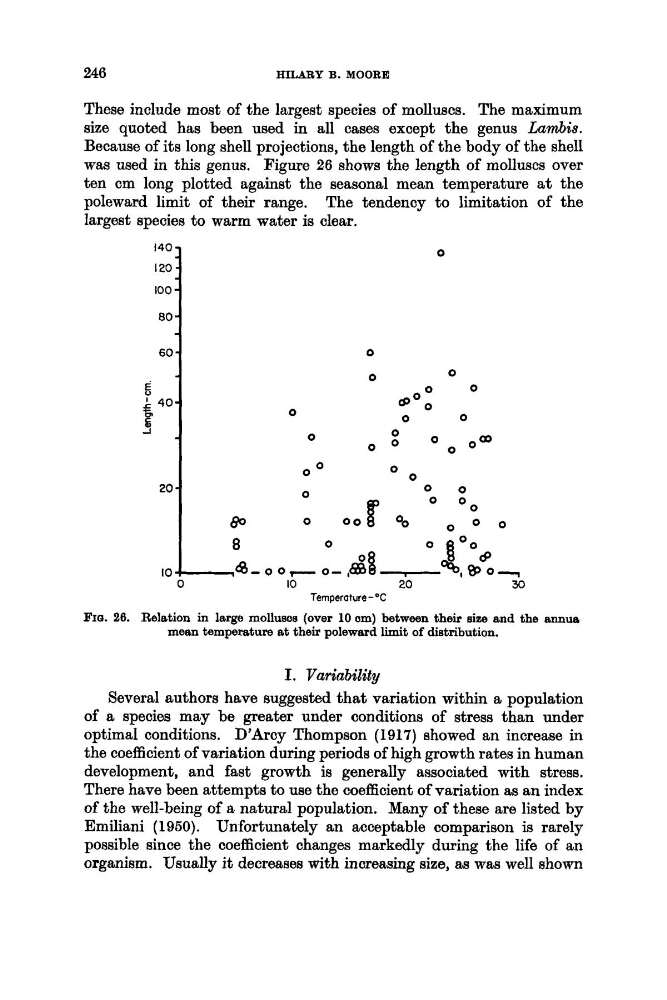
FIQ. 28. Relation in large mollusoe (over 10 om) between their size and the annua
mean temperature at their poleward limit of distribution.
I. Variability
Several authors have suggested that variation within a population
of a species may be greater under conditions of stress than under
optimal conditions. D'Arcy Thompson (1917) showed an increase in
the coefficient of variation during periods of high growth rates in human
development, and fast growth is generally associated with stress.
There have been attempts to use the coefficient of variation as an index
of the well-being of a natural population. Many of these are listed by
Emiliani (1950). Unfortunately an acceptable comparison is rarely
possible since the coefficient changes markedly during the life of an
organism. Usually it decreases with increasing size, as was well shown
These include most of the largest species of molluscs. The maximum
size quoted has been used in all cases except the genus Lambis.
Because of its long shell projections, the length of the body of the shell
was used in this genus. Figure 26 shows the length of molluscs over
ten cm long plotted against the seasonal mean temperature a t the
poleward limit of their range. The tendency to limitation of the
largest species to warm water is clear.
HILARY B. MOORE
I40 -
120 -
100 -
80 -
60 -
$
:
& 40-I
20 -
0
0
0
0
0
s o :
0
0
0
0
0
0
O
o m
0
0
0
o o
0
0
0
0
Temperature-eC
FIQ. 28. Relation in large mollusoe (over 10 om) between their size and the annua
mean temperature at their poleward limit of distribution.
I. Variability
Several authors have suggested that variation within a population
of a species may be greater under conditions of stress than under
optimal conditions. D'Arcy Thompson (1917) showed an increase in
the coefficient of variation during periods of high growth rates in human
development, and fast growth is generally associated with stress.
There have been attempts to use the coefficient of variation as an index
of the well-being of a natural population. Many of these are listed by
Emiliani (1950). Unfortunately an acceptable comparison is rarely
possible since the coefficient changes markedly during the life of an
organism. Usually it decreases with increasing size, as was well shown
These include most of the largest species of molluscs. The maximum
size quoted has been used in all cases except the genus Lambis.
Because of its long shell projections, the length of the body of the shell
was used in this genus. Figure 26 shows the length of molluscs over
ten cm long plotted against the seasonal mean temperature a t the
poleward limit of their range. The tendency to limitation of the
largest species to warm water is clear.