

ASPEUTS OF STRESS IN THE TROPICAL MARINE ENVIRONMENT
243
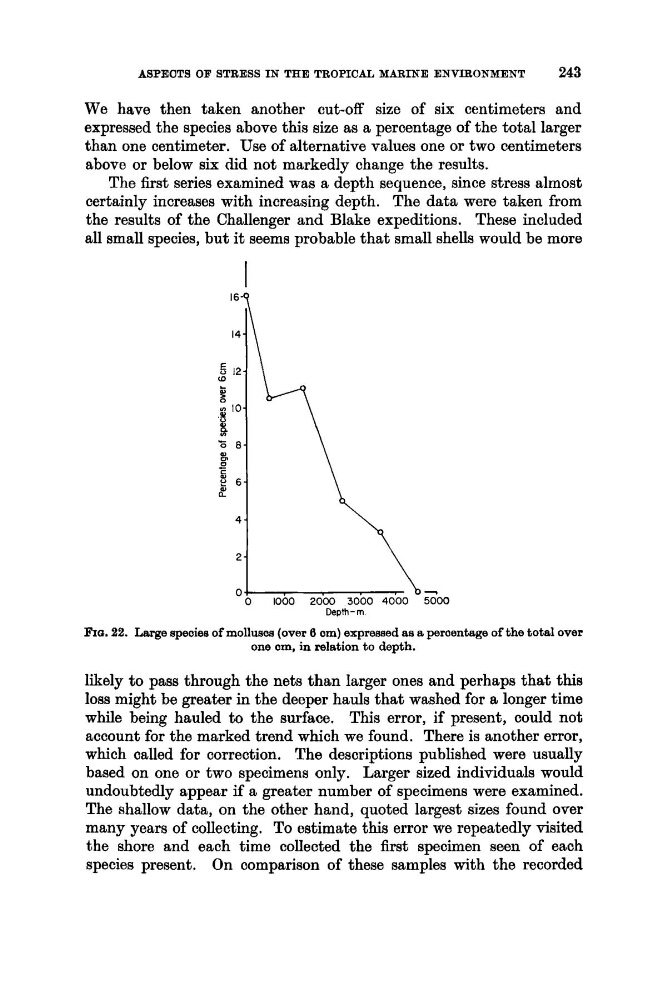
We have then taken another cut-off size of six centimeters and
expressed the species above this size as a percentage of the total larger
than one centimeter. Use of alternative values one or two centimeters
above or below six did not markedly change the results.
The fist series examined was a depth sequence, since stress almost
certainly increases with increasing depth. The data were taken from
the results of the Challenger and Blake expeditions. These included
all small species, but it seems probable that small shells would be more
-
5000
FIG. 22. Large speoies of mollusos (over 6 om) expressed as a peroentage of the total over
one om, i n relation to depth.
likely to pass through the nets than larger ones and perhaps that this
loss might be greater in the deeper hauls that washed for a longer time
while being hauled to the surface. This error, if present, could not
account for the marked trend which we found. There is another error,
which called for correction. The descriptions published were usually
based on one or two specimens only. Larger sized individuals would
undoubtedly appear if a greater number of specimens were examined.
The shallow data, on the other hand, quoted largest sizes found over
many years of collecting. To estimate this error we repeatedly visited
the shore and each time collected the first specimen seen of each
species present. On comparison of these samples with the recorded
243
We have then taken another cut-off size of six centimeters and
expressed the species above this size as a percentage of the total larger
than one centimeter. Use of alternative values one or two centimeters
above or below six did not markedly change the results.
The fist series examined was a depth sequence, since stress almost
certainly increases with increasing depth. The data were taken from
the results of the Challenger and Blake expeditions. These included
all small species, but it seems probable that small shells would be more
-
5000
FIG. 22. Large speoies of mollusos (over 6 om) expressed as a peroentage of the total over
one om, i n relation to depth.
likely to pass through the nets than larger ones and perhaps that this
loss might be greater in the deeper hauls that washed for a longer time
while being hauled to the surface. This error, if present, could not
account for the marked trend which we found. There is another error,
which called for correction. The descriptions published were usually
based on one or two specimens only. Larger sized individuals would
undoubtedly appear if a greater number of specimens were examined.
The shallow data, on the other hand, quoted largest sizes found over
many years of collecting. To estimate this error we repeatedly visited
the shore and each time collected the first specimen seen of each
species present. On comparison of these samples with the recorded