

ASPEUTS OB STRESS IN THE TROPIUAL MARINE ENVIRONMENT
239
the seasonal temperature, we have done so, giving the values as
percentages of the maximum growth rate. For temperate waters we
have included fish, barnacles, gastropods and bivalves. For tropical
waters, where data are scarcer, we have included urchins, gastropods and
bivalves. In the temperate species (Fig. 17) there is sometimes no growth
at the lowest temperatures. For most of the seasonal range growth
increases steadily, but in a few species it becomes constant or even drops
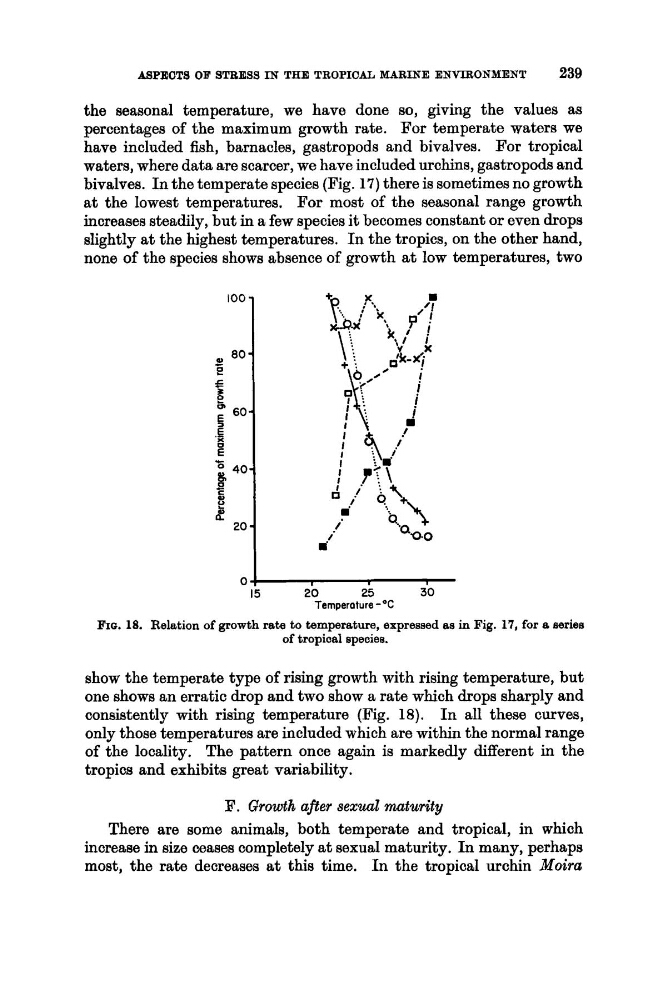
slightly at the highest temperatures. In the tropics, on the other hand,
none of the species shows absence of growth at low temperatures, two
0
1
15
20
25
30
FIG. 18. Reletion of growth rate to temperature, expressed 8s i n Fig. 17, for e series
Temperature - O C
of tropioel speoiea.
show the temperate type of rising growth with rising temperature, but
one shows an erratic drop and two show a rate which drops sharply and
consistently with rising temperature (Fig. 18). I n all these curves,
only those temperatures are included which are within the normal range
of the locality. The pattern once again is markedly different in the
tropics and exhibits great variability.
F. Growth after sexual maturity
There are some animals, both temperate and tropical, in which
increase in size ceases completely at sexual maturity. I n many, perhaps
most, the rate decreases at this time. In the tropical urchin Moira
239
the seasonal temperature, we have done so, giving the values as
percentages of the maximum growth rate. For temperate waters we
have included fish, barnacles, gastropods and bivalves. For tropical
waters, where data are scarcer, we have included urchins, gastropods and
bivalves. In the temperate species (Fig. 17) there is sometimes no growth
at the lowest temperatures. For most of the seasonal range growth
increases steadily, but in a few species it becomes constant or even drops
slightly at the highest temperatures. In the tropics, on the other hand,
none of the species shows absence of growth at low temperatures, two
0
1
15
20
25
30
FIG. 18. Reletion of growth rate to temperature, expressed 8s i n Fig. 17, for e series
Temperature - O C
of tropioel speoiea.
show the temperate type of rising growth with rising temperature, but
one shows an erratic drop and two show a rate which drops sharply and
consistently with rising temperature (Fig. 18). I n all these curves,
only those temperatures are included which are within the normal range
of the locality. The pattern once again is markedly different in the
tropics and exhibits great variability.
F. Growth after sexual maturity
There are some animals, both temperate and tropical, in which
increase in size ceases completely at sexual maturity. I n many, perhaps
most, the rate decreases at this time. In the tropical urchin Moira