

238
IIILARY B. MOORE
to answer a question with regard to the possible influence of food type
on growth rate. Phytoplankton production is highly seasonal in
temperate seas, but rather uniform throughout the year in the tropics.
The zooplankton tends to differ in the same way. The bivalves are
generally filter feeders, or deposit feeders, and so suffer a seasonal
drop in food supply in temperate seas. The barnacles also are largely
influenced by seasonal fluctuation in their food supply. The gastropods,
on the other hand, are mainly grazers or carnivores and so have a more
constant food supply ; urchins generally live among an overabundance
of food. The growth rakes in temperate waters show no significant
difference between filter feeders and other types. It would appear that
availability of food is not of great significance in determining growth
rates once communities have established a proper balance between
population and food supply. If this is so then the higher growth rates
observed in the tropics are not to be accounted for by the fact that food
supply is more continuous than it is in temperate waters.
E. Seasonal growth pattern
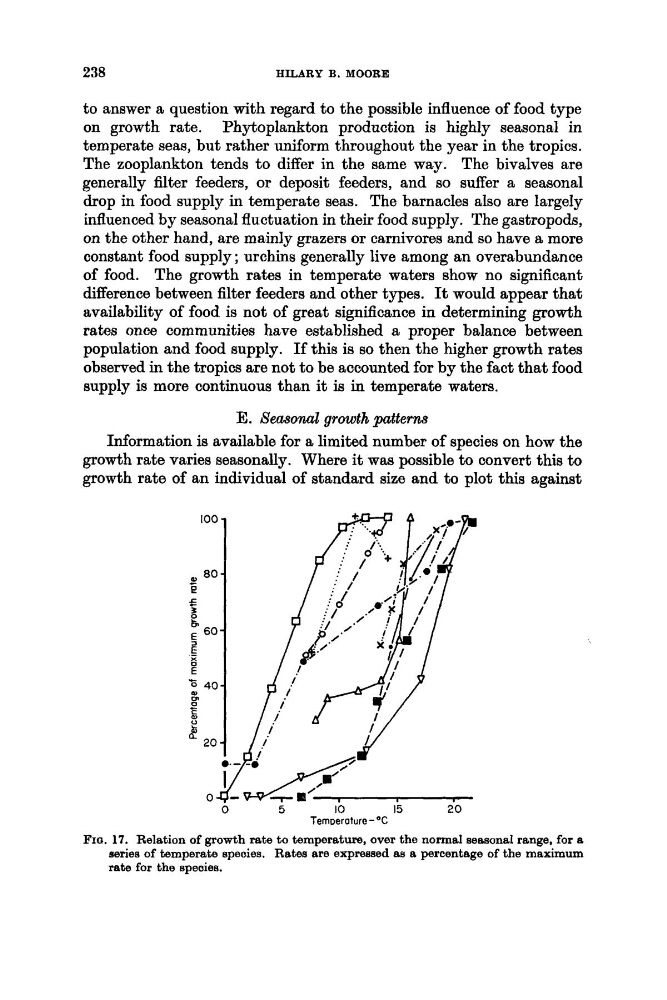
Information is available for a limited number of species on how the
growth rate varies seasonally. Where it was possible to convert this to
growth rate of an individual of standard size and to plot this against
FIQ. 17. Relation of growth rate to temperature, over the normal seasonal range, for a
series of temperate species. Rates are expressed as a percentage of the maximum
rate for the species.
IIILARY B. MOORE
to answer a question with regard to the possible influence of food type
on growth rate. Phytoplankton production is highly seasonal in
temperate seas, but rather uniform throughout the year in the tropics.
The zooplankton tends to differ in the same way. The bivalves are
generally filter feeders, or deposit feeders, and so suffer a seasonal
drop in food supply in temperate seas. The barnacles also are largely
influenced by seasonal fluctuation in their food supply. The gastropods,
on the other hand, are mainly grazers or carnivores and so have a more
constant food supply ; urchins generally live among an overabundance
of food. The growth rakes in temperate waters show no significant
difference between filter feeders and other types. It would appear that
availability of food is not of great significance in determining growth
rates once communities have established a proper balance between
population and food supply. If this is so then the higher growth rates
observed in the tropics are not to be accounted for by the fact that food
supply is more continuous than it is in temperate waters.
E. Seasonal growth pattern
Information is available for a limited number of species on how the
growth rate varies seasonally. Where it was possible to convert this to
growth rate of an individual of standard size and to plot this against
FIQ. 17. Relation of growth rate to temperature, over the normal seasonal range, for a
series of temperate species. Rates are expressed as a percentage of the maximum
rate for the species.