

THE BIOLOGY OF ASCIDIANS
53
the ascidian reacts when the Pontonia enters its siphon, which would
normally close on being stimulated. But if the ascidian accepts its
guest, what is the advantage to the host? It is striking to see, as I have,
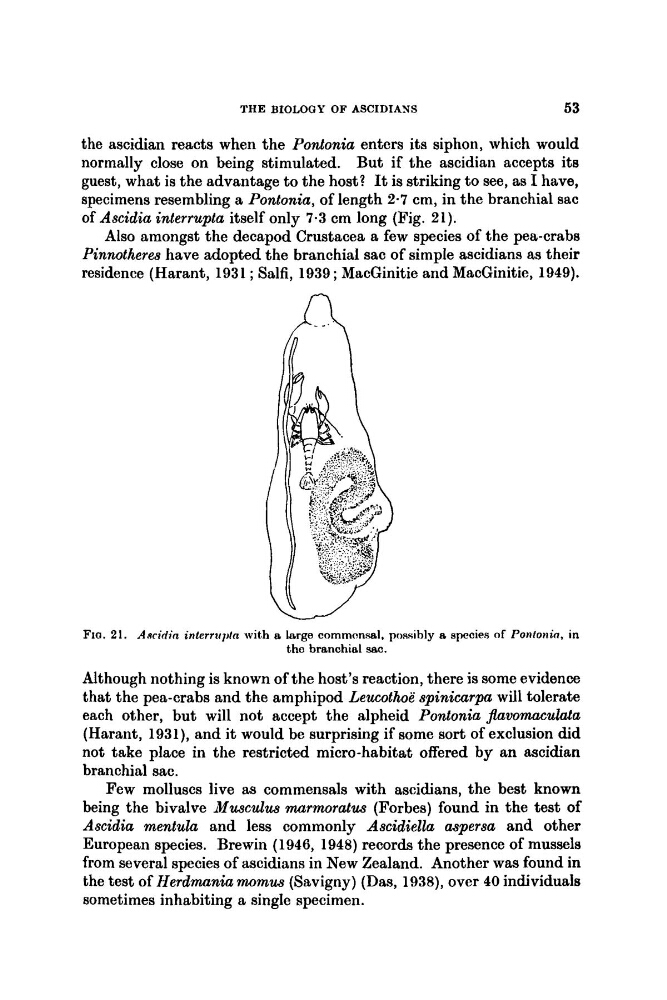
specimens resembling a Pontonia, of length 2-7 cm, in the branchial sac
of Ascidia interrupta itself only 7.3 cm long (Fig. 21).
Also amongst the decapod Crustacea a few species of the pea-crabs
Pinnotheres have adopted the branchial sac of simple ascidians as their
residence (Harant, 1931 ; Salfi, 1939 ; MacGinitie and MacGinitie, 1949).
Fia. 21. Aaridin interrupfrc with a large commonsel. possibly a species of Z'onfonin, in
tho branchial sac.
Although nothing is known of the host's reaction, there is some evidence
that the pea-crabs and the amphipod Leucothoe spinicarpa will tolerate
each other, but will not accept the alpheid Pontonia flavomaculata
(Harant, 1931), and it would be surprising if some sort of exclusion did
not take place in the restricted micro-habitat offered by an ascidian
branchial sac.
Few molluscs live as commensals with ascidians, the best known
being the bivalve Musculus marmoratus (Forbes) found in the test of
Ascidia mentula and less commonly Ascidiella aspersa and other
European species. Brewin (1946, 1948) records the presence of mussels
from several species of ascidians in New Zealand. Another was found in
the test of Herdmania momus (Savigny) (Das, 1938), over 40 individuals
sometimes inhabiting a single specimen.
53
the ascidian reacts when the Pontonia enters its siphon, which would
normally close on being stimulated. But if the ascidian accepts its
guest, what is the advantage to the host? It is striking to see, as I have,
specimens resembling a Pontonia, of length 2-7 cm, in the branchial sac
of Ascidia interrupta itself only 7.3 cm long (Fig. 21).
Also amongst the decapod Crustacea a few species of the pea-crabs
Pinnotheres have adopted the branchial sac of simple ascidians as their
residence (Harant, 1931 ; Salfi, 1939 ; MacGinitie and MacGinitie, 1949).
Fia. 21. Aaridin interrupfrc with a large commonsel. possibly a species of Z'onfonin, in
tho branchial sac.
Although nothing is known of the host's reaction, there is some evidence
that the pea-crabs and the amphipod Leucothoe spinicarpa will tolerate
each other, but will not accept the alpheid Pontonia flavomaculata
(Harant, 1931), and it would be surprising if some sort of exclusion did
not take place in the restricted micro-habitat offered by an ascidian
branchial sac.
Few molluscs live as commensals with ascidians, the best known
being the bivalve Musculus marmoratus (Forbes) found in the test of
Ascidia mentula and less commonly Ascidiella aspersa and other
European species. Brewin (1946, 1948) records the presence of mussels
from several species of ascidians in New Zealand. Another was found in
the test of Herdmania momus (Savigny) (Das, 1938), over 40 individuals
sometimes inhabiting a single specimen.