

52
R. H. MILLAR
Lichomolgidae, Archinotodelphyidae, Ascidicolidae and Enterocolidae.
In these, certain specics occur in several ascidians, but others appear to
be much more host-specific (C. Monniot, 1961, 19658). C. Monniot
(1961) has also found that some of the copepod species characteristically
occupy particular parts of the branchid sac and that there appears to
be no antagonism between species occupying the same host. What
factors determine the incidence of commensalism or parasitism, and
whether there is any chemical attraction leading to infection are unanswered questions.
.
.
At.
‘Pb
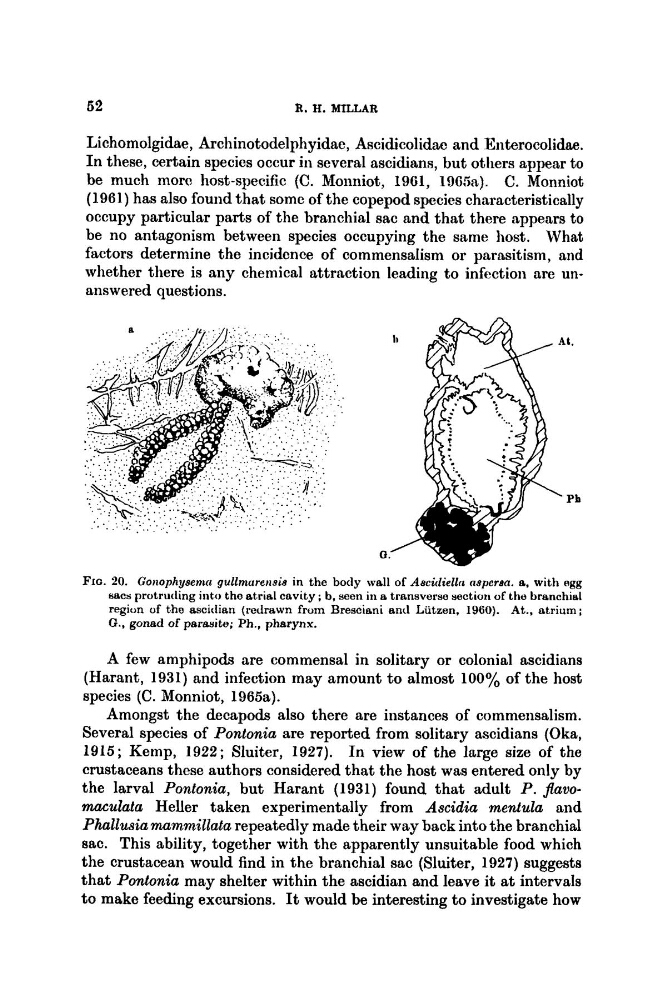
FIQ. 20. Gonophyaema gullmarensia in the body wall of Aacidielln nsperaa. 8. with egg
sacs protruding int.o tho atrial cavity ; b, soen in a transverse section of the branchid
region of tho ascitlian (redrawn from Bresciani and Liitzen, 1960). At., atrium;
G., gonad of parsuite; Ph., pharynx.
A few amphipods are commensal in solitary or colonial ascidians
(Harant, 1931) and infection may amount to almost 100% of the host
species (C. Monniot, 1965a).
Amongst the decapods also there are instances of commensalism.
Several species of Pontonia are reported from solitary ascidians (Oka,
1915; Kemp, 1922; Sluiter, 1927). In view of the large size of the
crustaceans these authors considered that the host was entered only by
the larval Pontonia, but Harant (1931) found that adult P . $avomaculata Heller taken experimentally from Ascidia mentula and
Phallusia mammillata repeatedly made their way back into the branchial
sac. This ability, together with the apparently unsuitable food which
the crustacean would find in the branchid sac (Sluiter, 1927) suggests
that Pontonia may shelter within the ascidian and leave it at intervals
to make feeding excursions. It would be interesting to investigate how
R. H. MILLAR
Lichomolgidae, Archinotodelphyidae, Ascidicolidae and Enterocolidae.
In these, certain specics occur in several ascidians, but others appear to
be much more host-specific (C. Monniot, 1961, 19658). C. Monniot
(1961) has also found that some of the copepod species characteristically
occupy particular parts of the branchid sac and that there appears to
be no antagonism between species occupying the same host. What
factors determine the incidence of commensalism or parasitism, and
whether there is any chemical attraction leading to infection are unanswered questions.
.
.
At.
‘Pb
FIQ. 20. Gonophyaema gullmarensia in the body wall of Aacidielln nsperaa. 8. with egg
sacs protruding int.o tho atrial cavity ; b, soen in a transverse section of the branchid
region of tho ascitlian (redrawn from Bresciani and Liitzen, 1960). At., atrium;
G., gonad of parsuite; Ph., pharynx.
A few amphipods are commensal in solitary or colonial ascidians
(Harant, 1931) and infection may amount to almost 100% of the host
species (C. Monniot, 1965a).
Amongst the decapods also there are instances of commensalism.
Several species of Pontonia are reported from solitary ascidians (Oka,
1915; Kemp, 1922; Sluiter, 1927). In view of the large size of the
crustaceans these authors considered that the host was entered only by
the larval Pontonia, but Harant (1931) found that adult P . $avomaculata Heller taken experimentally from Ascidia mentula and
Phallusia mammillata repeatedly made their way back into the branchial
sac. This ability, together with the apparently unsuitable food which
the crustacean would find in the branchid sac (Sluiter, 1927) suggests
that Pontonia may shelter within the ascidian and leave it at intervals
to make feeding excursions. It would be interesting to investigate how