

THE BIOLOGY OF ASCIDIANS
41
Microcosmus effectively constitutes an extension of the rocky shore
habitat on to the area of loose sediments and supports a rocky shore
fauna. In contrast Halocynthiapapillosa L., another large free-standing
ascidian, is devoid of epibiotic forms, possibly owing to its densely
papillated test (Costa, 1960). Loose deposits may be sufficiently varied
to provide a number of distinct micro-habitats within a single area and
accommodate species of diverse requirements, as in the Bay of Marseilles, where the three large ascidians Halocynthia papillosa, Microc o s m ~ sulcutus and Polycarpa pomaria (Savigny ) have different relationships with the substratum, as indicated in Fig. 17 (Costa, 1960).
In a detailed study of the fauna of coralline substrata off Banyuls
Laubier (1966) listed the microhabitats of 21 species of ascidian. Only
three were photophilic and ten preferred shade ; four lived as epibionts
on other organisms-chiefly
Bryozoa, hydroids and gorgonianswhereas eleven were attached directly to the hard substratum ; and a
variety of preferences was shown for the upper, lateral or lower surfaces
of objects. It is evident that, even with the small number of environmental factors considered, most species had a definable microhabitat.
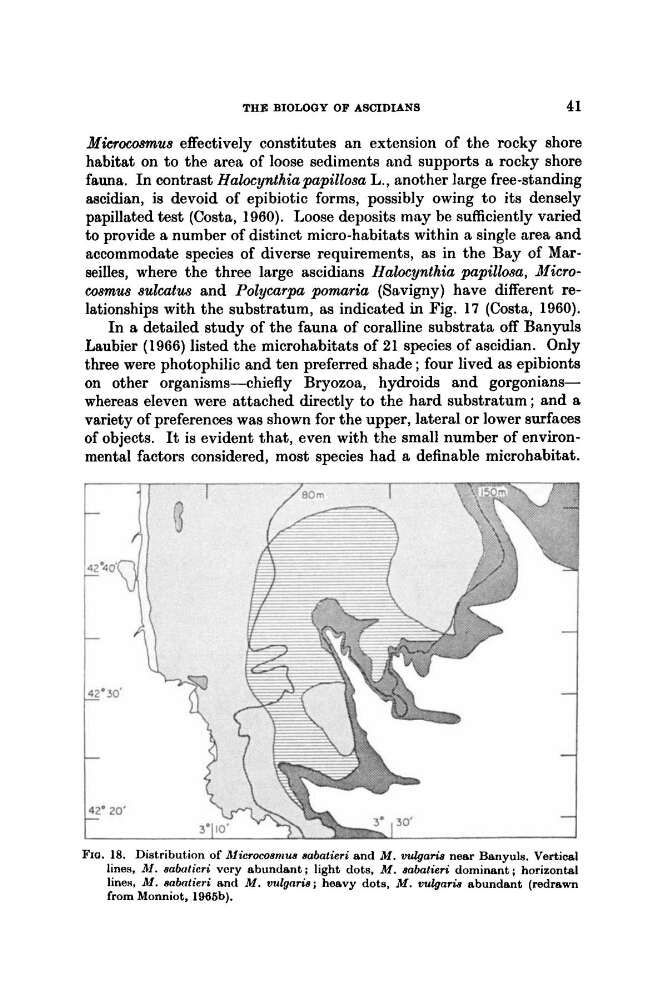
FIQ. 18. Distribution of Microcoanzw, aabatieri and M . v d g a r k near Banyuls. Vertical
lines, 11.1. sabatieri very abundant ; light dots, M . eabatieri dominant ; horizontal
lines, M . eabatieri and M . vulgarie; heavy dots, M . vulgarie abundant (redrawn
from Monniot. 1965b).
41
Microcosmus effectively constitutes an extension of the rocky shore
habitat on to the area of loose sediments and supports a rocky shore
fauna. In contrast Halocynthiapapillosa L., another large free-standing
ascidian, is devoid of epibiotic forms, possibly owing to its densely
papillated test (Costa, 1960). Loose deposits may be sufficiently varied
to provide a number of distinct micro-habitats within a single area and
accommodate species of diverse requirements, as in the Bay of Marseilles, where the three large ascidians Halocynthia papillosa, Microc o s m ~ sulcutus and Polycarpa pomaria (Savigny ) have different relationships with the substratum, as indicated in Fig. 17 (Costa, 1960).
In a detailed study of the fauna of coralline substrata off Banyuls
Laubier (1966) listed the microhabitats of 21 species of ascidian. Only
three were photophilic and ten preferred shade ; four lived as epibionts
on other organisms-chiefly
Bryozoa, hydroids and gorgonianswhereas eleven were attached directly to the hard substratum ; and a
variety of preferences was shown for the upper, lateral or lower surfaces
of objects. It is evident that, even with the small number of environmental factors considered, most species had a definable microhabitat.
FIQ. 18. Distribution of Microcoanzw, aabatieri and M . v d g a r k near Banyuls. Vertical
lines, 11.1. sabatieri very abundant ; light dots, M . eabatieri dominant ; horizontal
lines, M . eabatieri and M . vulgarie; heavy dots, M . vulgarie abundant (redrawn
from Monniot. 1965b).