

40
R. H. MlLLAR
the way in which the coarseness of the deposit affects the occurrence of
species (Millar, 1960).
Substrata which are classed as loose sediments may nonetheless have
sufficient hard surfaces to support a population of species not adapted
for living directly on sand or mud, as in the case of Ascidiella scubra
(Muller) (Dybern, 1969b). Often such species make use of the shells of
living molluscs, or the surface of benthic animals including other
ascidians. In this way, for instance, Styela coriacea maintains a population in deep muddy areas of the Firth of Clyde, by growing on the
upper valves of the mollusc Chlamys septemradiata (Miiller), 42% of
which may carry the ascidian, to the number of 2-5 on each Chlamys
(Allen, 1953). In the Baltic Sea the same species occurs on the shells of
Astarte borealis, some 20% of which have at least one specimen (Dybern,
1969~). And Molgula manhattensis has been found attached to the
siphons or shell of 23.5% of specimens of the bivalve Mya arenaria
L. cast up on a beach in New Jersey, U.S.A. (Aldrich, 1955). The
mesogastropod Trichotropis cancellata Hinds lives on unstable shelly
substrata and its hairy surface provides attachment for at least three
species of simple ascidian (Yonge, 1962). Appearances can sometimes
be deceptive, when species normally confined to solid substrat.es
are present on mud. Bouchet (1962) found Ciona and Ascidia mentula
living on a soft muddy bottom and only on close examination realized
that the animals were in fact attached to the roots of Zostera embedded
in the bottom. Ascidians with a hard test themselves serve for the
attachment of other ascidians, and 21 species have been found as
epibionts on the test of Microcosmus sabatieri Roule on fishing
grounds off Banyuls-sur-Mer, France (C. Monniot, 1965b). This
large ascidian plays an important part in the ecology of the area,
since together with its attached organisms numbering some 200 species
it builds up large living complexes known as " blocs B Microcosmus ",
which greatly influence the local productivity of the sea-bcd Thus
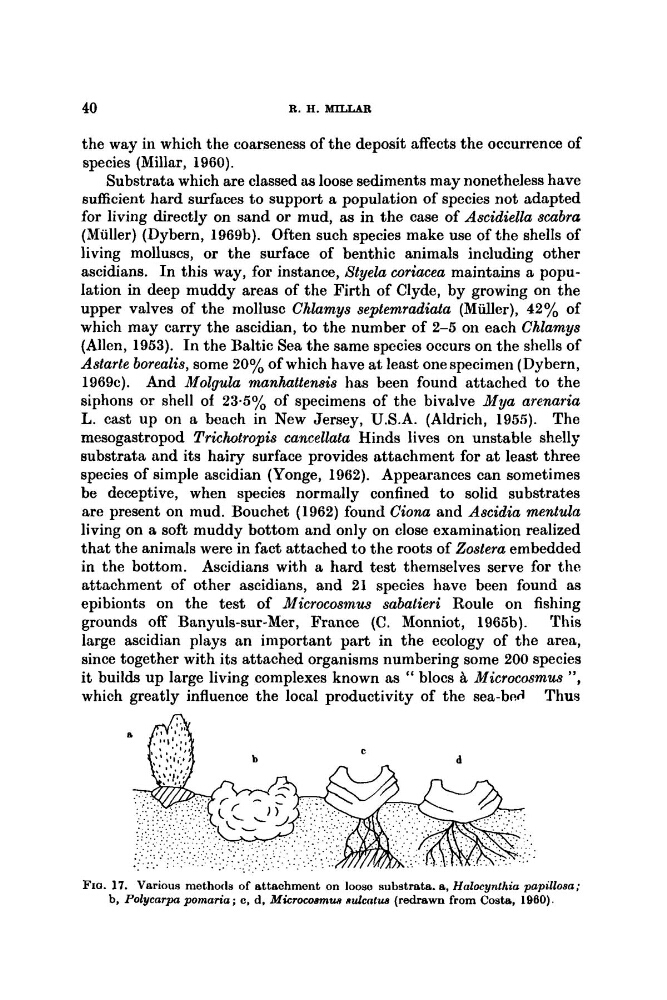
Fro. 17. Various methotls of attachment on looso substrata. a, Halocynthia papillosa;
b, Polycarpa pornaria; c, d, MicrocoemuR ~ u l ~ t ~
(redrawn from Costa, 1960).
R. H. MlLLAR
the way in which the coarseness of the deposit affects the occurrence of
species (Millar, 1960).
Substrata which are classed as loose sediments may nonetheless have
sufficient hard surfaces to support a population of species not adapted
for living directly on sand or mud, as in the case of Ascidiella scubra
(Muller) (Dybern, 1969b). Often such species make use of the shells of
living molluscs, or the surface of benthic animals including other
ascidians. In this way, for instance, Styela coriacea maintains a population in deep muddy areas of the Firth of Clyde, by growing on the
upper valves of the mollusc Chlamys septemradiata (Miiller), 42% of
which may carry the ascidian, to the number of 2-5 on each Chlamys
(Allen, 1953). In the Baltic Sea the same species occurs on the shells of
Astarte borealis, some 20% of which have at least one specimen (Dybern,
1969~). And Molgula manhattensis has been found attached to the
siphons or shell of 23.5% of specimens of the bivalve Mya arenaria
L. cast up on a beach in New Jersey, U.S.A. (Aldrich, 1955). The
mesogastropod Trichotropis cancellata Hinds lives on unstable shelly
substrata and its hairy surface provides attachment for at least three
species of simple ascidian (Yonge, 1962). Appearances can sometimes
be deceptive, when species normally confined to solid substrat.es
are present on mud. Bouchet (1962) found Ciona and Ascidia mentula
living on a soft muddy bottom and only on close examination realized
that the animals were in fact attached to the roots of Zostera embedded
in the bottom. Ascidians with a hard test themselves serve for the
attachment of other ascidians, and 21 species have been found as
epibionts on the test of Microcosmus sabatieri Roule on fishing
grounds off Banyuls-sur-Mer, France (C. Monniot, 1965b). This
large ascidian plays an important part in the ecology of the area,
since together with its attached organisms numbering some 200 species
it builds up large living complexes known as " blocs B Microcosmus ",
which greatly influence the local productivity of the sea-bcd Thus
Fro. 17. Various methotls of attachment on looso substrata. a, Halocynthia papillosa;
b, Polycarpa pornaria; c, d, MicrocoemuR ~ u l ~ t ~
(redrawn from Costa, 1960).