

T H E BIOLOGY O F WOOD-BORING TEREDINID MOLLUSCS
47 1
studies of Santhakumari (1970) on the medusa of this form have shown
that the species is assignable to the genus Eutima and has, therefore,
been named as Eutima commensalis.
At Barnegat Bay, New Jersey an interesting case of predator-prey
relationship between a ctenophore Mnemiopsis sp. and shipworm larvae
was observed during 1921-23 by Nelson (1926a). An inverse correlation
was noticed between the abundance of the ctenophore and the intensity
of shipworm infestation owing to predation by the ctenophore on the
larvae. This shows that the intensity of shipworm attack in a locality
could be influenced by the presence or absence of such predators.
Two species of turbellarians have been reported associated with
shipworms, the first record was by Schmidt (1886) of Grafilla brauni, a
rhabdocoele turbellarian parasite living in the digestive diverticula of
Teredo at Lesina (N.E. Adriatic) but has not been reported since its
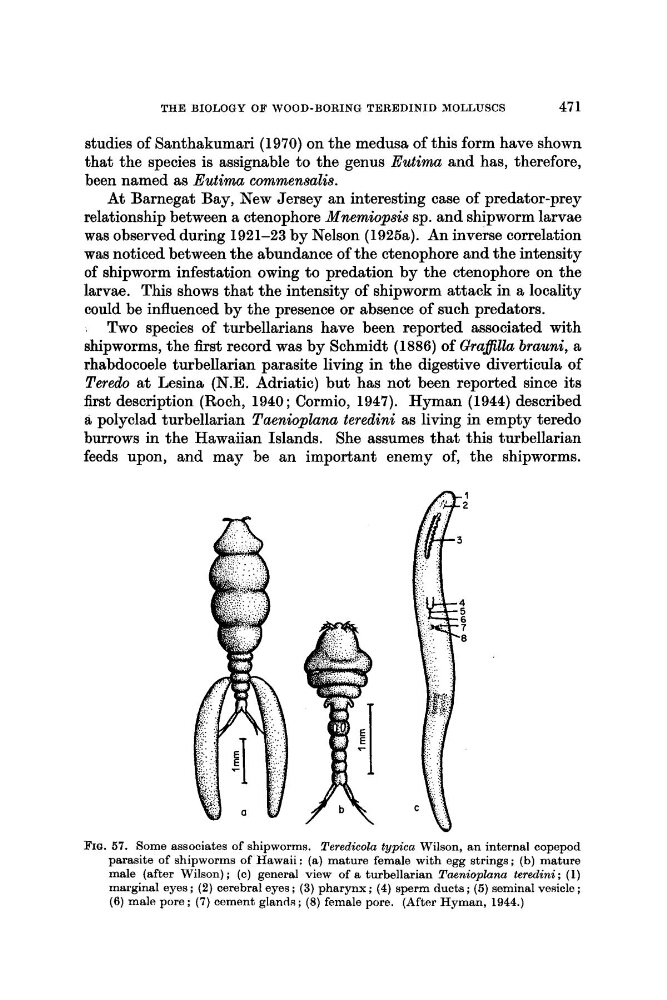
first description (Roch, 1940 ; Cormio, 1947). Hyman (1944) described
a polyclad turbellarian Taenioplana teredini as living in empty teredo
burrows in the Hawaiian Islands. She assumes that this turbellarian
feeds upon, and may be an important enemy of, the shipworms.
Fro. 57. Some associates of shipworms. Teredicolu typicu Wilson, an internal copepod
parasite of shipworms of Hawaii : (a) mature female with egg strings ; (b) mature
male (after Wilson) ; (c) general view of a turbellarian Tuenioplunu teredini ; (1)
marginal eyes; (2) cerebral eyes; (3) pharynx; (4) sperm ducts; ( 5 ) seminal vesicle;
(6) male pore; (7) cement, glands; (8) female pore. (After Hyman, 1944.)
47 1
studies of Santhakumari (1970) on the medusa of this form have shown
that the species is assignable to the genus Eutima and has, therefore,
been named as Eutima commensalis.
At Barnegat Bay, New Jersey an interesting case of predator-prey
relationship between a ctenophore Mnemiopsis sp. and shipworm larvae
was observed during 1921-23 by Nelson (1926a). An inverse correlation
was noticed between the abundance of the ctenophore and the intensity
of shipworm infestation owing to predation by the ctenophore on the
larvae. This shows that the intensity of shipworm attack in a locality
could be influenced by the presence or absence of such predators.
Two species of turbellarians have been reported associated with
shipworms, the first record was by Schmidt (1886) of Grafilla brauni, a
rhabdocoele turbellarian parasite living in the digestive diverticula of
Teredo at Lesina (N.E. Adriatic) but has not been reported since its
first description (Roch, 1940 ; Cormio, 1947). Hyman (1944) described
a polyclad turbellarian Taenioplana teredini as living in empty teredo
burrows in the Hawaiian Islands. She assumes that this turbellarian
feeds upon, and may be an important enemy of, the shipworms.
Fro. 57. Some associates of shipworms. Teredicolu typicu Wilson, an internal copepod
parasite of shipworms of Hawaii : (a) mature female with egg strings ; (b) mature
male (after Wilson) ; (c) general view of a turbellarian Tuenioplunu teredini ; (1)
marginal eyes; (2) cerebral eyes; (3) pharynx; (4) sperm ducts; ( 5 ) seminal vesicle;
(6) male pore; (7) cement, glands; (8) female pore. (After Hyman, 1944.)