

466
N. BALAKRISHNAN NAIR AND M. SARASWATHY
N. Relation to other borers
The mode of attack by molluscan and crustacan borers is very
different. To some extent this enables the various borers effectively to
share without serious competition the common and limited substrate.
The crustaceans work from the outside producing a multitude of
minute holes giving the wood a lace-like appearance and a sponge-like
texture (Fig. 49), but the molluscs especially the shipworms penetrate
deep into the heart wood. Their combined action converts the wood into
a highly porous, weak and fragile mass. The crustaceans are also able to
enter the creosoted outer surface of treated timber which the shipworm
larvae cannot do.
Crustacean borers such as Sphaeroma, Limnoria and Chelura may be
found in close association with the shipworms on a submerged piece of
timber. On the Atlantic coast of Canada an interesting ecological
relationship has been reported between hydrographic conditions and
the occurrence of borers like Limnoria and Teredo by M’Gonigle (1925).
Whereas a higher salinity with lower temperature favours the activity
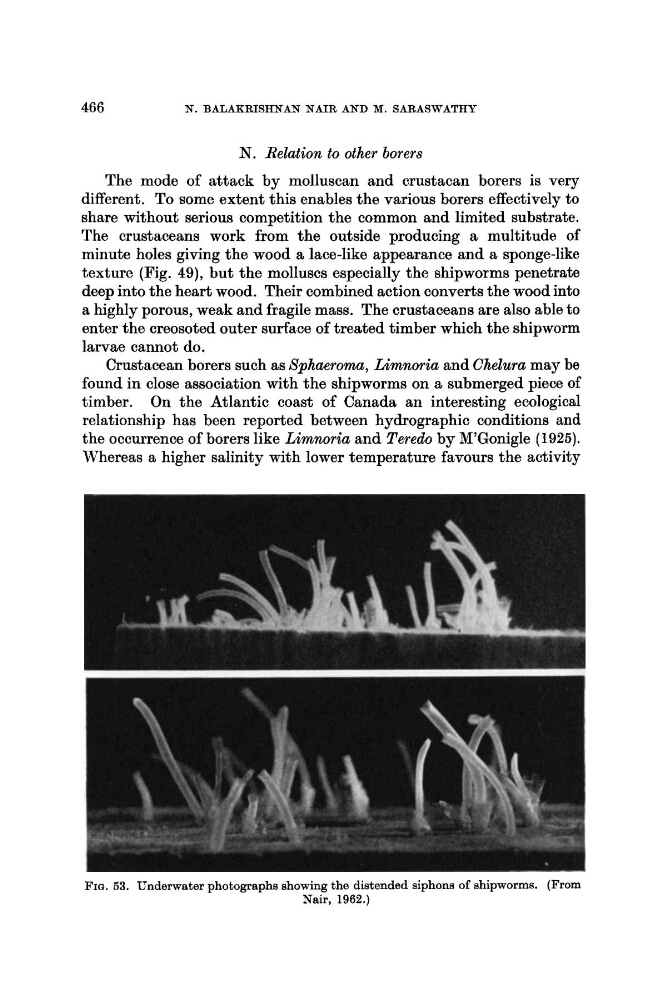
FIG. 53. Underwater photographs showing the distended siphons of shipworms. (From
Nair, 1962.)
N. BALAKRISHNAN NAIR AND M. SARASWATHY
N. Relation to other borers
The mode of attack by molluscan and crustacan borers is very
different. To some extent this enables the various borers effectively to
share without serious competition the common and limited substrate.
The crustaceans work from the outside producing a multitude of
minute holes giving the wood a lace-like appearance and a sponge-like
texture (Fig. 49), but the molluscs especially the shipworms penetrate
deep into the heart wood. Their combined action converts the wood into
a highly porous, weak and fragile mass. The crustaceans are also able to
enter the creosoted outer surface of treated timber which the shipworm
larvae cannot do.
Crustacean borers such as Sphaeroma, Limnoria and Chelura may be
found in close association with the shipworms on a submerged piece of
timber. On the Atlantic coast of Canada an interesting ecological
relationship has been reported between hydrographic conditions and
the occurrence of borers like Limnoria and Teredo by M’Gonigle (1925).
Whereas a higher salinity with lower temperature favours the activity
FIG. 53. Underwater photographs showing the distended siphons of shipworms. (From
Nair, 1962.)