

440
N. BALAKRISHNAN NAIR AND M. SARASWATTHY
nitrogen and in general for calcium and phosphorus are high while in
the second period glycogen and non-protein nitrogen show an increase
with an apparent fall in the percentage of the constituents which showed
higher values during the first period.
Respiration in both larval and adult teredinids has been investigated
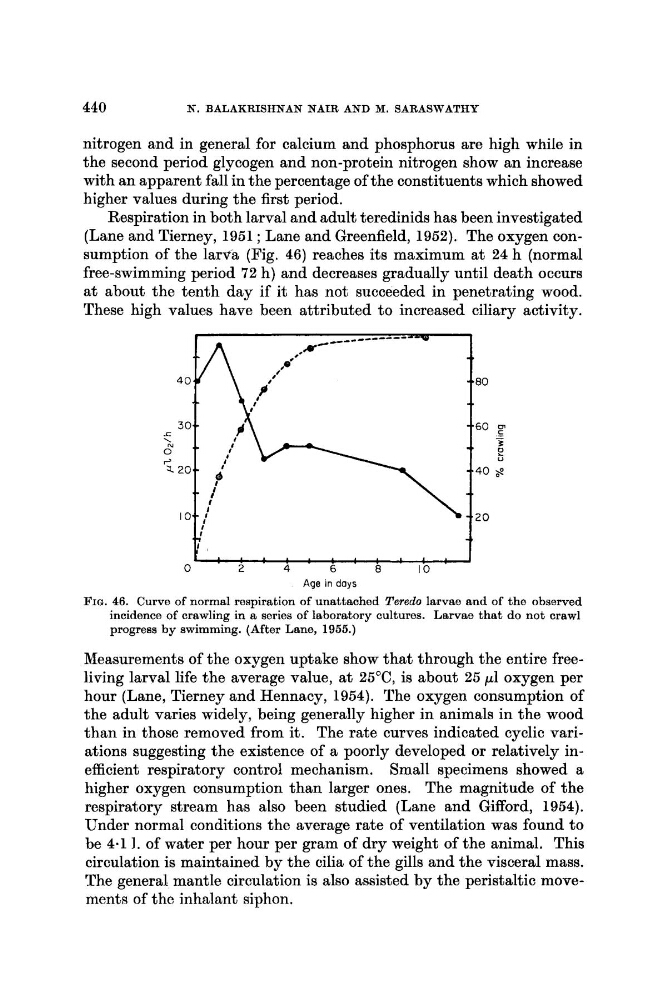
(Lane and Tierney, 1951 ; Lane and Greenfield, 1952). The oxygen consumption of the larva (Fig. 46) reaches its maximum at 24 h (normal
free-swimming period 72 h) and decreases gradually until death occurs
at about the tenth day if it has not succeeded in penetrating wood.
These high values have been attributed to increased ciliary activity.
Age in days
FIG. 46. Curve of normal respiration of unattached Teredo larvae and of the observed
incidence of crawling in a series of laboratory cultures. Larvae that do not crawl
progress by swimming. (After Lane, 1965.)
Measurements of the oxygen uptake show that through the entire freeliving larval life the average value, at 25"C, is about 25 pl oxygen per
hour (Lane, Tierney and Hennacy, 1954). The oxygen consumption of
the adult varies widely, being generally higher in animals in the wood
than in those removed from it. The rate curves indicated cyclic variations suggesting the existence of a poorly developed or relatively ineecient respiratory control mechanism. Small specimens showed a
higher oxygen consumption than larger ones. The magnitude of the
respiratory stream has also been studied (Lane and Gifford, 1954).
Under normal conditions the average rate of ventilation was found to
be 4.1 I. of water per hour per gram of dry weight of the animal. This
circulation is maintained by the cilia of the gills and the visceral mass.
The general mantle circulation is also assisted by the peristaltic movements of the inhalant siphon.
N. BALAKRISHNAN NAIR AND M. SARASWATTHY
nitrogen and in general for calcium and phosphorus are high while in
the second period glycogen and non-protein nitrogen show an increase
with an apparent fall in the percentage of the constituents which showed
higher values during the first period.
Respiration in both larval and adult teredinids has been investigated
(Lane and Tierney, 1951 ; Lane and Greenfield, 1952). The oxygen consumption of the larva (Fig. 46) reaches its maximum at 24 h (normal
free-swimming period 72 h) and decreases gradually until death occurs
at about the tenth day if it has not succeeded in penetrating wood.
These high values have been attributed to increased ciliary activity.
Age in days
FIG. 46. Curve of normal respiration of unattached Teredo larvae and of the observed
incidence of crawling in a series of laboratory cultures. Larvae that do not crawl
progress by swimming. (After Lane, 1965.)
Measurements of the oxygen uptake show that through the entire freeliving larval life the average value, at 25"C, is about 25 pl oxygen per
hour (Lane, Tierney and Hennacy, 1954). The oxygen consumption of
the adult varies widely, being generally higher in animals in the wood
than in those removed from it. The rate curves indicated cyclic variations suggesting the existence of a poorly developed or relatively ineecient respiratory control mechanism. Small specimens showed a
higher oxygen consumption than larger ones. The magnitude of the
respiratory stream has also been studied (Lane and Gifford, 1954).
Under normal conditions the average rate of ventilation was found to
be 4.1 I. of water per hour per gram of dry weight of the animal. This
circulation is maintained by the cilia of the gills and the visceral mass.
The general mantle circulation is also assisted by the peristaltic movements of the inhalant siphon.