

THE BIOLOGY OF WOOD-BORING TEREDINID MOLLUSCS
399
to an initial spawning which took place during that month. From this
low index in June the values crept up steadily to a peak in October
(32.45). Thereafter, the values showed a downward trend with a steep
fall in November (15.81). In December also the value remained about
that level followed by another major fall (6.11) in January. From
January values showed a slight rise through February and March and
reached a secondary peak in April. This was followed by a fall in values
to the lowest recorded for the year in June.
The data clearly show that N . hedleyi is not a continuous breeder in
this locality. The high values noted for females during the months
following June till October suggest very high activity of the ovary
during this period. High gonad activity in N . hedZeyi is thus restricted,
in this habitat, to a period of nearly 6 months from July to December.
The peak period of settlement will, however, be slightly different from
the period of maximum activity of the gonad since there is a time lag
between spawning and the time of settlement. It is interesting to note
that there is reasonable correlation between the data on the gonad index
and the data collected from a system of test panels used to find out the
time of settlement of the larvae.
VIII. FERTILIZATION
Three modes of fertilization have been recorded in the Teredinidae,
(1) Egg and sperm separately extruded into the ambient water, fertilization taking place externally, (2) sperm discharged into the water by
vile individual may be taken in through the inhalant siphon of another,
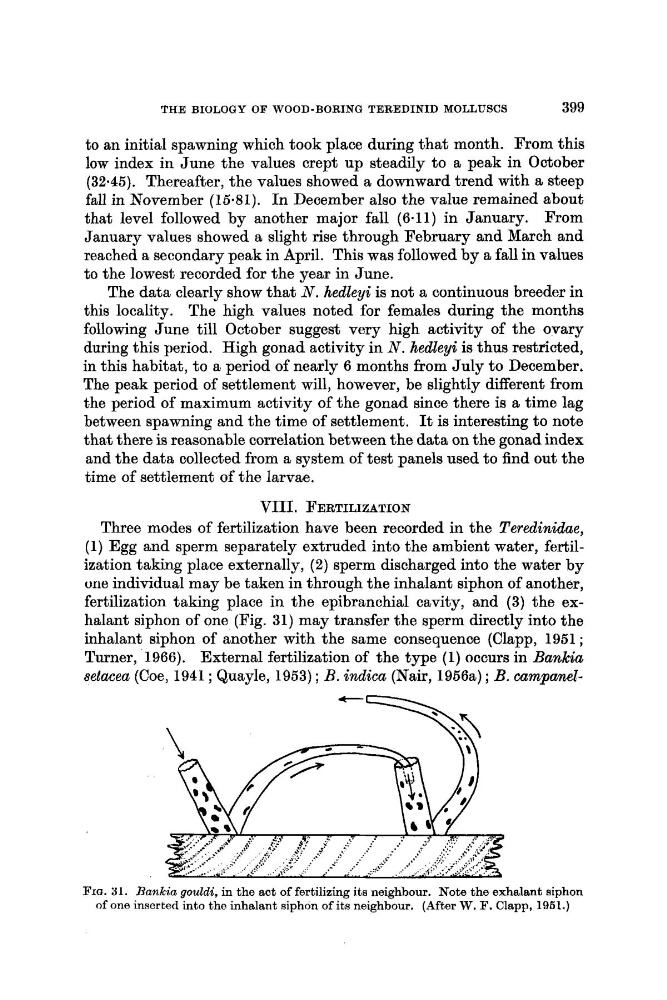
fertilization taking place in the epibranchial cavity, and (3) the exhalant siphon of one (Fig. 31) may transfer the sperm directly into the
inhalant siphon of another with the same consequence (Clapp, 1951 ;
Turner, 1966). External fertilization of the type (1) occurs in Bankia
setacea (Coe, 1941 ; Quayle, 1953) ; B. indica (Nair, 1956a) ; B. mmpanelFIG. 31. Bankia gouldi, in the act of fertilizing its neighbour. Note the exhalant siphon
of one inserted into the inhalant siphon of its neighbour. (After W. F. Clapp, 1961.)
399
to an initial spawning which took place during that month. From this
low index in June the values crept up steadily to a peak in October
(32.45). Thereafter, the values showed a downward trend with a steep
fall in November (15.81). In December also the value remained about
that level followed by another major fall (6.11) in January. From
January values showed a slight rise through February and March and
reached a secondary peak in April. This was followed by a fall in values
to the lowest recorded for the year in June.
The data clearly show that N . hedleyi is not a continuous breeder in
this locality. The high values noted for females during the months
following June till October suggest very high activity of the ovary
during this period. High gonad activity in N . hedZeyi is thus restricted,
in this habitat, to a period of nearly 6 months from July to December.
The peak period of settlement will, however, be slightly different from
the period of maximum activity of the gonad since there is a time lag
between spawning and the time of settlement. It is interesting to note
that there is reasonable correlation between the data on the gonad index
and the data collected from a system of test panels used to find out the
time of settlement of the larvae.
VIII. FERTILIZATION
Three modes of fertilization have been recorded in the Teredinidae,
(1) Egg and sperm separately extruded into the ambient water, fertilization taking place externally, (2) sperm discharged into the water by
vile individual may be taken in through the inhalant siphon of another,
fertilization taking place in the epibranchial cavity, and (3) the exhalant siphon of one (Fig. 31) may transfer the sperm directly into the
inhalant siphon of another with the same consequence (Clapp, 1951 ;
Turner, 1966). External fertilization of the type (1) occurs in Bankia
setacea (Coe, 1941 ; Quayle, 1953) ; B. indica (Nair, 1956a) ; B. mmpanelFIG. 31. Bankia gouldi, in the act of fertilizing its neighbour. Note the exhalant siphon
of one inserted into the inhalant siphon of its neighbour. (After W. F. Clapp, 1961.)