

THE BIOLOGY OF WOOD-BORING TEREDINID MOLLUSCS
383
elements of the glands and their disposition in the gill differ considerably in Bankia indica and B. qouldi. Saraswathy and Nair (1971) have
described the glands within the interlamellar spaces in the gill of
Nausitora hedleyi (Fig. 22). These are groups of rounded bodies which
appear as single units or more commonly in groups within the body of
the gill. Each seems to be made up of several closely packed spherules
and each spherule in turn contains a granular substance. Identical
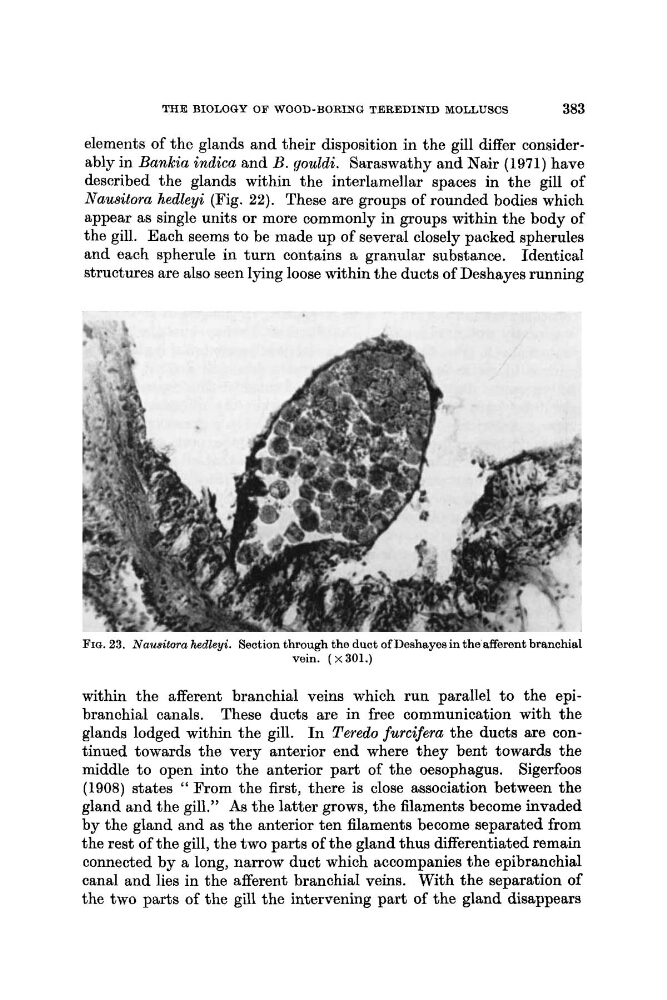
structures are also seen lying loose within the ducts of Deshayes running
FIG. 23. Nausitora hedleyi. Section through the duct of Deshayes in the afferent branchial
vein. ( x 301.)
within the afferent branchial veins which run parallel to the epibranchial canals. These ducts are in free communication with the
glands lodged within the gill. In Teredo furcifera the ducts are continued towards the very anterior end where they bent towards the
middle to open into the anterior part of the oesophagus. Sigerfoos
(1908) states " From the first, there is close association between the
gland and the gill." As the latter grows, the filaments become invaded
by the gland and as the anterior ten filaments become separated from
the rest of the gill, the two parts of the gland thus differentiated remain
connected by a long, narrow duct which accompanies the epibranchial
canal and lies in the afferent branchial veins. With the separation of
the two parts of the gill the intervening part of the gland disappears
383
elements of the glands and their disposition in the gill differ considerably in Bankia indica and B. qouldi. Saraswathy and Nair (1971) have
described the glands within the interlamellar spaces in the gill of
Nausitora hedleyi (Fig. 22). These are groups of rounded bodies which
appear as single units or more commonly in groups within the body of
the gill. Each seems to be made up of several closely packed spherules
and each spherule in turn contains a granular substance. Identical
structures are also seen lying loose within the ducts of Deshayes running
FIG. 23. Nausitora hedleyi. Section through the duct of Deshayes in the afferent branchial
vein. ( x 301.)
within the afferent branchial veins which run parallel to the epibranchial canals. These ducts are in free communication with the
glands lodged within the gill. In Teredo furcifera the ducts are continued towards the very anterior end where they bent towards the
middle to open into the anterior part of the oesophagus. Sigerfoos
(1908) states " From the first, there is close association between the
gland and the gill." As the latter grows, the filaments become invaded
by the gland and as the anterior ten filaments become separated from
the rest of the gill, the two parts of the gland thus differentiated remain
connected by a long, narrow duct which accompanies the epibranchial
canal and lies in the afferent branchial veins. With the separation of
the two parts of the gill the intervening part of the gland disappears