

THE BIOLOGY OF ASCIDIANS
23
further reduces accuracy. Most growth studies have been made by
measurements in successive samples of a population, and in only a few
cmes have individuals been followed. That the two methods give
sufficiently similar results is indicated by population studies on Ciona
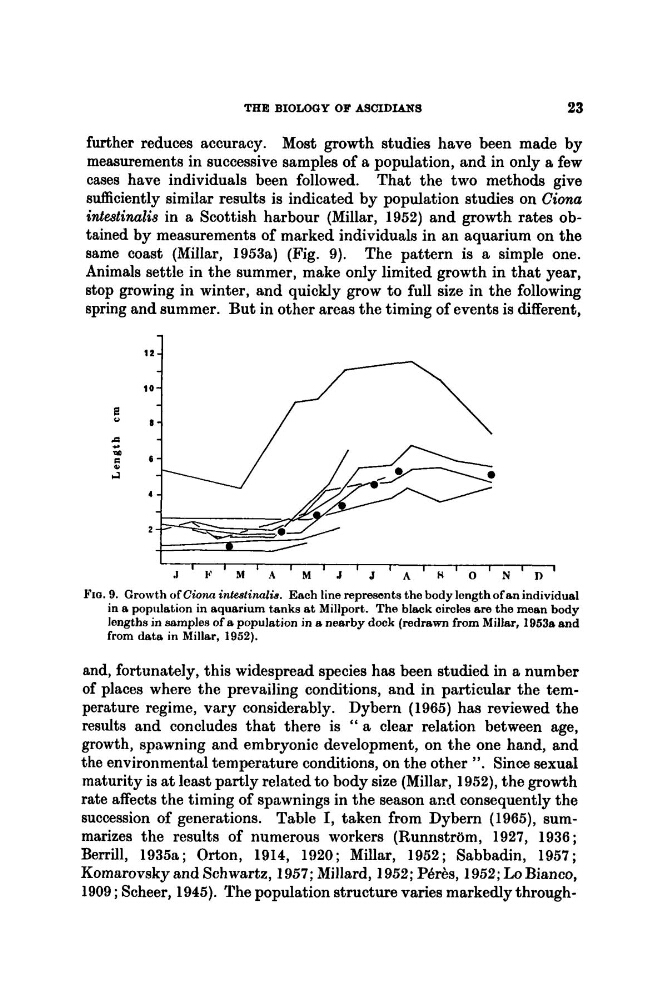
intestinalis in a Scottish harbour (Millar, 1952) and growth rates obtained by measurements of marked individuals in an aquarium on the
same coast (Millar, 1953a) (Fig. 9). The pattern is a simple one.
Animals settle in the summer, make only limited growth in that year,
stop growing in winter, and quickly grow to full size in the following
spring and summer. But in other areas the timing of events is different,
1 2 1
I
I
.I
I " M ' A
' M ' J ' J ' A ' H ' o ' N ' ~ '
Fro. 9. Growth of Cionn intestinalis. Each line represents the body length ofan individual
in a population in aquarium tanks at Millport. The black circles are the mean body
lengths in samples of a population in a nearby dock (redrawn from Miller, 1953a and
from data in Miller, 1952).
and, fortunately, this widespread species has been studied in a number
of places where the prevailing conditions, and in particular the temperature regime, vary considerably. Dybern (1965) has reviewed the
results and concludes that there is " a clear relation between age,
growth, spawning and embryonic development, on the one hand, and
the environmental temperature conditions, on the other ". Since sexual
maturity is at least partly related to body size (Millar, 1952), the growth
rate affects the timing of spawnings in the season a d . consequently the
succession of generations. Table I, taken from Dybern (1965), summarizes the results of numerous workers (RunnstrBm, 1927, 1936;
Berrill, 1935a; Orton, 1914, 1920; Millar, 1952; Sabbadin, 1957;
Komarovsky and Schwartz, 1957; Millard, 1952; Pbrhs, 1952; Lo Bianco,
1909 ; Scheer, 1945). The population structure vanes markedly through-
23
further reduces accuracy. Most growth studies have been made by
measurements in successive samples of a population, and in only a few
cmes have individuals been followed. That the two methods give
sufficiently similar results is indicated by population studies on Ciona
intestinalis in a Scottish harbour (Millar, 1952) and growth rates obtained by measurements of marked individuals in an aquarium on the
same coast (Millar, 1953a) (Fig. 9). The pattern is a simple one.
Animals settle in the summer, make only limited growth in that year,
stop growing in winter, and quickly grow to full size in the following
spring and summer. But in other areas the timing of events is different,
1 2 1
I
I
.I
I " M ' A
' M ' J ' J ' A ' H ' o ' N ' ~ '
Fro. 9. Growth of Cionn intestinalis. Each line represents the body length ofan individual
in a population in aquarium tanks at Millport. The black circles are the mean body
lengths in samples of a population in a nearby dock (redrawn from Miller, 1953a and
from data in Miller, 1952).
and, fortunately, this widespread species has been studied in a number
of places where the prevailing conditions, and in particular the temperature regime, vary considerably. Dybern (1965) has reviewed the
results and concludes that there is " a clear relation between age,
growth, spawning and embryonic development, on the one hand, and
the environmental temperature conditions, on the other ". Since sexual
maturity is at least partly related to body size (Millar, 1952), the growth
rate affects the timing of spawnings in the season a d . consequently the
succession of generations. Table I, taken from Dybern (1965), summarizes the results of numerous workers (RunnstrBm, 1927, 1936;
Berrill, 1935a; Orton, 1914, 1920; Millar, 1952; Sabbadin, 1957;
Komarovsky and Schwartz, 1957; Millard, 1952; Pbrhs, 1952; Lo Bianco,
1909 ; Scheer, 1945). The population structure vanes markedly through-