

THE BIOLOGY OF WOOD-BORING TEREDINID MOLLUSCS
351
RP APA
pp
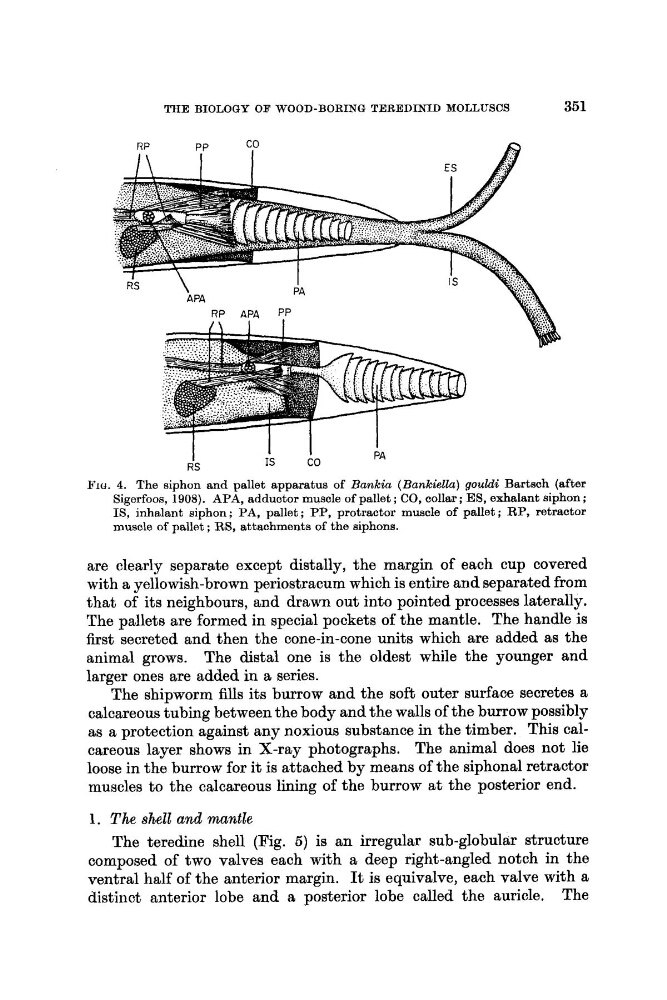
Flu. 4. The siphon and pallet apparatus of Banlcia (Balakiella) gouldi Baxtsch (after
Sigerfoos, 1908). APA, adductor muscle of pallet ; CO, collm; ES, exhalant siphon ;
IS, inhalant siphon; PA, pallet; PP, protractor muscle of pallet ; RP, retractor
muscle of pallet ; RS, attachments of the siphons.
are clearly separate except distally, the margin of each cup covered
with a yellowish-brown periostracum which is entire and separated from
that of its neighbours, and drawn out into pointed processes laterally.
The pallets are formed in special pockets of the mantle. The handle is
first secreted and then the cone-in-cone units which are added as the
animal grows. The distal one is the oldest while the younger and
larger ones are added in a series.
The shipworm fills its burrow and the soft outer surface secretes a
calcareous tubing between the body and the walls of the burrow possibly
as a protection against any noxious substance in the timber. This calcareous layer shows in X-ray photographs. The animal does not lie
loose in the burrow for it is attached by means of the siphonal retractor
muscles to the calcareous lining of the burrow at the posterior end.
1. The shell and mantle
The teredine shell (Fig. 5 ) is an irregular sub-globular structure
composed of two valves each with a deep right-angled notch in the
ventral half of the anterior margin. It is equivalve, each valve with a
distinct anterior lobe and a posterior lobe called the auricle. The
351
RP APA
pp
Flu. 4. The siphon and pallet apparatus of Banlcia (Balakiella) gouldi Baxtsch (after
Sigerfoos, 1908). APA, adductor muscle of pallet ; CO, collm; ES, exhalant siphon ;
IS, inhalant siphon; PA, pallet; PP, protractor muscle of pallet ; RP, retractor
muscle of pallet ; RS, attachments of the siphons.
are clearly separate except distally, the margin of each cup covered
with a yellowish-brown periostracum which is entire and separated from
that of its neighbours, and drawn out into pointed processes laterally.
The pallets are formed in special pockets of the mantle. The handle is
first secreted and then the cone-in-cone units which are added as the
animal grows. The distal one is the oldest while the younger and
larger ones are added in a series.
The shipworm fills its burrow and the soft outer surface secretes a
calcareous tubing between the body and the walls of the burrow possibly
as a protection against any noxious substance in the timber. This calcareous layer shows in X-ray photographs. The animal does not lie
loose in the burrow for it is attached by means of the siphonal retractor
muscles to the calcareous lining of the burrow at the posterior end.
1. The shell and mantle
The teredine shell (Fig. 5 ) is an irregular sub-globular structure
composed of two valves each with a deep right-angled notch in the
ventral half of the anterior margin. It is equivalve, each valve with a
distinct anterior lobe and a posterior lobe called the auricle. The