

348
N. BALAKRISHNAN NAIR AND M. SARASWATHY
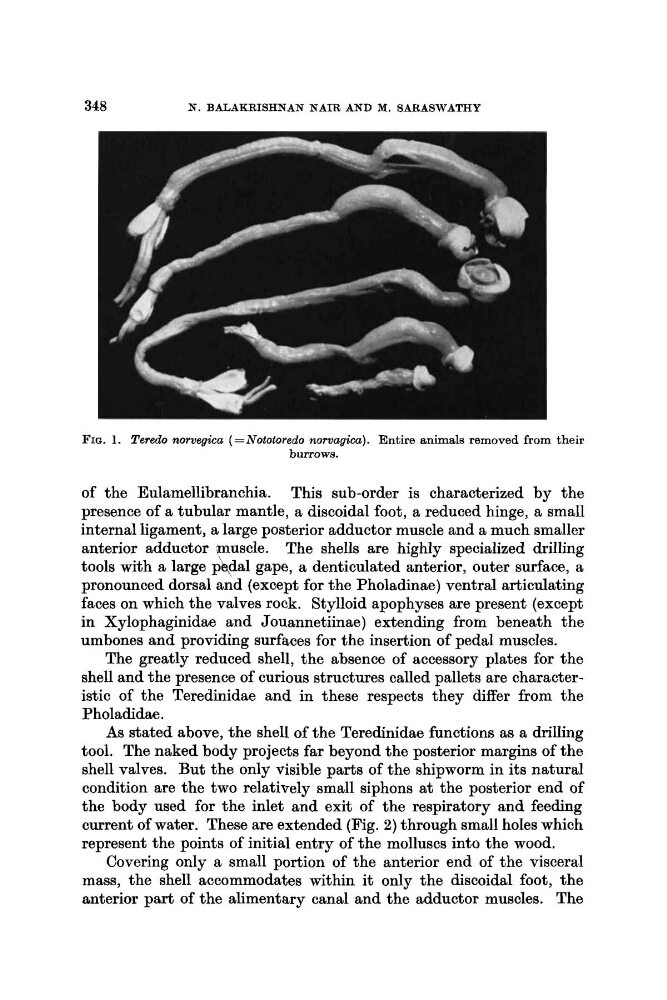
Fro. 1. Teredo norveggica ( =Nototoredo norvagica). Entire animals removed from their
burrows.
of the Eulamellibranchia. This sub-order is characterized by the
presence of a tubular mantle, a discoidal foot, a reduced hinge, a small
internal ligament, a large posterior adductor muscle and a much smaller
anterior adductor yuscle. The shells are highly specialized drilling
tools with a large pkydal gape, a denticulated anterior, outer surface, a
pronounced dorsal and (except for the Pholadinae) ventral articulating
faces on which the valves rock. Stylloid apophyses are present (except
in Xylophaginidae and Jouannetiinae) extending from beneath the
umbones and providing surfaces for the insertion of pedal muscles.
The greatly reduced shell, the absence of accessory plates for the
shell and the presence of curious structures called pallets are characteristic of the Teredinidae and in these respects they differ from the
Pholadidae.
As stated above, the shell of the Teredinidae functions as a drilling
tool. The naked body projects far beyond the posterior margins of the
shell valves. But the only visible parts of the shipworm in its natural
condition are the two relatively small siphons at the posterior end of
the body used for the inlet and exit of the respiratory and feeding
current of water. These are extended (Fig. 2) through small holes which
represent the points of initial entry of the molluscs into the wood.
Covering only a small portion of the anterior end of the visceral
mass, the shell accommodates within it only the discoidal foot, the
anterior part of the alimentary canal and the adductor muscles. The
N. BALAKRISHNAN NAIR AND M. SARASWATHY
Fro. 1. Teredo norveggica ( =Nototoredo norvagica). Entire animals removed from their
burrows.
of the Eulamellibranchia. This sub-order is characterized by the
presence of a tubular mantle, a discoidal foot, a reduced hinge, a small
internal ligament, a large posterior adductor muscle and a much smaller
anterior adductor yuscle. The shells are highly specialized drilling
tools with a large pkydal gape, a denticulated anterior, outer surface, a
pronounced dorsal and (except for the Pholadinae) ventral articulating
faces on which the valves rock. Stylloid apophyses are present (except
in Xylophaginidae and Jouannetiinae) extending from beneath the
umbones and providing surfaces for the insertion of pedal muscles.
The greatly reduced shell, the absence of accessory plates for the
shell and the presence of curious structures called pallets are characteristic of the Teredinidae and in these respects they differ from the
Pholadidae.
As stated above, the shell of the Teredinidae functions as a drilling
tool. The naked body projects far beyond the posterior margins of the
shell valves. But the only visible parts of the shipworm in its natural
condition are the two relatively small siphons at the posterior end of
the body used for the inlet and exit of the respiratory and feeding
current of water. These are extended (Fig. 2) through small holes which
represent the points of initial entry of the molluscs into the wood.
Covering only a small portion of the anterior end of the visceral
mass, the shell accommodates within it only the discoidal foot, the
anterior part of the alimentary canal and the adductor muscles. The