

UPWELLING AND THE PRODUCTION OF FISH
323
I
I
1
I
I
I
I
I
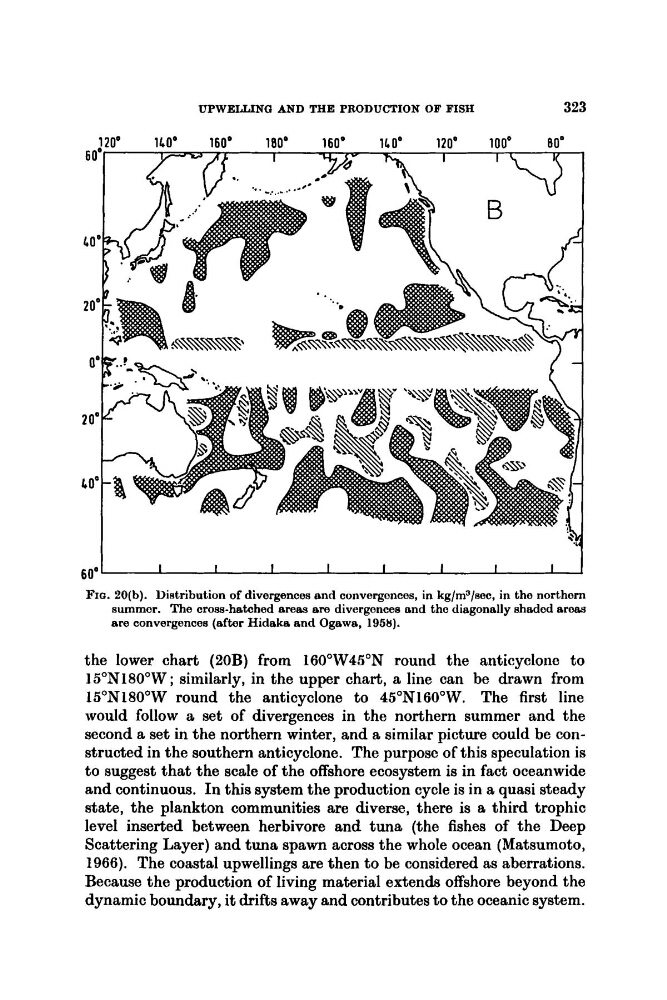
FIQ. 20(b). Distribution of divergences and convergonces, in kg/m3/sec, in tho northorn
summcr. The cross-hatched areas ere divergonces and tho diagonally shadod a r o a ~
are convergences (after Hidaka and Ogawa, 1958).
the lower chart (20B) from 160°W450N round the anticyclone to
15"N180°W; similarly, in the upper chart, a line can be drawn from
15°N1800W round the anticyclone to 45"N16OoW. The first line
would follow a set of divergences in the northern summer and the
second a set in the northern winter, and a similar picture could be constructed in the southern anticyclone. The purpose of this speculation is
to suggest that the scale of the offshore ecosystem is in fact oceanwide
and continuous. In this system the production cycle is in a quasi steady
state, the plankton communities are diverse, there is a third trophic
level inserted between herbivore and tuna (the fishes of the Deep
Scattering Layer) and tuna spawn across the whole ocean (Matsumoto,
1966). The coastal upwellings are then to be considered as aberrations.
Because the production of living material extends offshore beyond the
dynamic boundary, it drifts away and contributes to the oceanic system.
323
I
I
1
I
I
I
I
I
FIQ. 20(b). Distribution of divergences and convergonces, in kg/m3/sec, in tho northorn
summcr. The cross-hatched areas ere divergonces and tho diagonally shadod a r o a ~
are convergences (after Hidaka and Ogawa, 1958).
the lower chart (20B) from 160°W450N round the anticyclone to
15"N180°W; similarly, in the upper chart, a line can be drawn from
15°N1800W round the anticyclone to 45"N16OoW. The first line
would follow a set of divergences in the northern summer and the
second a set in the northern winter, and a similar picture could be constructed in the southern anticyclone. The purpose of this speculation is
to suggest that the scale of the offshore ecosystem is in fact oceanwide
and continuous. In this system the production cycle is in a quasi steady
state, the plankton communities are diverse, there is a third trophic
level inserted between herbivore and tuna (the fishes of the Deep
Scattering Layer) and tuna spawn across the whole ocean (Matsumoto,
1966). The coastal upwellings are then to be considered as aberrations.
Because the production of living material extends offshore beyond the
dynamic boundary, it drifts away and contributes to the oceanic system.