

322
D. H. cusma
60''
I
I
I
I
I
I
I
I
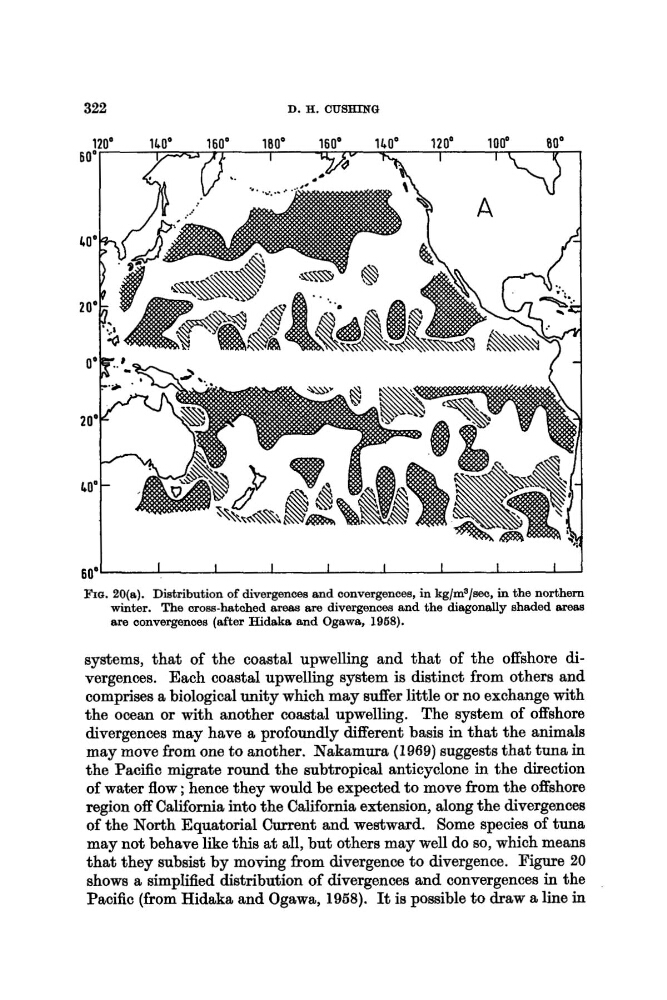
FIU. 2O(a). Distribution of divergences and convergences, in kg/m3/sec, i n the northern
winter. The cross-hatched meas m e divergences and the diagonally shaded m a s
are convergences (after Hidaka and Ogawa, 1968).
systems, that of the coastal upwelling and that of the offshore divergences. Each coastal upwelling system is distinct from others and
comprises a biological unity which may suffer little or no exchange with
the ocean or with another coastal upwelling. The system of offshore
divergences may have a profoundly different basis in that the animals
may move from one to another. Nakamura (1969) suggests that tuna in
the Pacific migrate round the subtropical anticyclone in the direction
of water flow ; hence they would be expected to move from the offshore
region off California into the California extension, along the divergences
of the North Equatorial Current and westward. Some species of tuna
may not behave like this at all, but others may well do so, which means
that they subsist by moving from divergence to divergence. Figure 20
shows a simplified distribution of divergences and convergences in the
Pacific (from Hidaka and Ogawa, 1958). It is possible to draw a line in
D. H. cusma
60''
I
I
I
I
I
I
I
I
FIU. 2O(a). Distribution of divergences and convergences, in kg/m3/sec, i n the northern
winter. The cross-hatched meas m e divergences and the diagonally shaded m a s
are convergences (after Hidaka and Ogawa, 1968).
systems, that of the coastal upwelling and that of the offshore divergences. Each coastal upwelling system is distinct from others and
comprises a biological unity which may suffer little or no exchange with
the ocean or with another coastal upwelling. The system of offshore
divergences may have a profoundly different basis in that the animals
may move from one to another. Nakamura (1969) suggests that tuna in
the Pacific migrate round the subtropical anticyclone in the direction
of water flow ; hence they would be expected to move from the offshore
region off California into the California extension, along the divergences
of the North Equatorial Current and westward. Some species of tuna
may not behave like this at all, but others may well do so, which means
that they subsist by moving from divergence to divergence. Figure 20
shows a simplified distribution of divergences and convergences in the
Pacific (from Hidaka and Ogawa, 1958). It is possible to draw a line in