

312
I). H. UUSHlXU
Current system (on Table 111), or in the stocks of zooplankton in the
whole current system, between the two areas, despite a difference of
three times in the Ekman offshore transport.
The simplest view of the upwelling production cycle is t o consider it
as starting at the bottom of the photic layer and continuing as the water
rises. The quantity of plants and animals in the water below 200m
must be low and as a consequence, the production cycle in an
upwelling area resembles that in temperate areas rather closely,
because that also is a discontinuous cycle. Heinrich (1961) has
suggested that the average generation time in the upwelling areas is
about 40 days, so effective grazing should start about 20 days after the
start of upwelling. The photic layer may be up t o 50 m deep and the
rate of upwelling might be 1, or exceptionally, 5 m/day, so the peak of
the production cycle should occur at or near the surface, at or near the
line of upwelling. A more complex situation occurs if the plant production becomes vulnerable t o mixture of zooplankton generated by
earlier productions.
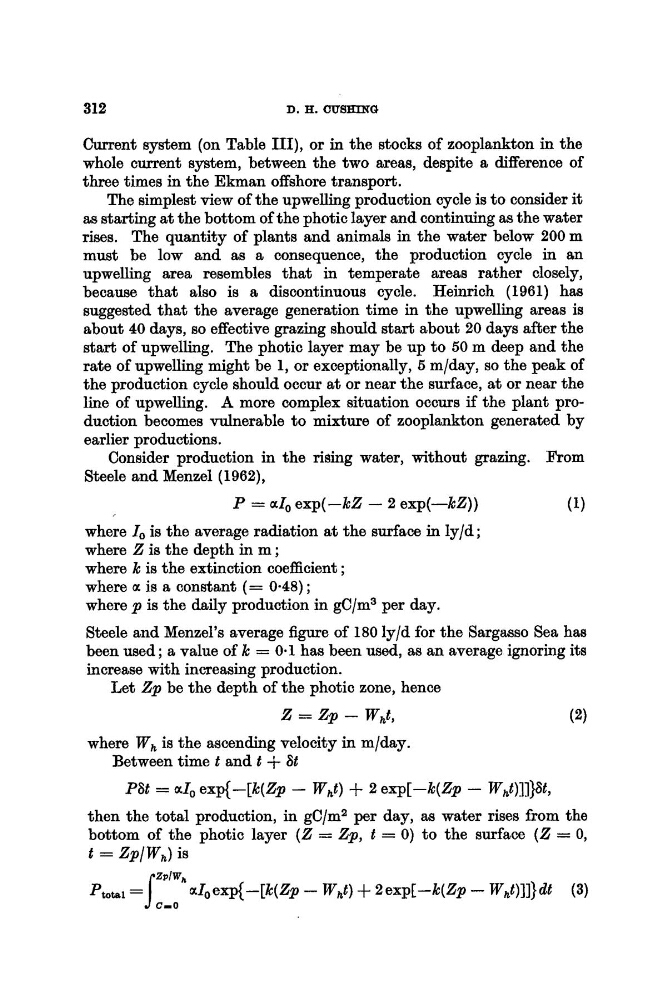
Consider production in the rising water, without grazing. From
Steele and Menzel (1 962),
P = aIo exp( -kZ - 2 exp(-kZ))
(1)
where I,, is the average radiation at the surface in ly/d ;
where 2 is the depth in m ;
where k is the extinction coefficient ;
where a is a constant (= 0-48) ;
where p is the daily production in gC/m3 per day.
Steele and Menzel's average figure of 180 ly/d for the Sargasso Sea has
been used ; a value of k = 0.1 has been used, as an average ignoring its
increase with increasing production.
Let Zp be the depth of the photic zone, hence
2 = zp - wht,
(2)
where W, is the ascending velocity in m/day.
Between time t and t + 6t
P6t = aIo exp(-[k(Zp - Wht) + 2 exp[-k(Zp - Wht)]]}st,
then the total production, in gC/m2 per day, as water rises from the
bottom of the photic layer (2 = 2 p , t = 0) to the surface (2 = 0,
t = z p / W h ) is
I). H. UUSHlXU
Current system (on Table 111), or in the stocks of zooplankton in the
whole current system, between the two areas, despite a difference of
three times in the Ekman offshore transport.
The simplest view of the upwelling production cycle is t o consider it
as starting at the bottom of the photic layer and continuing as the water
rises. The quantity of plants and animals in the water below 200m
must be low and as a consequence, the production cycle in an
upwelling area resembles that in temperate areas rather closely,
because that also is a discontinuous cycle. Heinrich (1961) has
suggested that the average generation time in the upwelling areas is
about 40 days, so effective grazing should start about 20 days after the
start of upwelling. The photic layer may be up t o 50 m deep and the
rate of upwelling might be 1, or exceptionally, 5 m/day, so the peak of
the production cycle should occur at or near the surface, at or near the
line of upwelling. A more complex situation occurs if the plant production becomes vulnerable t o mixture of zooplankton generated by
earlier productions.
Consider production in the rising water, without grazing. From
Steele and Menzel (1 962),
P = aIo exp( -kZ - 2 exp(-kZ))
(1)
where I,, is the average radiation at the surface in ly/d ;
where 2 is the depth in m ;
where k is the extinction coefficient ;
where a is a constant (= 0-48) ;
where p is the daily production in gC/m3 per day.
Steele and Menzel's average figure of 180 ly/d for the Sargasso Sea has
been used ; a value of k = 0.1 has been used, as an average ignoring its
increase with increasing production.
Let Zp be the depth of the photic zone, hence
2 = zp - wht,
(2)
where W, is the ascending velocity in m/day.
Between time t and t + 6t
P6t = aIo exp(-[k(Zp - Wht) + 2 exp[-k(Zp - Wht)]]}st,
then the total production, in gC/m2 per day, as water rises from the
bottom of the photic layer (2 = 2 p , t = 0) to the surface (2 = 0,
t = z p / W h ) is