

TAURINE IN MARINE INVERTEBRATES
229
Henze (1911) had found betaine in octopus muscle. They overlooked
the fact that Henze (1904,1913 and 1914) had also found large amounts
of taurine in Octopus. Semi-quantitative analyses of the amino acids
of nerves of seven species of marine invertebrates showed that on
average taurine was second in abundance only to aspartic acid (Lewis,
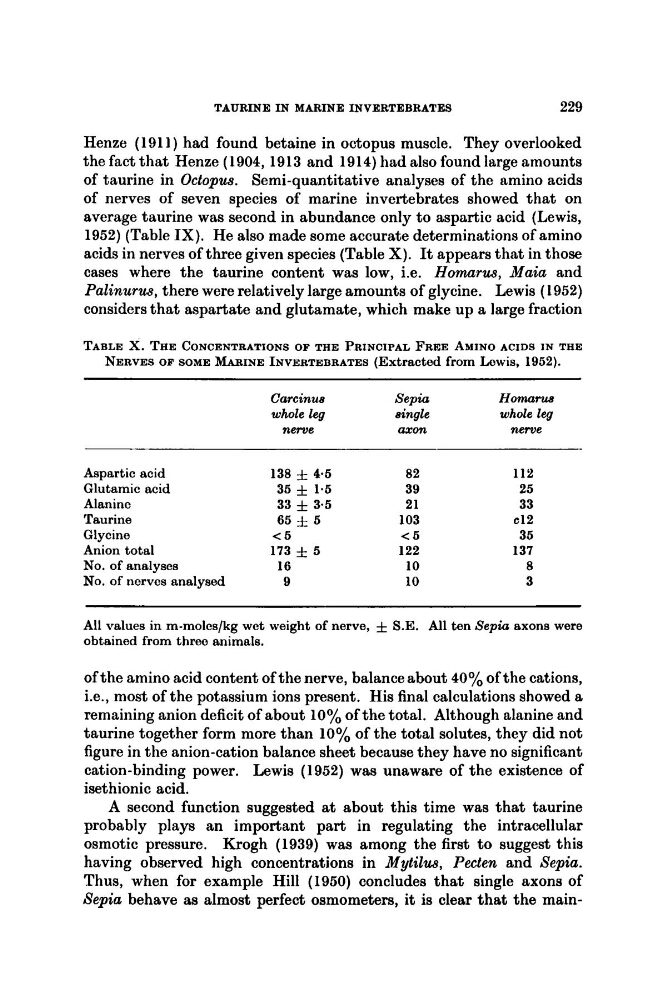
1952) (Table IX). He also made some accurate determinations of amino
acids in nerves of three given species (Table X). It appears that in those
cases where the taurine content was low, i.e. Homurus, Maia and
Palinurus, there were relatively large amounts of glycine. Lewis (1952)
considers that aspartate and glutamate, which make up a large fraction
TABLE X. THE CONCENTRATIONS OF THE PRINCIPAL FREE AMINO ACIDS I N THE
NERVES OF SOME MARINE INVERTEBRATES (Extracted from Lowis, 1952).
Carcinwr
Sepia
Homarua
w b l e leg
eingle
whole leg
nerve
axon
nerve
Aspartic acid
Glutamic acid
Alaninc
Taurine
Glycine
Anion total
N o . of analyses
No. of nervcs analysed
138 f 4.5
35 f 1-5
65 f 5
< 5
173 f 5
16
9
33 f 3-5
82
39
21
103
< 5
122
10
10
112
25
33
c12
35
137
8
3
A l l values in m-molcs/kg wct weight of nerve, f S.E. All ten Sepia axons were
obtained from three animals.
of the amino acid content of the nerve, balance about 40% of the cations,
i.e., most of the potassium ions present. His final calculations showed a
remaining anion deficit of about 10% of the total. Although alanine and
taurine together form more than 10% of the total solutes, they did not
figure in the anion-cation balance sheet because they have no significant
cation-binding power. Lewis (1952) was unaware of the existence of
isethionic acid.
A second function suggested at about this time was that taurine
probably plays an important part in regulating the intracellular
osmotic pressure. Krogh (1939) was among the first t o suggest this
having observed high concentrations in Mytilus, Pecten and Sepia.
Thus, when for example Hill (1950) concludes that single axons of
Sepia behave as almost perfect osmometers, it is clear that the main-
229
Henze (1911) had found betaine in octopus muscle. They overlooked
the fact that Henze (1904,1913 and 1914) had also found large amounts
of taurine in Octopus. Semi-quantitative analyses of the amino acids
of nerves of seven species of marine invertebrates showed that on
average taurine was second in abundance only to aspartic acid (Lewis,
1952) (Table IX). He also made some accurate determinations of amino
acids in nerves of three given species (Table X). It appears that in those
cases where the taurine content was low, i.e. Homurus, Maia and
Palinurus, there were relatively large amounts of glycine. Lewis (1952)
considers that aspartate and glutamate, which make up a large fraction
TABLE X. THE CONCENTRATIONS OF THE PRINCIPAL FREE AMINO ACIDS I N THE
NERVES OF SOME MARINE INVERTEBRATES (Extracted from Lowis, 1952).
Carcinwr
Sepia
Homarua
w b l e leg
eingle
whole leg
nerve
axon
nerve
Aspartic acid
Glutamic acid
Alaninc
Taurine
Glycine
Anion total
N o . of analyses
No. of nervcs analysed
138 f 4.5
35 f 1-5
65 f 5
< 5
173 f 5
16
9
33 f 3-5
82
39
21
103
< 5
122
10
10
112
25
33
c12
35
137
8
3
A l l values in m-molcs/kg wct weight of nerve, f S.E. All ten Sepia axons were
obtained from three animals.
of the amino acid content of the nerve, balance about 40% of the cations,
i.e., most of the potassium ions present. His final calculations showed a
remaining anion deficit of about 10% of the total. Although alanine and
taurine together form more than 10% of the total solutes, they did not
figure in the anion-cation balance sheet because they have no significant
cation-binding power. Lewis (1952) was unaware of the existence of
isethionic acid.
A second function suggested at about this time was that taurine
probably plays an important part in regulating the intracellular
osmotic pressure. Krogh (1939) was among the first t o suggest this
having observed high concentrations in Mytilus, Pecten and Sepia.
Thus, when for example Hill (1950) concludes that single axons of
Sepia behave as almost perfect osmometers, it is clear that the main-