

TAURINE IN MhRINE INVERTEBRATES
216
species it occurs in large quantities. Thus the purpose of this review is
to assess and discuss what little is known of its occurrence and functions
in invertebrates in the hope that it might stimulate research into the
functions of one of the more neglected chemicals commonly present in
tissues of these animals.
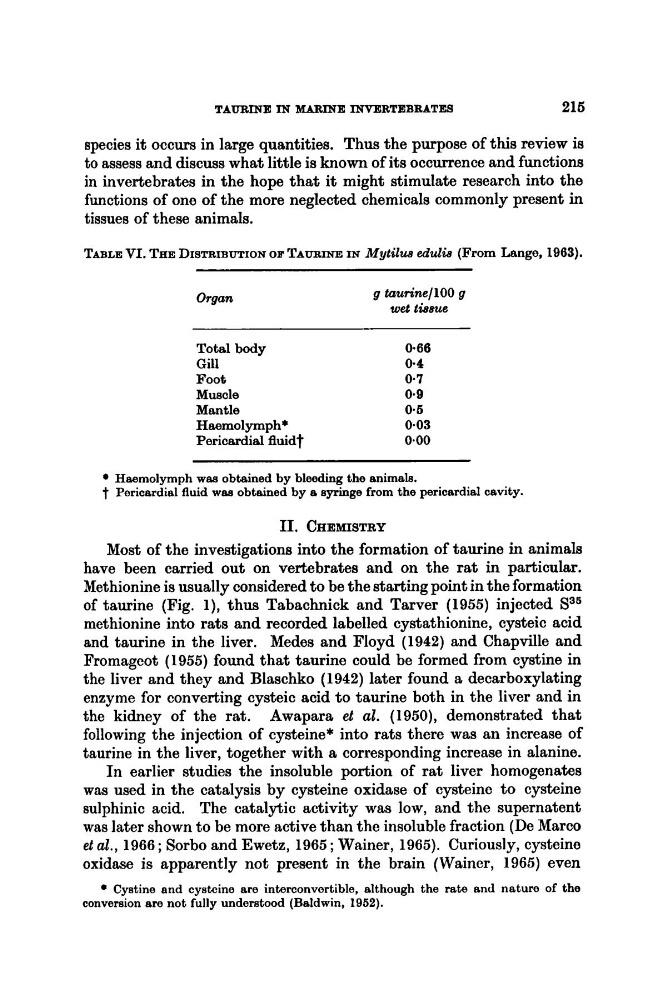
TABLE VI. THE DISTRIBUTION OF TAURINE IN Mytilw, edulie (From Lange, 1963).
Organ
g taUrine/lOO g
wet tissue
Total body
Gill
Foot
Muscle
Mantle
Haemolymph*
Pericardial fluid?
0.68
0-4
0.7
0.9
0.5
0.03
0.00
Haemolymph was obtained by bleeding the animals.
t Pericardial fluid waa obtained by a syringe from the pericardial cavity.
11. CHEMISTRY
Most of the investigations into the formation of taurine in animals
have been carried out on vertebrates and on the rat in particular.
Methionine is usually considered to be the starting point in the formation
of taurine (Fig. l), thus Tabachnick and Tarver (1955) injected S35
methionine into rats and recorded labelled cystathionine, cysteic acid
and taurine in the liver. Medes and Floyd (1942) and Chapville and
Fromagcot (1955) found that taurine could be formed from cystine in
the liver and they and Blaschko (1942) later found a decarboxylating
enzyme for converting cysteic acid t o taurine both in the liver and in
the kidney of the rat. Awapara et al. (1950), demonstrated that
following the injection of cysteine* into rats there was an increase of
taurine in the liver, together with a corresponding increase in alanine.
In earlier studies the insoluble portion of rat liver homogenates
was used in the catalysis by cysteine oxidase of cysteine to cysteine
sulphinic acid. The catalytic activity was low, and the supernatent
was later shown to be more active than the insoluble fraction (De Marco
et al., 1966; Sorb0 and Ewetz, 1965; Wainer, 1965). Curiously, cysteine
oxidase is apparently not present in the brain (Wainer, 1965) even
conversion are not fully understood (Baldwin, 1962).
Cystine and cystcine are interconvertible, although the rate and nature of the
216
species it occurs in large quantities. Thus the purpose of this review is
to assess and discuss what little is known of its occurrence and functions
in invertebrates in the hope that it might stimulate research into the
functions of one of the more neglected chemicals commonly present in
tissues of these animals.
TABLE VI. THE DISTRIBUTION OF TAURINE IN Mytilw, edulie (From Lange, 1963).
Organ
g taUrine/lOO g
wet tissue
Total body
Gill
Foot
Muscle
Mantle
Haemolymph*
Pericardial fluid?
0.68
0-4
0.7
0.9
0.5
0.03
0.00
Haemolymph was obtained by bleeding the animals.
t Pericardial fluid waa obtained by a syringe from the pericardial cavity.
11. CHEMISTRY
Most of the investigations into the formation of taurine in animals
have been carried out on vertebrates and on the rat in particular.
Methionine is usually considered to be the starting point in the formation
of taurine (Fig. l), thus Tabachnick and Tarver (1955) injected S35
methionine into rats and recorded labelled cystathionine, cysteic acid
and taurine in the liver. Medes and Floyd (1942) and Chapville and
Fromagcot (1955) found that taurine could be formed from cystine in
the liver and they and Blaschko (1942) later found a decarboxylating
enzyme for converting cysteic acid t o taurine both in the liver and in
the kidney of the rat. Awapara et al. (1950), demonstrated that
following the injection of cysteine* into rats there was an increase of
taurine in the liver, together with a corresponding increase in alanine.
In earlier studies the insoluble portion of rat liver homogenates
was used in the catalysis by cysteine oxidase of cysteine to cysteine
sulphinic acid. The catalytic activity was low, and the supernatent
was later shown to be more active than the insoluble fraction (De Marco
et al., 1966; Sorb0 and Ewetz, 1965; Wainer, 1965). Curiously, cysteine
oxidase is apparently not present in the brain (Wainer, 1965) even
conversion are not fully understood (Baldwin, 1962).
Cystine and cystcine are interconvertible, although the rate and nature of the