

TAURINE IN MARINE INVERTEBRATES
213
Thus apart from the occurrence as a conjugent with cholic acid in
bile salts of vertebrates, taurine occurs widely in invertebrates-particularly marine invertebrates, in its free form. The taurine content of
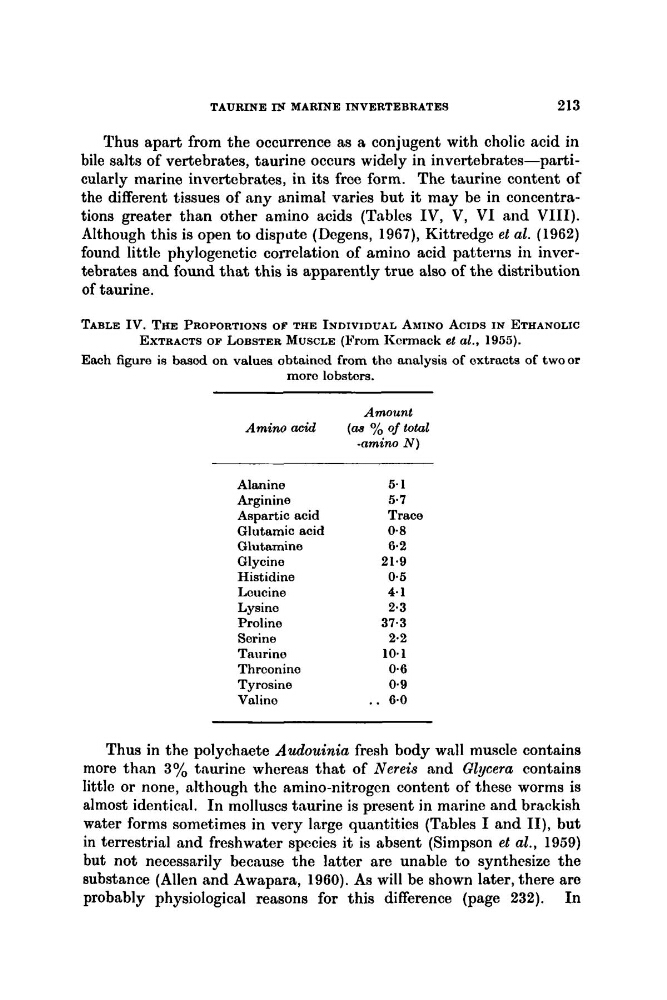
the different tissues of any animal varies but it may be in concentrations greater than other amino acids (Tables IV, V, VI and VIII).
Although this is open to dispate (Degens, 1967), Kittredge et al. (1962)
found little phylogenctic correlation of amino acid patterns in invertebrates and found that this is apparently true also of the distribution
of taurine.
TABLE Iv. THE PROPORTIONS OF THE INDIVIDUAL AniINo ACIDS IN ETHANOLIC
EXTRACTS OF LOBSTER MUSCLE (From Kcrmack et al., 1955).
Each figure is basod on values obtainod from tho analysis of extracts of twoor
more lobstors.
Amount
(ae yo of total
-amino N )
Amino acid
Alanine
Arginine
Aspartic acid
Glutamic acid
Glutamine
Glycine
Histidine
Loucine
Lysino
Proline
Serine
Taurino
Thrconine
Tyrosine
Valine
5.1
5-7
Trace
0- 8
6.2
21.9
0.5
4.1
2.3
37.3
2.2
10.1
0.6
0.9
. 6.0
Thus in the polychaete Audouinia fresh body wall muscle contains
more than 3% tnurine whereas that of Nereis and Glycera contains
little or none, although the amino-nitrogen content of these worms is
almost identical. In molluscs taurine is present in marine and brackish
water forms sometimes in very large quantities (Tables I and II), but
in terrestrial and freshwater species it is absent (Simpson et al., 1959)
but not necessarily because the latter are unable t o synthesize the
substance (Allen and Awapara, 1960). As will be shown later, there are
probably physiological reasons for this difference (page 232). In
213
Thus apart from the occurrence as a conjugent with cholic acid in
bile salts of vertebrates, taurine occurs widely in invertebrates-particularly marine invertebrates, in its free form. The taurine content of
the different tissues of any animal varies but it may be in concentrations greater than other amino acids (Tables IV, V, VI and VIII).
Although this is open to dispate (Degens, 1967), Kittredge et al. (1962)
found little phylogenctic correlation of amino acid patterns in invertebrates and found that this is apparently true also of the distribution
of taurine.
TABLE Iv. THE PROPORTIONS OF THE INDIVIDUAL AniINo ACIDS IN ETHANOLIC
EXTRACTS OF LOBSTER MUSCLE (From Kcrmack et al., 1955).
Each figure is basod on values obtainod from tho analysis of extracts of twoor
more lobstors.
Amount
(ae yo of total
-amino N )
Amino acid
Alanine
Arginine
Aspartic acid
Glutamic acid
Glutamine
Glycine
Histidine
Loucine
Lysino
Proline
Serine
Taurino
Thrconine
Tyrosine
Valine
5.1
5-7
Trace
0- 8
6.2
21.9
0.5
4.1
2.3
37.3
2.2
10.1
0.6
0.9
. 6.0
Thus in the polychaete Audouinia fresh body wall muscle contains
more than 3% tnurine whereas that of Nereis and Glycera contains
little or none, although the amino-nitrogen content of these worms is
almost identical. In molluscs taurine is present in marine and brackish
water forms sometimes in very large quantities (Tables I and II), but
in terrestrial and freshwater species it is absent (Simpson et al., 1959)
but not necessarily because the latter are unable t o synthesize the
substance (Allen and Awapara, 1960). As will be shown later, there are
probably physiological reasons for this difference (page 232). In