

190
E. D. 9. CORNER AND ANTHONY 0 . DAVLES
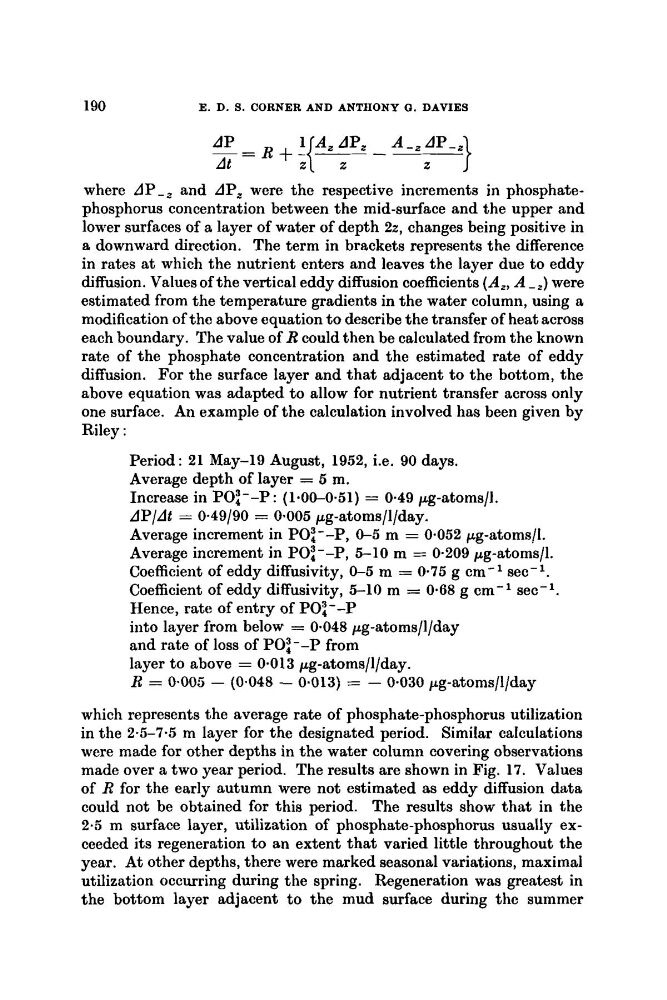
where AP-, and AP, were the respective increments in phosphatephosphorus concentration between the mid-surface and the upper and
lower surfaces of a layer of water of depth 22, changes being positive in
a downward direction. The term in brackets represents the difference
in rates at which the nutrient enters and leaves the layer due to eddy
diffusion. Valuesof the vertical eddy diffusion coefficients (Az, A -*) were
estimated from the temperature gradients in the water column, using a
modification of the above equation t o describe the transfer of heat across
each boundary. The value of R could then be calculated from the known
rate of the phosphate concentration and the estimated rate of eddy
diffusion. For the surface layer and that adjacent to the bottom, the
above equation was adapted to allow for nutrient transfer across only
one surface. An example of the calculation involved has been given by
Riley :
Period : 21 May-19 August, 1952, i.e. 90 days.
Average depth of layer = 5 m.
Increase in PO:--P : (1.00-0-51) = 0.49 pg-atoms/l.
AP/At = 0.49/90 = 0.005 pg-atoms/l/day.
Average increment in PO:--P, 0-5 m = 0.052 pg-atomsll.
Average increment in POi--P, 5-10 m = 0.209 pg-atoms/l.
Coefficient of eddy diffusivity, 0-5 m = 0.75 g cm-l sec-l.
Coefficient of eddy diffusivity, 5-10 m = 0.68 g cm-l sec-'.
Hence, rate of entry of PO;--P
into layer from below = 0.048 pg-atoms/l/day
and rate of loss of POi--P from
layer to above = 0.013 pg-atoms/l/day.
R = 0.005 - (0.048 - 0.013) = - 0-030 pg-atomsfllday
which represents the average rate of phosphate-phosphorus utilization
in the 2-5-7-5 m layer for the designated period. Similar caIculations
were made for other depths in the water column covering observations
made over a two year period. The results are shown in Fig. 17. Values
of R for the early autumn were not estimated as eddy diffusion data
could not be obtained for this period. The results show that in the
2-5 m surface layer, utilization of phosphate-phosphorus usually exceeded its regeneration to an extent that varied little throughout the
year. At other depths, there were marked seasonal variations, maximal
utilization occurring during the spring. Regeneration was greatest in
the bottom layer adjacent to the mud surface during the summer
E. D. 9. CORNER AND ANTHONY 0 . DAVLES
where AP-, and AP, were the respective increments in phosphatephosphorus concentration between the mid-surface and the upper and
lower surfaces of a layer of water of depth 22, changes being positive in
a downward direction. The term in brackets represents the difference
in rates at which the nutrient enters and leaves the layer due to eddy
diffusion. Valuesof the vertical eddy diffusion coefficients (Az, A -*) were
estimated from the temperature gradients in the water column, using a
modification of the above equation t o describe the transfer of heat across
each boundary. The value of R could then be calculated from the known
rate of the phosphate concentration and the estimated rate of eddy
diffusion. For the surface layer and that adjacent to the bottom, the
above equation was adapted to allow for nutrient transfer across only
one surface. An example of the calculation involved has been given by
Riley :
Period : 21 May-19 August, 1952, i.e. 90 days.
Average depth of layer = 5 m.
Increase in PO:--P : (1.00-0-51) = 0.49 pg-atoms/l.
AP/At = 0.49/90 = 0.005 pg-atoms/l/day.
Average increment in PO:--P, 0-5 m = 0.052 pg-atomsll.
Average increment in POi--P, 5-10 m = 0.209 pg-atoms/l.
Coefficient of eddy diffusivity, 0-5 m = 0.75 g cm-l sec-l.
Coefficient of eddy diffusivity, 5-10 m = 0.68 g cm-l sec-'.
Hence, rate of entry of PO;--P
into layer from below = 0.048 pg-atoms/l/day
and rate of loss of POi--P from
layer to above = 0.013 pg-atoms/l/day.
R = 0.005 - (0.048 - 0.013) = - 0-030 pg-atomsfllday
which represents the average rate of phosphate-phosphorus utilization
in the 2-5-7-5 m layer for the designated period. Similar caIculations
were made for other depths in the water column covering observations
made over a two year period. The results are shown in Fig. 17. Values
of R for the early autumn were not estimated as eddy diffusion data
could not be obtained for this period. The results show that in the
2-5 m surface layer, utilization of phosphate-phosphorus usually exceeded its regeneration to an extent that varied little throughout the
year. At other depths, there were marked seasonal variations, maximal
utilization occurring during the spring. Regeneration was greatest in
the bottom layer adjacent to the mud surface during the summer