

PLANKTON IN NITROQEN AND PHOSPHORUS CYCLES
167
Ketchum w u m e d that all the captured food was assimilated so
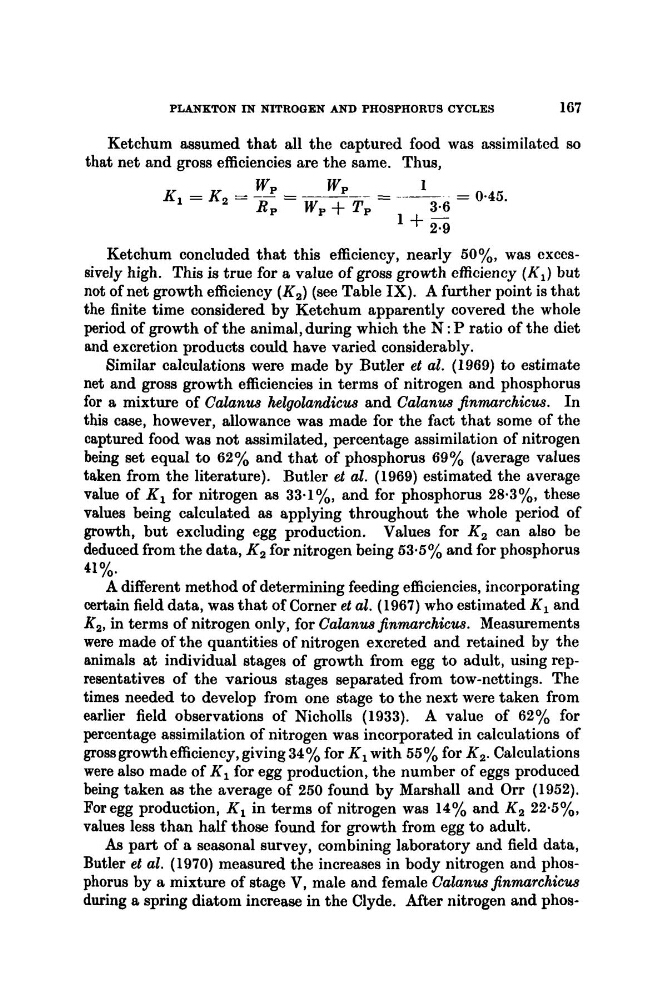
that net and gross efficiencies are the same. Thus,
Ketchum concluded that this efficiency, nearly 50%, was excessively high. This is true for a value of gross growth efficiency (K,) but
not of net growth efficiency (K,) (see Table IX). A further point is that
the finite time considered by Ketchum apparently covered the whole
period of growth of the animal, during which the N : P ratio of the diet
and excretion products could have varied considerably.
Similar calculations were made by Butler et al. (1969) to estimate
net and gross growth efficiencies in terms of nitrogen and phosphorus
for a mixture of Calanus helgolandicus and Calanw Jinmurchicus. In
this case, however, allowance was made for the fact that some of the
captured food was not assimilated, percentage assimilation of nitrogen
being set equal to 62% and that of phosphorus 69% (average values
taken from the literature). Butler et al. (1969) estimated the average
value of K , for nitrogen as 33.1%, and for phosphorus 28*3%, these
values being calculated as applying throughout the whole period of
growth, but excluding egg production. Values for K , can also be
deduced from the data, K , for nitrogen being 53.5% and for phosphorus
41%.
A different method of determining feeding efficiencies, incorporating
certain field data, was that of Corner et al. (1967) who estimated K , and
K,, in terms of nitrogen only, for Calanus Jinmurchicus. Measurements
were made of the quantities of nitrogen excreted and retained by the
animals at individual stages of growth from egg to adult, using representatives of the various stages separated from tow-nettings. The
times needed to develop from one stage to the next were taken from
earlier field observations of Nicholls (1933). A value of 62% for
percentage assimilation of nitrogen was incorporated in calculations of
grossgrowthefficiency, giving 34% for K, with 55% for K,. Calculations
were also made of K, for egg production, the number of eggs produced
being taken as the average of 250 found by Marshall and Orr (1952).
For egg production, K , in terms of nitrogen was 14% and K , 22.5%,
values less than half those found for growth from egg to adult.
As part of a seasonal survey, combining laboratory and field data,
Butler et al. (1970) measured the increases in body nitrogen and phosphorus by a mixture of stage V, male and female Calanusjnmurchicus
during a spring diatom increase in the Clyde. After nitrogen and phos-
167
Ketchum w u m e d that all the captured food was assimilated so
that net and gross efficiencies are the same. Thus,
Ketchum concluded that this efficiency, nearly 50%, was excessively high. This is true for a value of gross growth efficiency (K,) but
not of net growth efficiency (K,) (see Table IX). A further point is that
the finite time considered by Ketchum apparently covered the whole
period of growth of the animal, during which the N : P ratio of the diet
and excretion products could have varied considerably.
Similar calculations were made by Butler et al. (1969) to estimate
net and gross growth efficiencies in terms of nitrogen and phosphorus
for a mixture of Calanus helgolandicus and Calanw Jinmurchicus. In
this case, however, allowance was made for the fact that some of the
captured food was not assimilated, percentage assimilation of nitrogen
being set equal to 62% and that of phosphorus 69% (average values
taken from the literature). Butler et al. (1969) estimated the average
value of K , for nitrogen as 33.1%, and for phosphorus 28*3%, these
values being calculated as applying throughout the whole period of
growth, but excluding egg production. Values for K , can also be
deduced from the data, K , for nitrogen being 53.5% and for phosphorus
41%.
A different method of determining feeding efficiencies, incorporating
certain field data, was that of Corner et al. (1967) who estimated K , and
K,, in terms of nitrogen only, for Calanus Jinmurchicus. Measurements
were made of the quantities of nitrogen excreted and retained by the
animals at individual stages of growth from egg to adult, using representatives of the various stages separated from tow-nettings. The
times needed to develop from one stage to the next were taken from
earlier field observations of Nicholls (1933). A value of 62% for
percentage assimilation of nitrogen was incorporated in calculations of
grossgrowthefficiency, giving 34% for K, with 55% for K,. Calculations
were also made of K, for egg production, the number of eggs produced
being taken as the average of 250 found by Marshall and Orr (1952).
For egg production, K , in terms of nitrogen was 14% and K , 22.5%,
values less than half those found for growth from egg to adult.
As part of a seasonal survey, combining laboratory and field data,
Butler et al. (1970) measured the increases in body nitrogen and phosphorus by a mixture of stage V, male and female Calanusjnmurchicus
during a spring diatom increase in the Clyde. After nitrogen and phos-