

166
E. D. 9. CORNER AND ANTHONY Q. DAVIES
terms of a bulk constituent of the diet, carbon (Lasker, 1960) or nitrogen
(Corner et al., 1967) for example, and no studies have been made with
particular dietary fractions such as individual amino acids or lipids.
Obviously, gross growth efficiency may be low in terms of a bulk
constituent of the diet, such as phosphorus, which has a rapid rate of
turnover (see Table 8), but could be relatively high in terms of particular
phosphorus compounds. Qualitative considerations of zooplankton
nutrition have been emphasized from another aspect by Harvey (1960)
who pointed out that in order to obtain their maximum needs of a
particular dietary constituent (e.g. an amino acid) the animals might
have to capture, assimilate and metabolize an excess of others.
The first attempt to calculate the growth efficiency of zooplankton
in terms of nitrogen and phosphorus was that of Ketchum (1962),
using the data of Harris and Riley (1956) and Harris (1959) for the
ratios N : P in phytoplankton, herbivorous zooplankton and their
excretion products. Harris and Riley (1956) found the average ratio
N : P (in terms of weight N :weight P) for the phytoplankton in Long
Island Sound to be 7.3 :I compared with a value of 10.9 :1 for zooplankton ; and Harris (1959) showed that the average value for this
ratio in the soluble excretion products of the animals was 4-37:l.
Ketchum gives no details of his calculations but presumably they were
based on the following argument : over a finite period, food captured
and assimilated by the animal is equivalent to the sum of the quantities
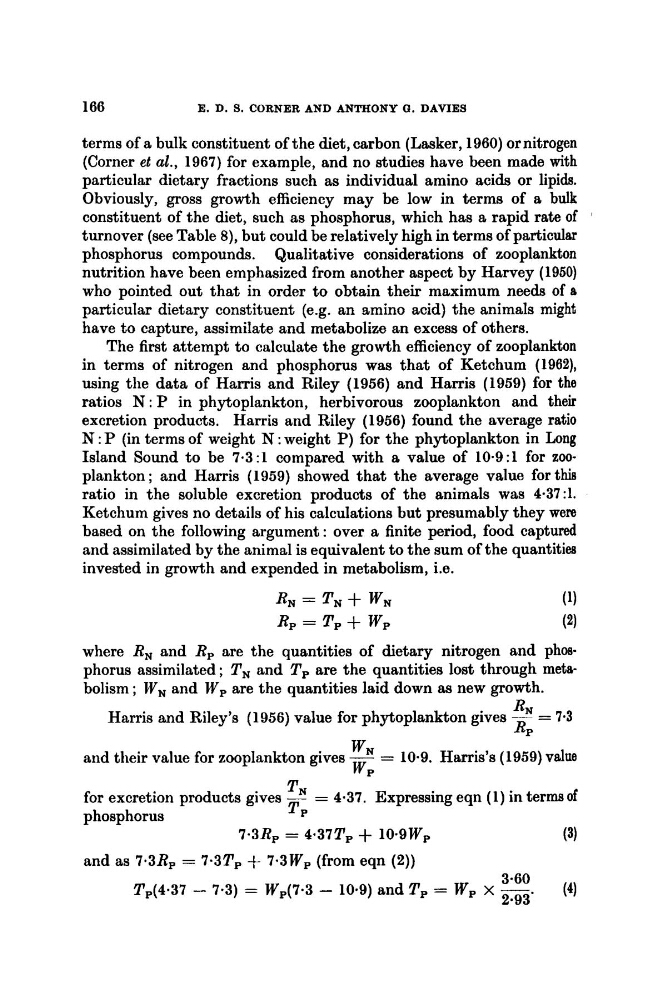
invested in growth and expended in metabolism, i.e.
where R, and R, are the quantities of dietary nitrogen and phosphorus assimilated ; T, and T, are the quantities lost through metabolism ; WN and W, are the quantities laid down as new growth.
R N
RP
Harris and Riley's (1956) value for phytoplankton gives - = 7.3
WN
W,
and their value for zooplankton gives - = 10.9. Harris's (1959) value
for excretion products gives - = 4.37. Expressing eqn (1) in terms of
T N
phosphorus
TP
7.3RP = 4.37Tp + 10-9Wp
(3)
(4)
and as 7.3RP = 7.3T, + 7.3Wp (from eqn (2))
3-60
T,(4-37 - 7-3) = W,(7-3 - 10.9) and T, = Wp x __
2-93'
E. D. 9. CORNER AND ANTHONY Q. DAVIES
terms of a bulk constituent of the diet, carbon (Lasker, 1960) or nitrogen
(Corner et al., 1967) for example, and no studies have been made with
particular dietary fractions such as individual amino acids or lipids.
Obviously, gross growth efficiency may be low in terms of a bulk
constituent of the diet, such as phosphorus, which has a rapid rate of
turnover (see Table 8), but could be relatively high in terms of particular
phosphorus compounds. Qualitative considerations of zooplankton
nutrition have been emphasized from another aspect by Harvey (1960)
who pointed out that in order to obtain their maximum needs of a
particular dietary constituent (e.g. an amino acid) the animals might
have to capture, assimilate and metabolize an excess of others.
The first attempt to calculate the growth efficiency of zooplankton
in terms of nitrogen and phosphorus was that of Ketchum (1962),
using the data of Harris and Riley (1956) and Harris (1959) for the
ratios N : P in phytoplankton, herbivorous zooplankton and their
excretion products. Harris and Riley (1956) found the average ratio
N : P (in terms of weight N :weight P) for the phytoplankton in Long
Island Sound to be 7.3 :I compared with a value of 10.9 :1 for zooplankton ; and Harris (1959) showed that the average value for this
ratio in the soluble excretion products of the animals was 4-37:l.
Ketchum gives no details of his calculations but presumably they were
based on the following argument : over a finite period, food captured
and assimilated by the animal is equivalent to the sum of the quantities
invested in growth and expended in metabolism, i.e.
where R, and R, are the quantities of dietary nitrogen and phosphorus assimilated ; T, and T, are the quantities lost through metabolism ; WN and W, are the quantities laid down as new growth.
R N
RP
Harris and Riley's (1956) value for phytoplankton gives - = 7.3
WN
W,
and their value for zooplankton gives - = 10.9. Harris's (1959) value
for excretion products gives - = 4.37. Expressing eqn (1) in terms of
T N
phosphorus
TP
7.3RP = 4.37Tp + 10-9Wp
(3)
(4)
and as 7.3RP = 7.3T, + 7.3Wp (from eqn (2))
3-60
T,(4-37 - 7-3) = W,(7-3 - 10.9) and T, = Wp x __
2-93'