

PLANKTON IN NITROGEN AND PHOSPHORUS CYCLES
123
juponica and Chuetoceros gracile Schiitt vary hyperbolically with the
nitrate level in the culture medium. There is also evidence, however,
that the nutrient content of the phytoplankton cells may be the
factor which determines their division rate: this has been shown for
the phosphate-limited growth of Phueoductylum tricornutum (Kuenzler
and Ketchum, 1962), for the nitrate-limited growth of Isochrysis
galbaiza Parke (Caperon, 1968), for the vitamin B,,-limited growth of
Monochrysis Zutheri (Droop, 1968) and for the iron-limited growth of
Dunuliella tertiolecta (Davies, 1970). In the latter three cases, a hyperbolic relationship between the growth rate and the cellular content of
the limiting nutrient was demonstrated.
That nutrient uptake and cell growth are not directly related has
long been recognized. Ketchum (1939a), for instance, found that a
decrease in nitrate concentration which halved its rate of uptake by
Phaeodactylurn tricornutum had no effect upon the rate of cell growth ;
and recently it has been shown that the maximal rates of nitrate uptake by Asterionella japonica and Chuetoceros gracile arc mom than four
times the maximal growth rates when the rates are expressed as
doublings per day of respectively the cellular nitrate and the cell
population (Eppley and Thomas, 1969). Eppley and Thomas have,
however, demonstrated that if the specific rates of nutrient uptake, V,
and of cell growth, p, are both assumed t o be hyperbolic functions
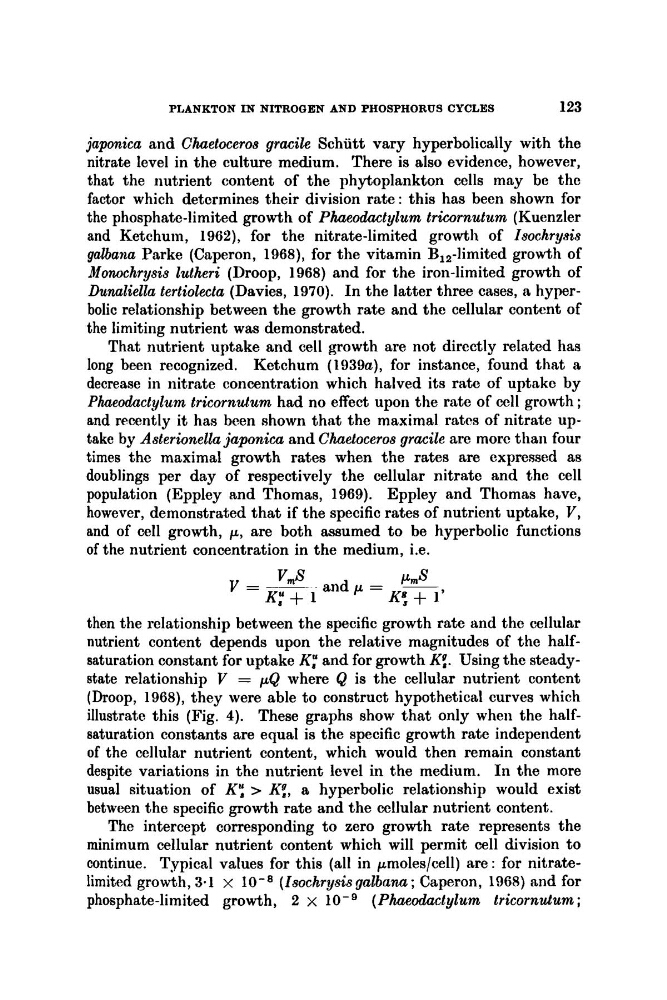
of the nutrient concentration in the medium, i.e.
then the relationship between the specific growth rate and the cellular
nutrient content depends upon the relative magnitudes of the halfsaturation constant for uptake K: and for growth K:. Using the steadystate relationship V = pQ where Q is the cellular nutrient content
(Droop, 1968), they were able to construct hypothetical curves which
illustratc this (Fig. 4). These graphs show that only when the halfsaturation constants are equal is the specific growth rate independent
of the cellular nutrient content, which would then remain constant
despite variations in the nutrient level in the medium. I n the more
usual situation of K: > Kf, a hyperbolic relationship would exist
between the specific growth rate and the cellular nutrient content.
The intercept corresponding t o zero growth rate represents the
minimum cellular nutrient content which will permit cell division to
continue. Typical values for this (all in pmoles/cell) are: for nitratelimited growth, 3.1 x 10⁻⁸ (Isochrysisgalbana; Caperon, 1968) and for
phosphate-limited growth, 2 x
(Phaeodactylum tricornutum ;
123
juponica and Chuetoceros gracile Schiitt vary hyperbolically with the
nitrate level in the culture medium. There is also evidence, however,
that the nutrient content of the phytoplankton cells may be the
factor which determines their division rate: this has been shown for
the phosphate-limited growth of Phueoductylum tricornutum (Kuenzler
and Ketchum, 1962), for the nitrate-limited growth of Isochrysis
galbaiza Parke (Caperon, 1968), for the vitamin B,,-limited growth of
Monochrysis Zutheri (Droop, 1968) and for the iron-limited growth of
Dunuliella tertiolecta (Davies, 1970). In the latter three cases, a hyperbolic relationship between the growth rate and the cellular content of
the limiting nutrient was demonstrated.
That nutrient uptake and cell growth are not directly related has
long been recognized. Ketchum (1939a), for instance, found that a
decrease in nitrate concentration which halved its rate of uptake by
Phaeodactylurn tricornutum had no effect upon the rate of cell growth ;
and recently it has been shown that the maximal rates of nitrate uptake by Asterionella japonica and Chuetoceros gracile arc mom than four
times the maximal growth rates when the rates are expressed as
doublings per day of respectively the cellular nitrate and the cell
population (Eppley and Thomas, 1969). Eppley and Thomas have,
however, demonstrated that if the specific rates of nutrient uptake, V,
and of cell growth, p, are both assumed t o be hyperbolic functions
of the nutrient concentration in the medium, i.e.
then the relationship between the specific growth rate and the cellular
nutrient content depends upon the relative magnitudes of the halfsaturation constant for uptake K: and for growth K:. Using the steadystate relationship V = pQ where Q is the cellular nutrient content
(Droop, 1968), they were able to construct hypothetical curves which
illustratc this (Fig. 4). These graphs show that only when the halfsaturation constants are equal is the specific growth rate independent
of the cellular nutrient content, which would then remain constant
despite variations in the nutrient level in the medium. I n the more
usual situation of K: > Kf, a hyperbolic relationship would exist
between the specific growth rate and the cellular nutrient content.
The intercept corresponding t o zero growth rate represents the
minimum cellular nutrient content which will permit cell division to
continue. Typical values for this (all in pmoles/cell) are: for nitratelimited growth, 3.1 x 10⁻⁸ (Isochrysisgalbana; Caperon, 1968) and for
phosphate-limited growth, 2 x
(Phaeodactylum tricornutum ;