

74
GORDON A. RILEY
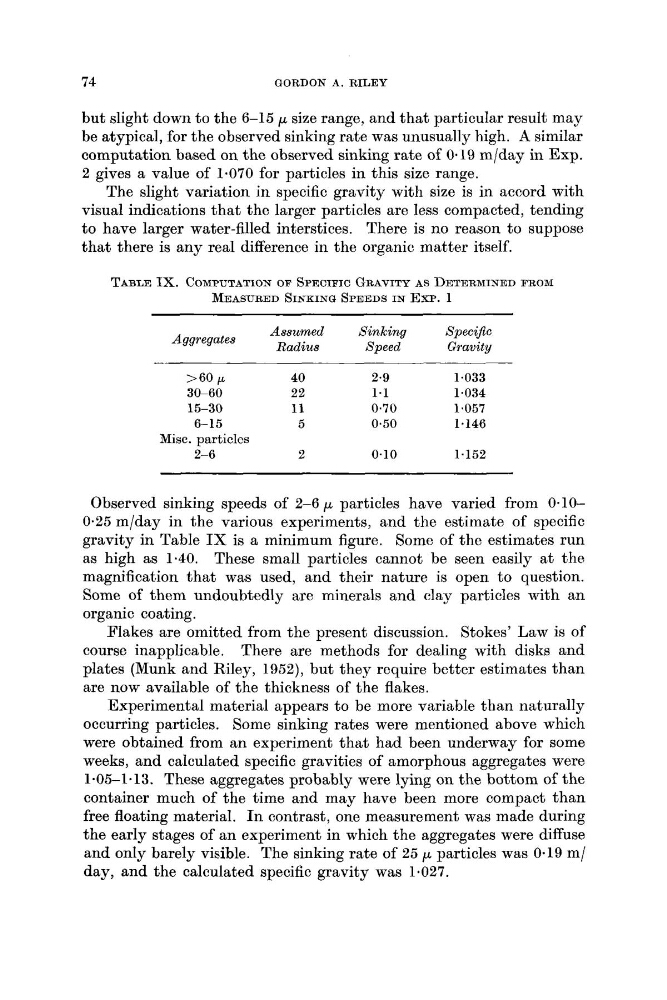
but slight down to the 6-15 p size range, and that particular result may
be atypical, for the observed sinking rate was unusually high. A similar
computation based on the observed sinking rate of 0.19 m/day in Exp.
2 gives a value of 1.070 for particles in this size range.
The slight variation in specific gravity with size is in accord with
visual indications that the larger particles are less compacted, tending
to have larger water-filled interstices. There is no reason to suppose
that there is any real difference in the organic matter itself.
TABLE IX. COMPUTATION OF SPECIFIC GRAVITY AS DETERMINED FROM
MEASURED SINKING SPEEDS IN EXP. 1
Assumed
Sinking
Specific
Radius
Speed
Gravity
Aggregates
>60 p
40
2.9
1.033
30-60
22
1.1
1.034
15-30
11
0.70
1.057
6-15
5
0.50
1.146
2-6
2
0.10
1.152
Misc. particles
Observed sinking speeds of 2-61” particles have varied from 0.100.25 m/day in the various experiments, and the estimate of specific
gravity in Table IX is a minimum figure. Some of the estimates run
as high as 1.40. These small particles cannot be seen easily at the
magnification that was used, and their nature is open to question.
Some of them undoubtedly are minerals and clay particles with an
organic coating.
Flakes are omitted from the present discussion. Stokes’ Law is of
course inapplicable. There are methods for dealing with disks and
plates (Munk and Riley, 1952), but they require better estimates than
are now available of the thickness of the flakes.
Experimental material appears to be more variable than naturally
occurring particles. Some sinking rates were mentioned above which
were obtained from an experiment that had been underway for some
weeks, and calculated specific gravities of amorphous aggregates were
1.05-1.13. These aggregates probably were lying on the bottom of the
container much of the time and may have been more compact than
free floating material. I n contrast, one measurement was made during
the early stages of an experiment in which the aggregates were diffuse
and only barely visible. The sinking rate of 25 1“ particles was 0.19 m/
day, and the calculated specific gravity was 1.027.
GORDON A. RILEY
but slight down to the 6-15 p size range, and that particular result may
be atypical, for the observed sinking rate was unusually high. A similar
computation based on the observed sinking rate of 0.19 m/day in Exp.
2 gives a value of 1.070 for particles in this size range.
The slight variation in specific gravity with size is in accord with
visual indications that the larger particles are less compacted, tending
to have larger water-filled interstices. There is no reason to suppose
that there is any real difference in the organic matter itself.
TABLE IX. COMPUTATION OF SPECIFIC GRAVITY AS DETERMINED FROM
MEASURED SINKING SPEEDS IN EXP. 1
Assumed
Sinking
Specific
Radius
Speed
Gravity
Aggregates
>60 p
40
2.9
1.033
30-60
22
1.1
1.034
15-30
11
0.70
1.057
6-15
5
0.50
1.146
2-6
2
0.10
1.152
Misc. particles
Observed sinking speeds of 2-61” particles have varied from 0.100.25 m/day in the various experiments, and the estimate of specific
gravity in Table IX is a minimum figure. Some of the estimates run
as high as 1.40. These small particles cannot be seen easily at the
magnification that was used, and their nature is open to question.
Some of them undoubtedly are minerals and clay particles with an
organic coating.
Flakes are omitted from the present discussion. Stokes’ Law is of
course inapplicable. There are methods for dealing with disks and
plates (Munk and Riley, 1952), but they require better estimates than
are now available of the thickness of the flakes.
Experimental material appears to be more variable than naturally
occurring particles. Some sinking rates were mentioned above which
were obtained from an experiment that had been underway for some
weeks, and calculated specific gravities of amorphous aggregates were
1.05-1.13. These aggregates probably were lying on the bottom of the
container much of the time and may have been more compact than
free floating material. I n contrast, one measurement was made during
the early stages of an experiment in which the aggregates were diffuse
and only barely visible. The sinking rate of 25 1“ particles was 0.19 m/
day, and the calculated specific gravity was 1.027.