

PARTICULATE ORGANIC MATTER I N SEA WATER
73
The results are shown in Table VIII. In this particular set of data
particles with a diameter of more than 30 p constituted only 3.6% of
the total number but represented over 80% of the total volume.
One can go a step further, multiplying the total volume in each
size range by its mean sinking rate, summing, and dividing by the total
volume of all particles, and thus arriving at a mean sinking rate for the
assemblage as a whole. I n the present case it is 1.4 miday. A similar
computation for Exp. 2 gives a value of 0.8 m/day. Mean sinking rates
for the three deep water samples in Table VII ranged from 0.41-0.50
m/day.
These results suggest that most of the organic matter is concentrated in larger particles and sinks at a rate that is near the upper
limit of experimentally determined values. However, this conclusion
must be qualified by adding that the organic content of the particles
probably is not precisely proportional to volume. Most of the large
masses are visibly less compacted than the small ones. In the free
floating state they are loose conglomerates of material, with open
spaces in which bacteria and microflagellates can be seen circulating
freely. Thus the overall volume is not a good index of the actual
volume of solid material.
Moreover, there are large numbers of particles that are smaller
than 2 p, ranging down toward the limits of visibility and presumably
beyond, into the colloidal range. As indicated earlier, the quantitative
aspects of this size spectrum have not been described in a satisfactory
way. Thus a significant but essentially unknown fraction of the total
particulate carbon occurs in small particles with a sinking rate that is
probably less than 0.1 m/day.
Experimentally determined sinking rates were used to estimate the
specific gravity of the various size ranges of particles. This calculation
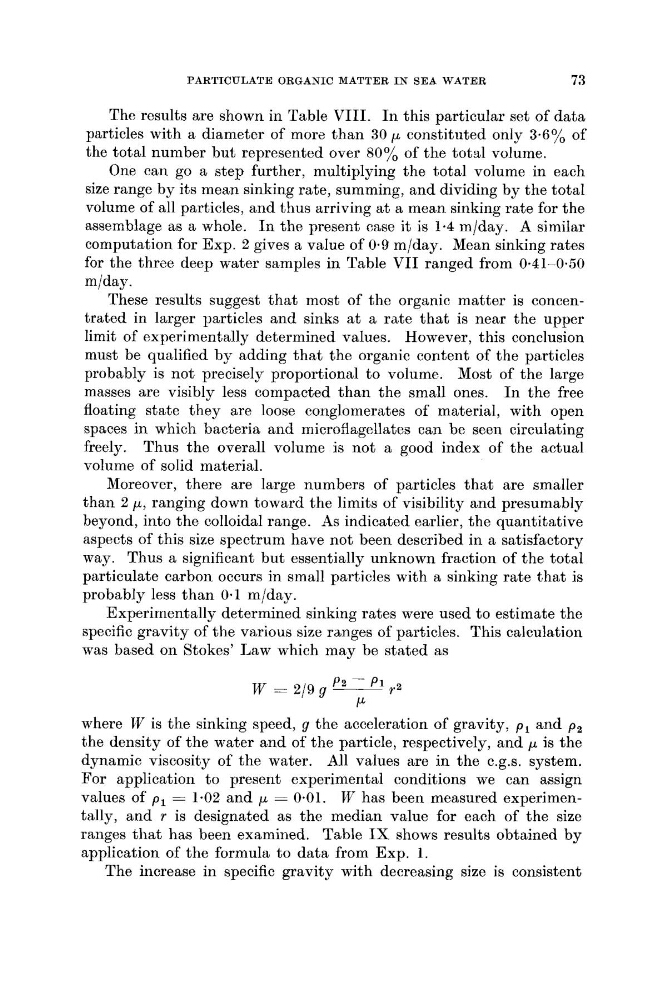
was based on Stokes’ Law which may be stated as
P z -- P1 r z
W = 219 g ~
P
where W is the sinking speed, g the acceleration of gravity, p1 and pz
the density of the water and of the particle, respectively, and p is the
dynamic viscosity of the water. All values are in the c.g.s. system.
For application to present experimental conditions we can assign
values of p1 = 1.02 and p = 0.01. W has been measured experimentally, and r is designated as the median value for each of the size
ranges that has been examined. Table IX shows results obtained by
application of the formula to data from Exp. 1.
The increase in specific gravity with decreasing size is consistent
73
The results are shown in Table VIII. In this particular set of data
particles with a diameter of more than 30 p constituted only 3.6% of
the total number but represented over 80% of the total volume.
One can go a step further, multiplying the total volume in each
size range by its mean sinking rate, summing, and dividing by the total
volume of all particles, and thus arriving at a mean sinking rate for the
assemblage as a whole. I n the present case it is 1.4 miday. A similar
computation for Exp. 2 gives a value of 0.8 m/day. Mean sinking rates
for the three deep water samples in Table VII ranged from 0.41-0.50
m/day.
These results suggest that most of the organic matter is concentrated in larger particles and sinks at a rate that is near the upper
limit of experimentally determined values. However, this conclusion
must be qualified by adding that the organic content of the particles
probably is not precisely proportional to volume. Most of the large
masses are visibly less compacted than the small ones. In the free
floating state they are loose conglomerates of material, with open
spaces in which bacteria and microflagellates can be seen circulating
freely. Thus the overall volume is not a good index of the actual
volume of solid material.
Moreover, there are large numbers of particles that are smaller
than 2 p, ranging down toward the limits of visibility and presumably
beyond, into the colloidal range. As indicated earlier, the quantitative
aspects of this size spectrum have not been described in a satisfactory
way. Thus a significant but essentially unknown fraction of the total
particulate carbon occurs in small particles with a sinking rate that is
probably less than 0.1 m/day.
Experimentally determined sinking rates were used to estimate the
specific gravity of the various size ranges of particles. This calculation
was based on Stokes’ Law which may be stated as
P z -- P1 r z
W = 219 g ~
P
where W is the sinking speed, g the acceleration of gravity, p1 and pz
the density of the water and of the particle, respectively, and p is the
dynamic viscosity of the water. All values are in the c.g.s. system.
For application to present experimental conditions we can assign
values of p1 = 1.02 and p = 0.01. W has been measured experimentally, and r is designated as the median value for each of the size
ranges that has been examined. Table IX shows results obtained by
application of the formula to data from Exp. 1.
The increase in specific gravity with decreasing size is consistent