

SCATOLOGICAL STPDIES OF THE BIVALVIA (MOLLUSCA)
3%
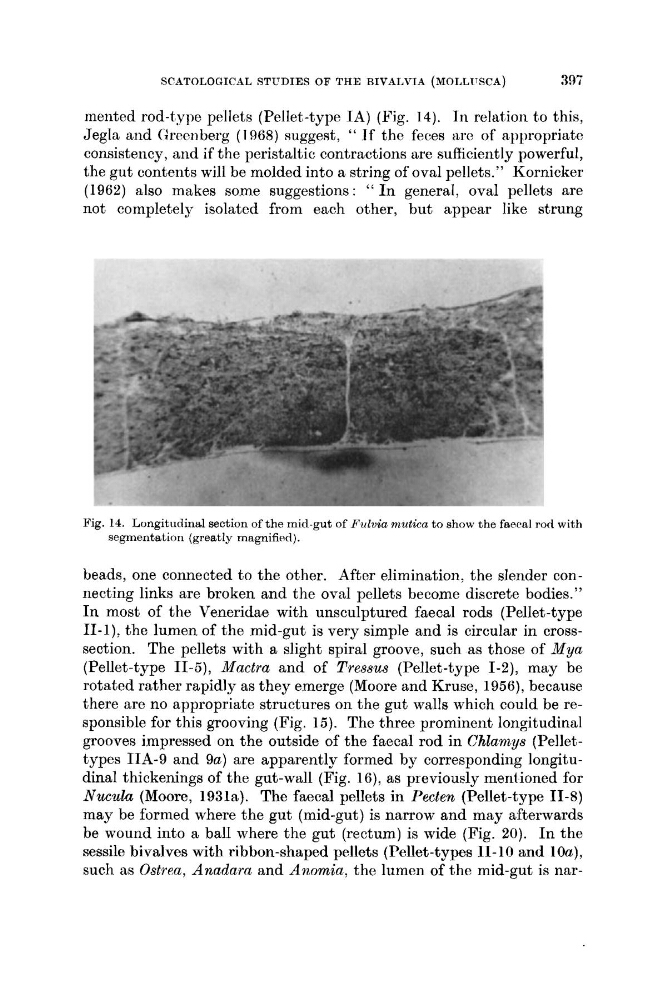
rnented rod-type pellets (Pellet-type I A ) (Fig. 14). In relatJion to this,
Jegla and (ireenloerg ( 1 988) suggest, “ If the feces arc of appropriate
consistency, and if the peristaltic contractions are sufficiently powerful,
the gut contents will be molded into a string of oval pellets.” Kornicker
(1962) also makes some suggestions : “ I n general, oval pellets are
not completely isolated from each other, but appear like strung
Fig. 14. Longitudinal section of the mid-gut of Fulvia nmlicn to show the faecal rod with
segmentation (greatly magnified).
beads, one connected to the other. After elimination, the slender connecting links are broken and the oval pellets become discrete bodies.”
I n most of the Veneridae with unsculptured faecal rods (Pellet-type
11-l), the lumen of the mid-gut is very simple and is circular in crosssection. The pellets with a slight spiral groove, such as those of Mya
(Pellet-type 11-5), Mactra and of Tressus (Pellet-type I-2), may be
rotated rather rapidly as they emerge (Moore and Kruse, 1956), because
there are no appropriate structures on the gut walls which could be responsible for this grooving (Fig. 15). The three prominent longitudinal
grooves impressed on the outside of the faecal rod in Chlamys (Pellettypes IIA-9 and 9a) are apparently formed by corresponding longitudinal thickenings of the gut-wall (Fig. 16), as previously mentioned for
Nuculu (Moore, 1931a). The faecal pellets in Pecten (Pellet-type 11-8)
may be formed where the gut (mid-gut) is narrow and may afterwards
be wound into a ball where the gut (rectum) is wide (Fig. 20). I n the
sessile bivalves with ribbon-shaped pellets (Pellet-types 11- 10 and lOa),
such as Ostrea, Anadara and Anomia, the lumen of the mid-gut is nar-
3%
rnented rod-type pellets (Pellet-type I A ) (Fig. 14). In relatJion to this,
Jegla and (ireenloerg ( 1 988) suggest, “ If the feces arc of appropriate
consistency, and if the peristaltic contractions are sufficiently powerful,
the gut contents will be molded into a string of oval pellets.” Kornicker
(1962) also makes some suggestions : “ I n general, oval pellets are
not completely isolated from each other, but appear like strung
Fig. 14. Longitudinal section of the mid-gut of Fulvia nmlicn to show the faecal rod with
segmentation (greatly magnified).
beads, one connected to the other. After elimination, the slender connecting links are broken and the oval pellets become discrete bodies.”
I n most of the Veneridae with unsculptured faecal rods (Pellet-type
11-l), the lumen of the mid-gut is very simple and is circular in crosssection. The pellets with a slight spiral groove, such as those of Mya
(Pellet-type 11-5), Mactra and of Tressus (Pellet-type I-2), may be
rotated rather rapidly as they emerge (Moore and Kruse, 1956), because
there are no appropriate structures on the gut walls which could be responsible for this grooving (Fig. 15). The three prominent longitudinal
grooves impressed on the outside of the faecal rod in Chlamys (Pellettypes IIA-9 and 9a) are apparently formed by corresponding longitudinal thickenings of the gut-wall (Fig. 16), as previously mentioned for
Nuculu (Moore, 1931a). The faecal pellets in Pecten (Pellet-type 11-8)
may be formed where the gut (mid-gut) is narrow and may afterwards
be wound into a ball where the gut (rectum) is wide (Fig. 20). I n the
sessile bivalves with ribbon-shaped pellets (Pellet-types 11- 10 and lOa),
such as Ostrea, Anadara and Anomia, the lumen of the mid-gut is nar-