

396
KOHMAN 1
'
. ARAKA\VA
stomach the faecal strings are conveyed into the mid-gut where the
ciliary action of the epithelium instead of pcristaltic motion is primarily
concerned with transport, since a muscular layer is either absent or
poorly developed in the gut-wall. When passing through the gut, the
mucus-bound faeces may be gradually solidified into firm pellets by the
withdrawal of water as well as by the high intestinal p H value, and at
t.he same time they may be moulded externally by structures on the
gut-wall, such as cilia, longitudinal folds, plicate ridges and typhlosoles.
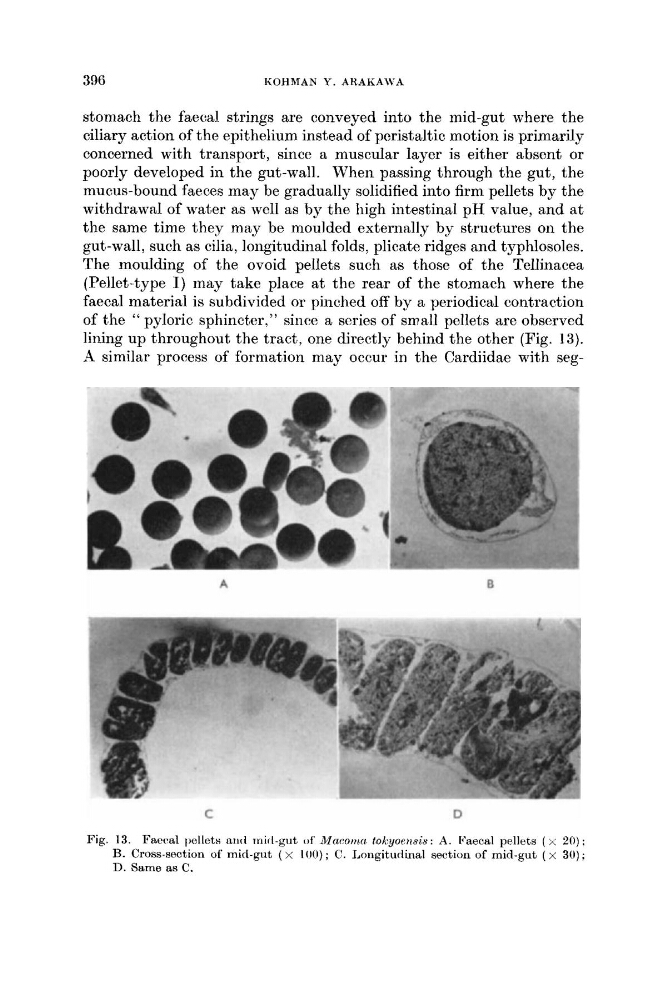
The moulding of the ovoid pellets such as those of the Tellinacea
(Pellet-type I) may take place at the rear of the stomach where the
faecal material is subdivided or pinched off by a periodical contraction
of t,he " pyloric sphincter," since a series of small pelletts are observed
lining up throughout the tract, one directly behind the other (Fig. 13).
A similar process of formation may occur in the Cardiidae with segFig. 13. Faecal pellets aiirl initl-gut ( ~ f ' nlcwotrttr toLyortisis: A . Faecal pellets ( x 20):
B. Cross-section of mitl-gut ( x 100) ; C . Imigitidinal section of mid-gut ( x 30) ;
D. Same as C .
KOHMAN 1
'
. ARAKA\VA
stomach the faecal strings are conveyed into the mid-gut where the
ciliary action of the epithelium instead of pcristaltic motion is primarily
concerned with transport, since a muscular layer is either absent or
poorly developed in the gut-wall. When passing through the gut, the
mucus-bound faeces may be gradually solidified into firm pellets by the
withdrawal of water as well as by the high intestinal p H value, and at
t.he same time they may be moulded externally by structures on the
gut-wall, such as cilia, longitudinal folds, plicate ridges and typhlosoles.
The moulding of the ovoid pellets such as those of the Tellinacea
(Pellet-type I) may take place at the rear of the stomach where the
faecal material is subdivided or pinched off by a periodical contraction
of t,he " pyloric sphincter," since a series of small pelletts are observed
lining up throughout the tract, one directly behind the other (Fig. 13).
A similar process of formation may occur in the Cardiidae with segFig. 13. Faecal pellets aiirl initl-gut ( ~ f ' nlcwotrttr toLyortisis: A . Faecal pellets ( x 20):
B. Cross-section of mitl-gut ( x 100) ; C . Imigitidinal section of mid-gut ( x 30) ;
D. Same as C .