

148
C. F. HICKLING
TABLE I1
Organic matter
Annual crop of
Annual crop of
Algae, kglhectare
Fish, kglhectare
%
0.39
1.23
2.41
3.27
4.17
-
15 000
18 750
25 000
28 250
-
1 2 0 0
1 5 0 0
2 000
2 500
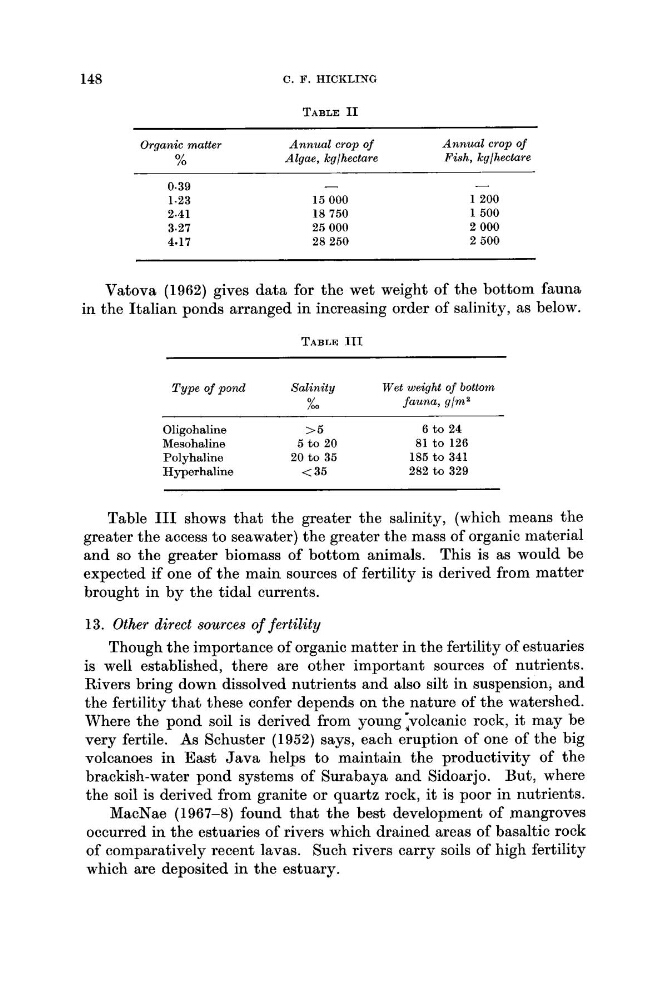
Vatova (1962) gives data for the wet weight of the bottom fauna
in the Italian ponds arranged in increasing order of salinity, as below.
Type of pond
Salinity
Wet weight of bottom
%o
fauna, g/m2
Oligohaline
> 5
6 to 24
Mesohaline
5 to 20
81 to 126
Polyhaline
20 to 35
185 to 341
Hyperhaline
< 35
282 t o 329
Table I11 shows that the greater the salinity, (which means the
greater the access to seawater) the greater the mass of organic material
and so the greater biomass of bottom animals. This is as would be
expected if one of the main sources of fertility is derived from matter
brought in by the tidal currents.
13. Other direct sources of fertility
Though the importance of organic matter in the fertility of estuaries
is well established, there are other important sources of nutrients.
Rivers bring down dissolved nutrients and also silt in suspension, and
the fertility that these confer depends on the nature of the watershed.
Where the pond soil is derived from youngivolcanic rock, it may be
very fertile. As Schuster (1952) says, each eruption of one of the big
volcanoes in East Java helps to maintain the productivity of the
brackish-water pond systems of Surabaya and Sidoarjo. But, where
the soil is derived from granite or quartz rock, it is poor in nutrients.
MacNae (1967-8) found that the best development of mangroves
occurred in the estuaries of rivers which drained areas of basaltic rock
of comparatively recent lavas. Such rivers carry soils of high fertility
which are deposited in the estuary.
C. F. HICKLING
TABLE I1
Organic matter
Annual crop of
Annual crop of
Algae, kglhectare
Fish, kglhectare
%
0.39
1.23
2.41
3.27
4.17
-
15 000
18 750
25 000
28 250
-
1 2 0 0
1 5 0 0
2 000
2 500
Vatova (1962) gives data for the wet weight of the bottom fauna
in the Italian ponds arranged in increasing order of salinity, as below.
Type of pond
Salinity
Wet weight of bottom
%o
fauna, g/m2
Oligohaline
> 5
6 to 24
Mesohaline
5 to 20
81 to 126
Polyhaline
20 to 35
185 to 341
Hyperhaline
< 35
282 t o 329
Table I11 shows that the greater the salinity, (which means the
greater the access to seawater) the greater the mass of organic material
and so the greater biomass of bottom animals. This is as would be
expected if one of the main sources of fertility is derived from matter
brought in by the tidal currents.
13. Other direct sources of fertility
Though the importance of organic matter in the fertility of estuaries
is well established, there are other important sources of nutrients.
Rivers bring down dissolved nutrients and also silt in suspension, and
the fertility that these confer depends on the nature of the watershed.
Where the pond soil is derived from youngivolcanic rock, it may be
very fertile. As Schuster (1952) says, each eruption of one of the big
volcanoes in East Java helps to maintain the productivity of the
brackish-water pond systems of Surabaya and Sidoarjo. But, where
the soil is derived from granite or quartz rock, it is poor in nutrients.
MacNae (1967-8) found that the best development of mangroves
occurred in the estuaries of rivers which drained areas of basaltic rock
of comparatively recent lavas. Such rivers carry soils of high fertility
which are deposited in the estuary.